
Skip to content
Start My 3 Free Days $0 today · cancel anytime

Algebra Resources

3 algebra resources: 1 worksheet, 1 activity and 1 Common Core Lesson. How teachers use these

Algebra Resources

3 algebra resources: 1 worksheet, 1 activity and 1 Common Core Lesson. How teachers use these

Worksheet
Worksheet5th GradeSolving Equations with Variables on Both Sides Worksheet

This Solving Equations with Variables on Both Sides Worksheet gives 5th graders six equations to solve for x by collecting variable terms on one side. Includes a complete answer key—perfect for focused, no-prep algebra practice.

Activity
Activity3rd Grade3.OA.7 Common Core Activity

This 3.OA.7 Common Core activity has 3rd-4th grade students match snowflake problem cards to fish answer cards to find unknown numbers, with a practice page and answer key included.

Common Core Lesson
Common Core Lesson5th Grade5.OA.1 Fifth Grade Common Core Lesson

In this 5.OA.1 Fifth Grade Common Core Lesson, studentsuse parentheses, brackets, or braces in numerical expressions, and evaluate expressions withthese symbols.

From our teachers' playbook

Find the mystery number!

What do kids learn about algebra?

Algebra starts long before middle school. In the early grades, kids find the missing number in equations like 3 + ? = 8 and spot the rule in a growing pattern. By 3rd grade, they use a letter or a box to stand for an unknown and connect multiplication to division. In 5th grade, they use parentheses and order of operations, and older students solve equations like 2x + 3 = x + 7 by keeping both sides balanced. The click comes when kids see the equal sign means "the same as," not "the answer comes next."

Our favorite ways to teach algebra

Algebra feels friendly when kids can see the balance. These are our go-to moves.

Balance the scale

Draw a big balance scale and put 5 cubes on one side, 2 cubes and a mystery bag on the other. Ask "How many cubes are hiding in the bag?" Kids see that both sides must match. That's an equation!

Why it works: going from real objects to pictures to symbols is a core recommendation of the U.S. Department of Education's elementary math guide.
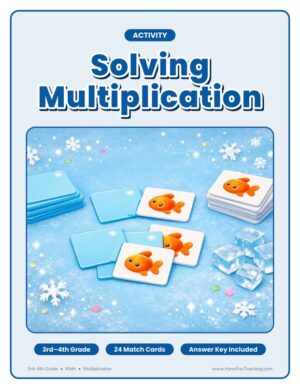
3.OA.7 Common Core ActivityTry it with3.OA.7 Common Core ActivityActivitiesOpen it →

Do the same to both sides

Solve one equation on the board, thinking out loud: "If I take away x from this side, I have to take it from that side too." Show each step on its own line. Then kids try one with a partner while you listen in.

Why it works: handing over the work step by step, from teacher to student, is one of the most widely used teaching frameworks (Pearson and Gallagher, 1983).

Solving Equations with Variables on Both Sides WorksheetTry it withSolving Equations with Variables on Both Sides WorksheetWorksheetsOpen it →

True or false?

Write equations like 7 = 3 + 4 or 5 + 2 = 6 + 1 and ask, "True or false? Prove it." Kids defend their answers to a partner. It busts the idea that the answer always goes on the right.

Why it works: when kids say the precise math words, their understanding gets sharper, a recommendation of the U.S. Department of Education's elementary math guide.

5.OA.1 Fifth Grade Common Core LessonTry it with5.OA.1 Fifth Grade Common Core LessonCommon Core LessonsOpen it →

Questions parents and teachers ask about algebra

When do kids start learning algebra?

Algebraic thinking starts in kindergarten and 1st grade with patterns and missing numbers. Formal algebra with variables usually begins in middle school, around 6th to 8th grade.

What is a variable in math?

A variable is a letter or symbol that stands for an unknown number. In x + 4 = 10, x is the variable, and it equals 6.

How do I explain solving an equation to my child?

Compare it to a balance scale. Whatever you do to one side, you must do to the other to keep it balanced. Keep going until the mystery number is by itself.

Why do kids struggle with the equal sign?

Many kids think it means "write the answer here." Practice equations written different ways, like 9 = 4 + 5, so they learn it means both sides have the same value.

Keep exploring



