
Symmetry Worksheet
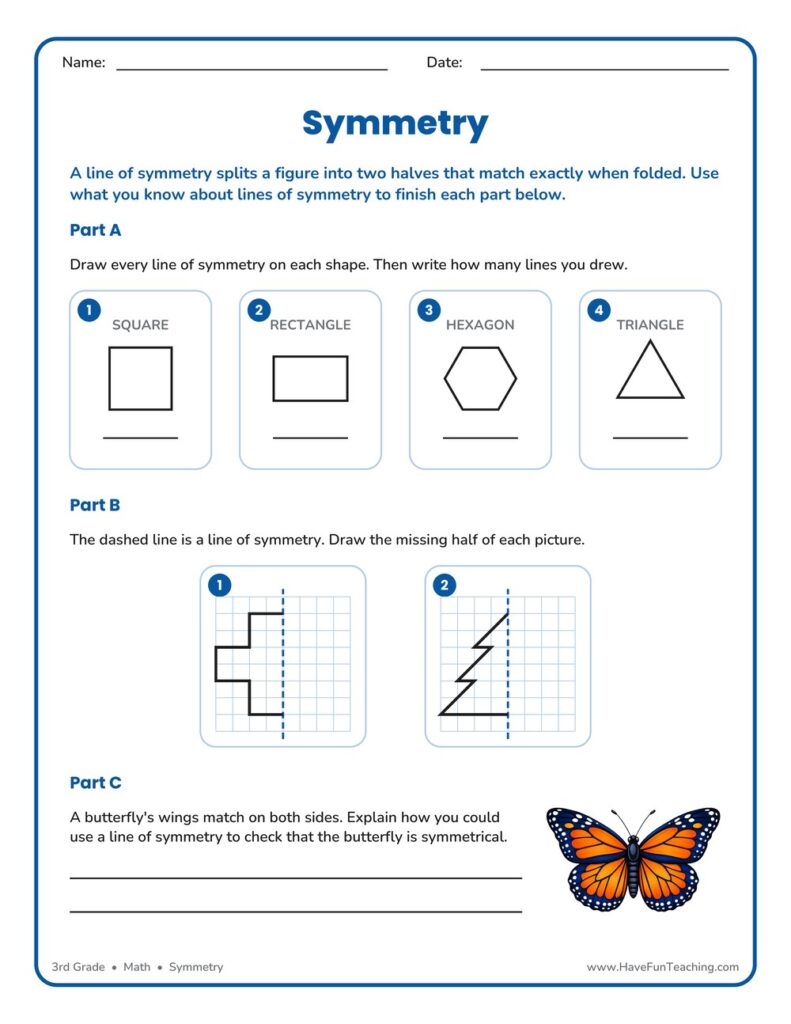
This symmetry worksheet gives 3rd grade students hands-on practice drawing lines of symmetry, completing symmetrical grid pictures, and explaining their thinking. Answer key included for fast, no-prep geometry practice.
$6.97
Or free with a membership — members pay $3.33/mo for all 10,000+ resources. See plans
Want this one free?
Tell us where to send it and it’s yours — no card, no catch.
One free resource per teacher. We’ll also send free teaching ideas each week — unsubscribe anytime.
Teaching is easier with a membership
Unlimited printables, games & videos for PreK–6th — for your classroom or homeschool. Cancel anytime.
Start your 3-day free trial$0 today · cancel anytime · Instant access to 10,000+ resources
About this resource
Description
Symmetry is one of the first big ideas in geometry that helps children see structure in the world around them. A figure is symmetrical when a single straight line can split it into two halves that match exactly, and that line is called a line of symmetry. This symmetry worksheet gives 3rd grade students focused practice with both sides of that idea: finding every line of symmetry hiding inside a shape, and using a line of symmetry to build a matching half of their own.
This lines of symmetry worksheet moves from shapes to pictures to reasoning in three short parts. In Part A, students draw every line of symmetry on a square, a rectangle, a hexagon, and an equilateral triangle, then record how many lines they found. In Part B, they use a grid and a dashed line of symmetry to draw the missing half of two pictures so each one becomes symmetrical. In Part C, they look at a butterfly and explain in writing how a line of symmetry could prove its wings match. Print it as a math warm-up, a geometry center, a homework page, or a quick check before a unit test.
What’s Included
- 1 print-ready PDF worksheet
- Answer key
- 3 activities: drawing lines of symmetry on 4 shapes, completing 2 symmetrical grid pictures, and a written explanation
Three things make this symmetry worksheet work well for third graders. First, it asks students to draw, not just circle, so they have to test each line instead of guessing which shapes look even. Second, the grid pictures give instant feedback: a half that is drawn one square off will not match, so children learn to count carefully and check their own work. Third, the written explanation at the end pushes students past recognition and into reasoning, which is exactly the kind of thinking that geometry questions ask for later on.
Extend the lesson with a paper-folding test: cut out shapes, fold them on the lines students drew, and hold them up to the light to see whether the halves land on top of each other. Take a symmetry walk around the classroom or the neighborhood and photograph symmetrical things such as windows, leaves, letters, road signs, and faces. Try a paint-blot activity by folding paper over a drop of paint, or hand a partner half of a simple drawing and ask them to finish the other side. Letters are a fun challenge too, since some capital letters have one line of symmetry, some have two, and some have none.
Related Resources
What teachers say
Reviews
You must be logged in to post a review.
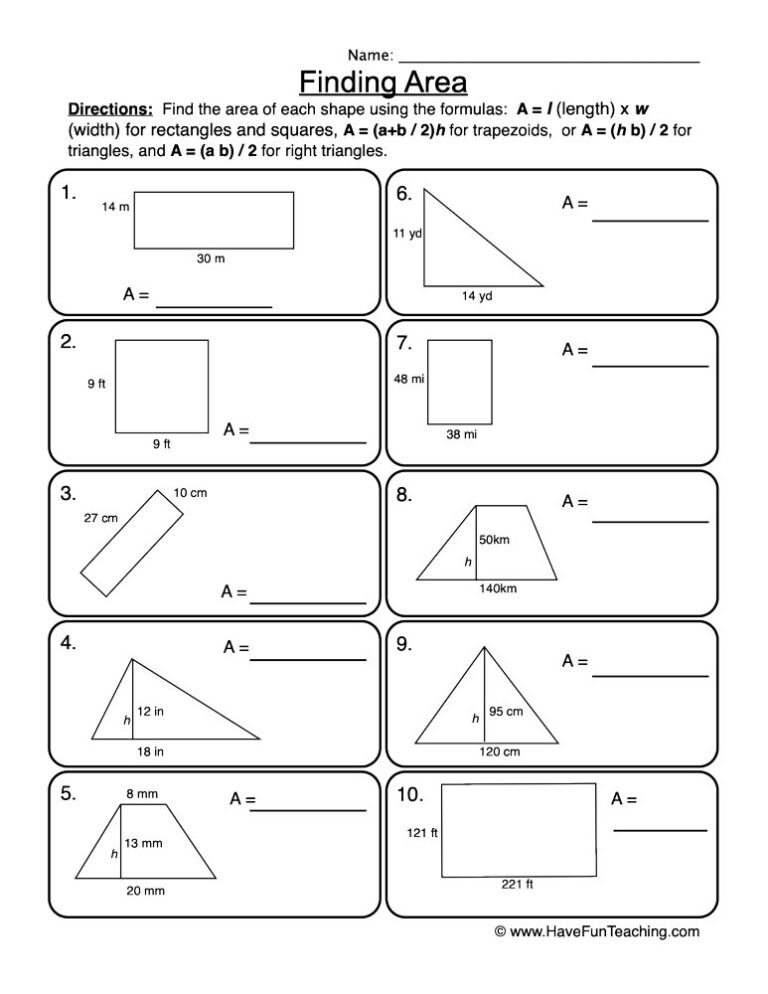
A Finding Different Shapes Area Worksheet where 3rd graders find the area of rectangles, squares, and composite shapes in square units. Answer key included—great for no-prep area practice.

This 3rd grade Finding the Area of Grid Shapes Worksheet has students count unit squares to find the area of rectangles and L-shapes. Answer key included.
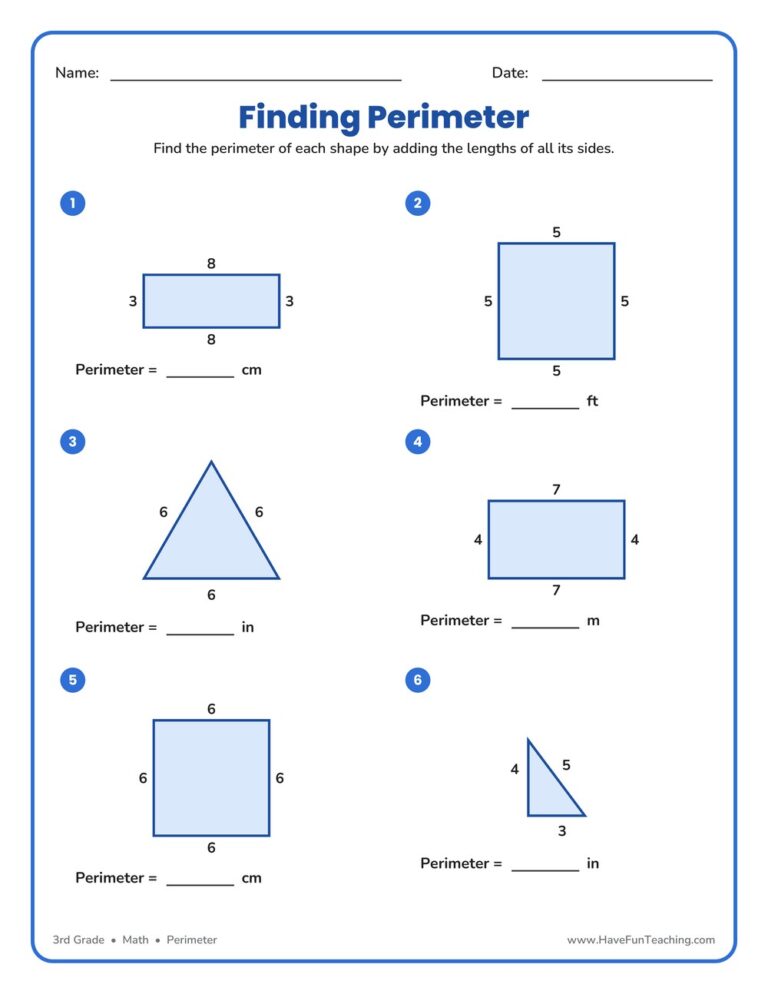
A 3rd grade finding shape perimeter worksheet where students add the side lengths of rectangles, squares, and triangles to find each shape’s perimeter. Includes a complete answer key for quick, no-prep geometry practice.

Using the Shapes Song, students learn all about shapes, including Shape Names and Shape Recognition. The Shapes Song by Have Fun Teaching is a song that teaches the shapes. Shapes have names their made of angles and lines, there are flat shapes and solid shapes we see them all the…
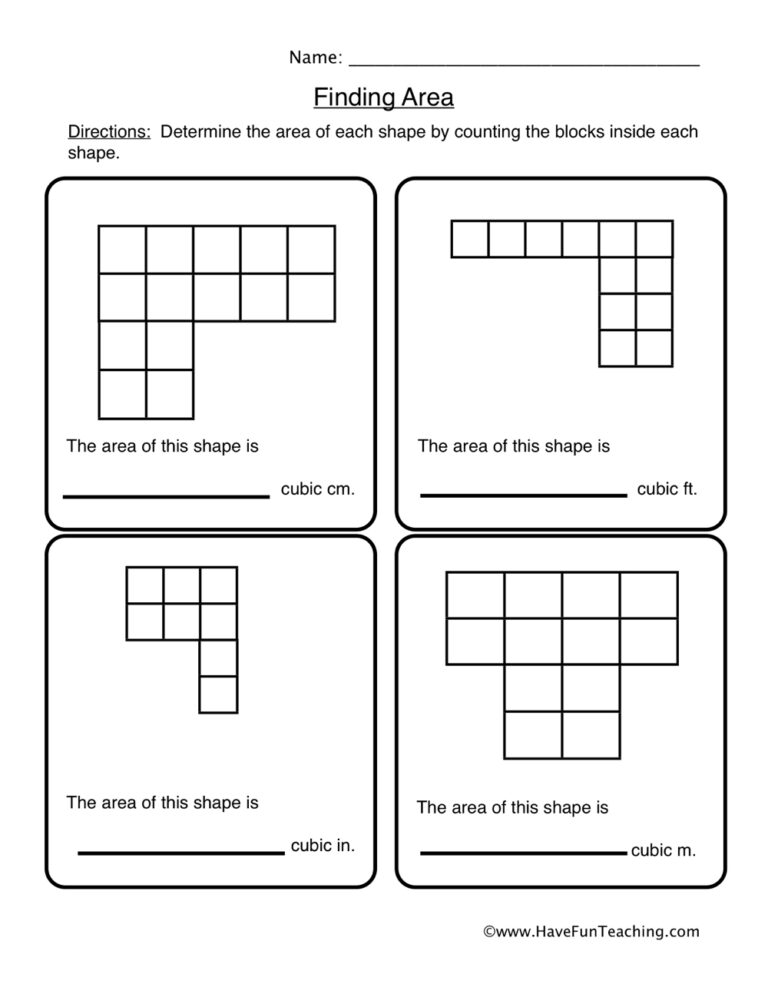
A count-the-squares finding area of irregular shapes worksheet that helps 3rd graders measure area by counting unit squares on six grid figures. Answer key included, perfect for no-prep area practice at home or school.

This Finding the Area by Multiplying Worksheet gives 3rd graders six labeled rectangles on a unit grid to practice finding area by multiplying length by width. An answer key is included for easy, no-prep geometry practice.
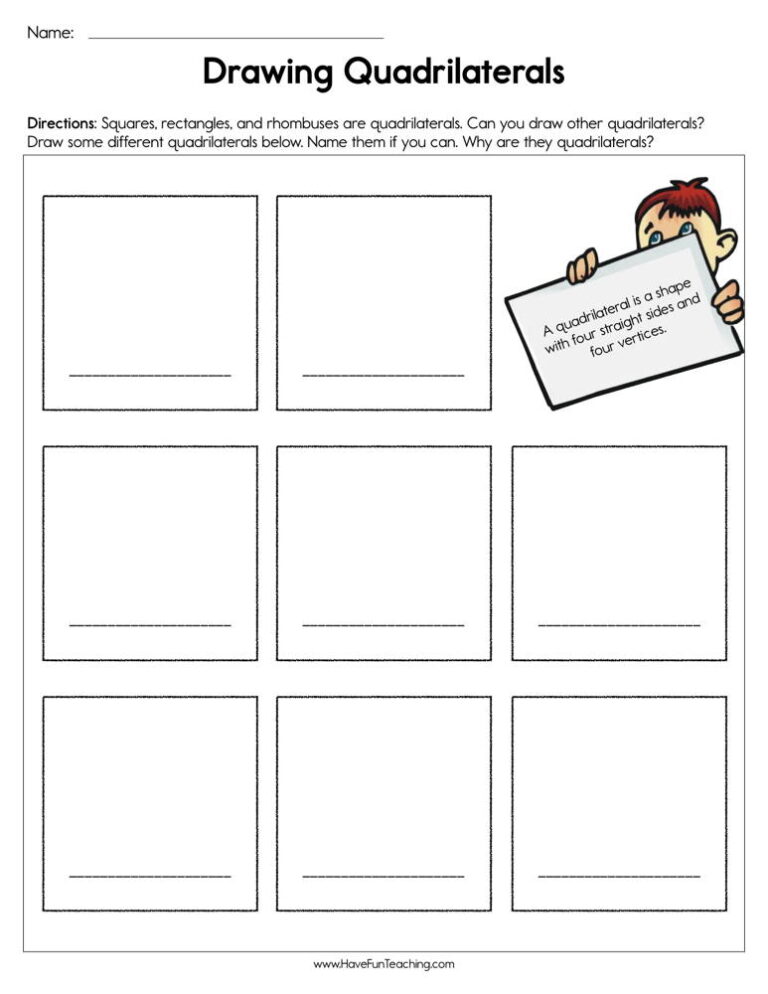
This drawing quadrilaterals worksheet has 3rd graders construct a square, rectangle, rhombus, and trapezoid on dot grids, then explain their thinking. Answer key included for fast, no-prep geometry practice.

This Finding the Area in Square Units Worksheet lets 3rd graders count same-size squares inside six shapes to measure area. Includes a complete answer key—great for hands-on, no-prep geometry practice at home or school.

Using the Square Song (MP3), students learn all about squares, including Shape Names and Shape Recognition through a catchy song!
Using the Shape Song (MP3), students learn all about shapes, including Shape Names and Shape Recognition through a catchy song!

A 3rd grade Finding Quadrilaterals Worksheet where students count sides, color the four-sided shapes, match quadrilateral names to their attributes, and explain their thinking. Answer key included for fast, no-prep geometry practice.

A Solving Perimeter Word Problems Worksheet that gives 3rd graders five real-world problems, including one missing-side challenge with a written explanation. Answer key included for fast, no-prep perimeter practice.
Reviews
There are no reviews yet