
Skip to content
Start My 3 Free Days $0 today · cancel anytime

5th Grade Antonyms Resources

2 5th grade antonyms resources: 1 worksheet and 1 Common Core Lesson. How teachers use these

5th Grade Antonyms Resources

2 5th grade antonyms resources: 1 worksheet and 1 Common Core Lesson. How teachers use these

Worksheet
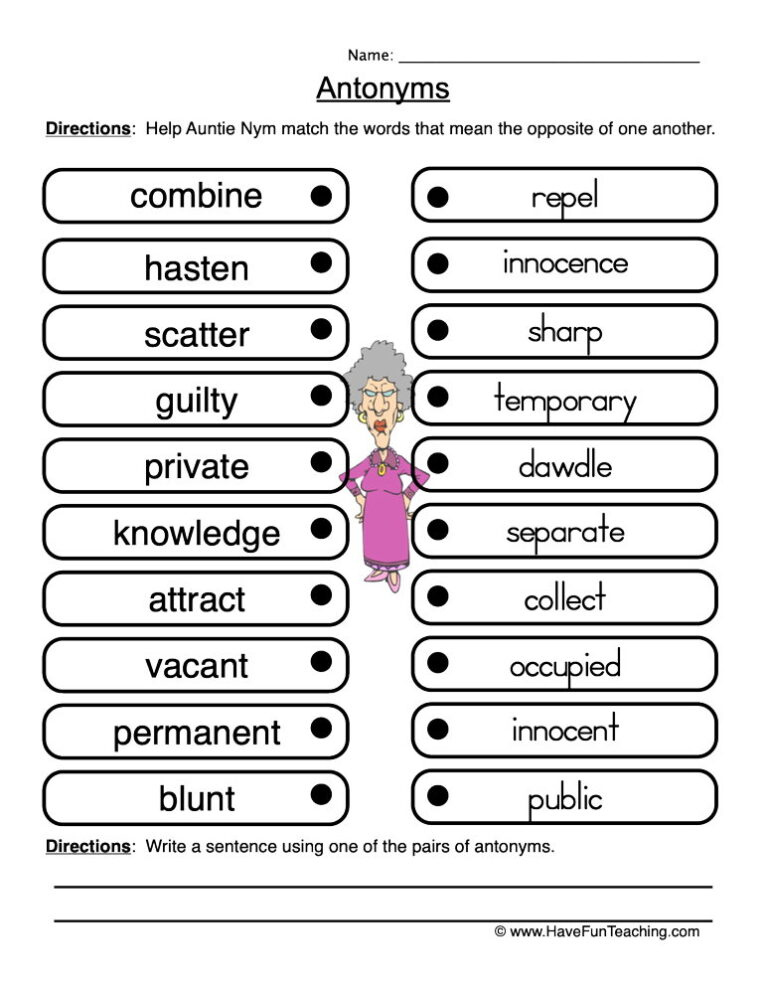
Worksheet5th GradeAntonyms Pairs Worksheet

This Antonyms Pairs Worksheet gives 5th graders six academic word pairs to match, four sentences to complete, and two sentences to write. An answer key is included, so vocabulary practice takes no prep.

Common Core Lesson
Common Core Lesson5th GradeL.5.5 Fifth Grade Common Core Lesson

Using this L.5.5 Fifth Grade Common Core Lesson, students determine the meaning of words by matching synonym and antonyms cards.

From our teachers' playbook

Opposites with a little more muscle

What do 5th graders learn about antonyms?

Fifth graders use antonyms as a tool for understanding tougher vocabulary. They work with advanced pairs like abundant / scarce, reluctant / eager and temporary / permanent. They learn that the relationship between words, synonym or antonym, can unlock a meaning, and they use contrast clues in sentences: "Unlike his timid sister, Max was bold." They also notice shades of meaning and pick the most precise opposite for their writing. The click comes when a student meets a brand new word, spots a contrast clue like "unlike" or "but," and figures it out without a dictionary.

How we teach antonyms in 5th grade

At this level, antonyms are about reading strategy and precise word choice. These moves build both.

Pair it up fast

Post six advanced words and their scrambled opposites. Partners have three minutes to match them and use one pair in a sentence. Talking it through helps kids remember words they will meet again in their reading.

Why it works: a big review of study methods ranked quick self-quizzing among the most powerful ways to remember (Dunlosky and colleagues, 2013).

Antonyms Pairs WorksheetTry it withAntonyms Pairs WorksheetWorksheetsOpen it →

Hunt for contrast clues

Read a sentence with a tricky word and a contrast signal like "but," "however" or "unlike." Think aloud as you use the opposite word to figure out the meaning. Then students try it with sentences from their own books.

Why it works: showing first, practicing together, then letting kids try alone is the "gradual release" model teachers have relied on for decades (Pearson and Gallagher, 1983).

L.5.5 Fifth Grade Common Core LessonTry it withL.5.5 Fifth Grade Common Core LessonCommon Core LessonsOpen it →

Word relationship chart

Create a class chart with three columns: word, synonym and antonym. Add new words from read-alouds each week. Building it together over the unit helps students see words as part of a family, not a list.

Why it works: going from real objects to pictures to symbols is a core recommendation of the U.S. Department of Education's elementary math guide.

Questions parents and teachers ask

What are 5th grade antonym examples?

Good 5th grade pairs include ancient and modern, generous and stingy, expand and contract, victory and defeat, and abundant and scarce.

What is a contrast context clue?

It is a clue that shows a word means the opposite of another word in the sentence. Signal words like but, however, unlike and instead often point to a contrast clue.

How do antonyms help with reading comprehension?

When students know a word's opposite, they can figure out unfamiliar words from context. Antonyms also help readers understand comparisons and contrasts authors make.

How can I build my 5th grader's vocabulary at home?

Read together, talk about interesting words and ask "What would the opposite be?" Word games like crossword puzzles and word chains make it fun.



