
Skip to content
Start My 3 Free Days $0 today · cancel anytime

5th Grade Averages Resources

3 5th grade averages resources: 3 worksheets. How teachers use these

5th Grade Averages Resources

3 5th grade averages resources: 3 worksheets. How teachers use these

Worksheet
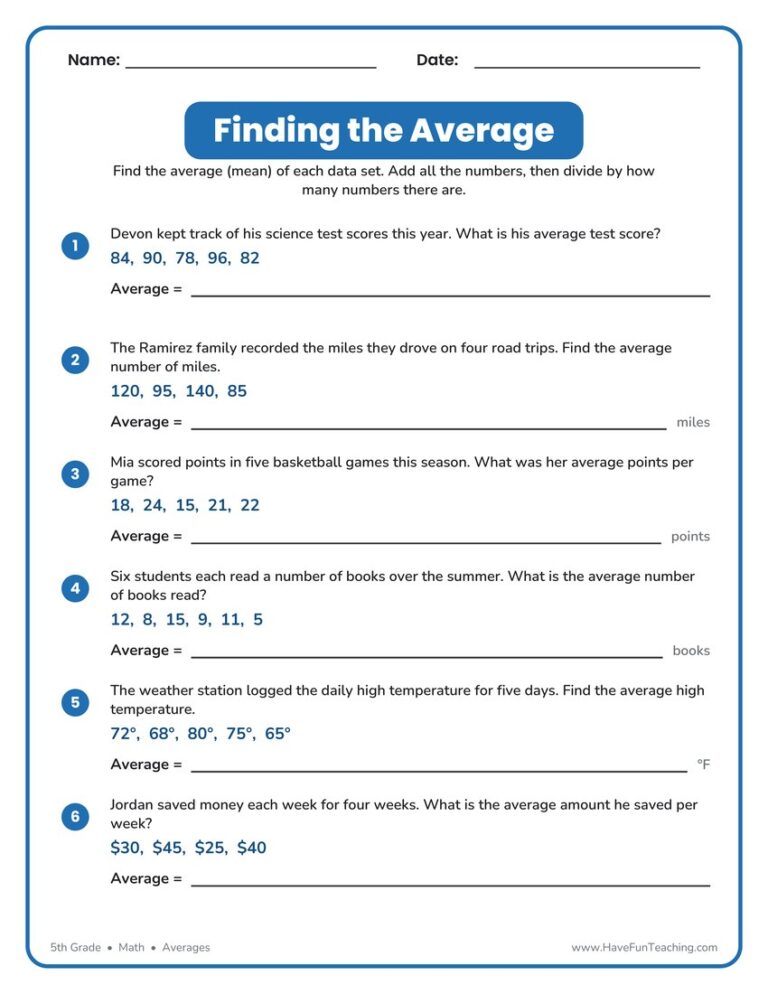
Worksheet5th GradeFinding the Average Word Problems Worksheet

This Finding the Average Word Problems Worksheet gives 5th graders real-world practice calculating the mean of test scores, miles, temperatures, and money. Includes a complete answer key—a no-prep way to build averaging skills at home or school.

Worksheet
Worksheet5th GradeFinding the Average To Hundred Thousands Worksheet

This finding the average to hundred thousands worksheet gives 5th graders three real data sets to add and divide, with numbers that climb from the hundreds to the hundred thousands. Answer key included.

Worksheet
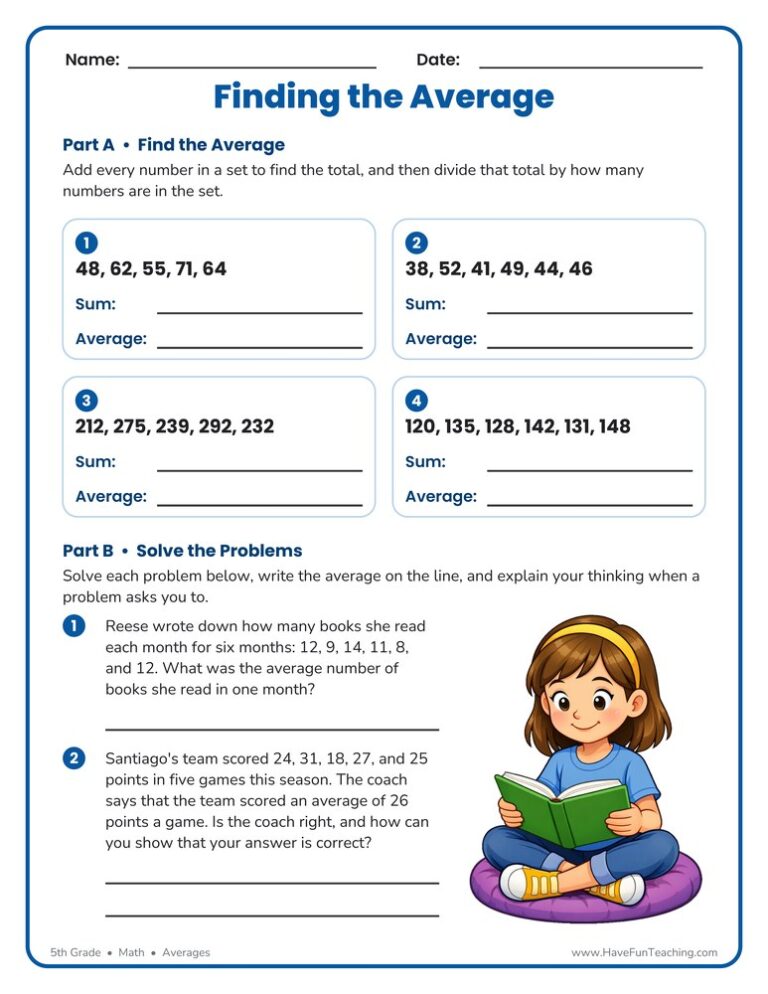
Worksheet5th GradeFinding Averages Larger Number Set Worksheet

This finding averages larger number set worksheet gives 5th grade students four number sets and two word problems to solve, with an answer key included, so averaging a larger set becomes routine.

From our teachers' playbook

Find the fair share

What do 5th graders learn about averages?

In 5th grade, kids learn that an average (the mean) is a fair share. Add up all the numbers, then divide by how many there are: (8 + 6 + 10) ÷ 3 = 8. It's a perfect chance to practice addition and long division with bigger numbers too. They solve word problems about test scores, temperatures and sports stats, and learn to check that their answer makes sense: the average always lands between the smallest and largest number. The click moment comes when they "level out" stacks of cubes and see the average with their own eyes.

Our favorite ways to teach averages

Averages make sense when kids see them before they compute them. These moves start there.

Level the towers

Give groups cube towers of 3, 5 and 7. Kids move cubes from tall towers to short ones until every tower is the same height: 5. Then they compute (3 + 5 + 7) ÷ 3 and see it matches. Hands first makes the formula meaningful.

Why it works: kids understand an idea best when they touch it, then draw it, then write it, the order the U.S. Department of Education recommends for elementary math.
Finding the Average Word Problems WorksheetTry it withFinding the Average Word Problems WorksheetWorksheetsOpen it →

Does it make sense?

Show a set of numbers and three possible averages, one too big, one too small and one right. Kids pick and explain. This quick check catches the "forgot to divide" mistake every time.

Why it works: a big review of study methods ranked quick self-quizzing among the most powerful ways to remember (Dunlosky and colleagues, 2013).

Finding the Average To Hundred Thousands WorksheetTry it withFinding the Average To Hundred Thousands WorksheetWorksheetsOpen it →

Average of the week

Each Friday, kids find the class average for something real: minutes read, temperature, spelling score. Small, regular practice with real data keeps the steps fresh all year.

Why it works: the brain holds on to what it meets again and again over time; spaced practice was rated among the very best methods (Dunlosky and colleagues, 2013).

Finding Averages Larger Number Set WorksheetTry it withFinding Averages Larger Number Set WorksheetWorksheetsOpen it →

Questions parents and teachers ask about averages

How do you find the average in 5th grade math?

Add all the numbers together, then divide by how many numbers there are. For 4, 6 and 8, add to get 18 and divide by 3 to get 6.

Is average the same as mean?

Yes. In elementary math, "average" usually means the mean. Kids later learn about median and mode, which are other kinds of averages.

What if the average comes out as a decimal?

That's fine. An average doesn't have to be a whole number. 5th graders can write it as a decimal, like 7.5, or round if the problem asks.

How can I practice averages at home?

Use real numbers: average daily screen time, family heights or test scores. Ask your child to estimate first, then calculate and compare.



