Skip to content
Start My 3 Free Days $0 today · cancel anytime

1st Grade Contractions Resources

4 1st grade contractions resources: 3 activities and 1 flash card. How teachers use these

1st Grade Contractions Resources

4 1st grade contractions resources: 3 activities and 1 flash card. How teachers use these

Flash Cards
Flash Cards1st GradeContractions Flash Cards

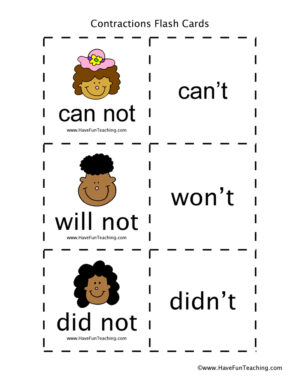
These contractions flash cards help kindergarten to 4th grade students see how two words join to make a contraction, with 24 fold-over cards and a practice page. Answer key included.

Activity
Activity1st GradeSnowman Contractions Activity

Play this snowman contractions activity as a memory game: 1st to 3rd grade students match two-word Mitten Cards to Snowman contraction cards and record each pair. Answer key included.

Activity
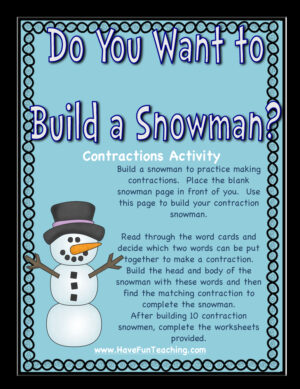
Activity1st GradeDo You Want to Build a Snowman Contractions Activity

This do you want to build a snowman contractions activity has 1st to 3rd grade students match two-word body cards to contraction head cards, then practice on a worksheet. Answer key included.

Activity
Activity1st GradeContractions Activity

Using Contractions Activity, students match two word phrase cards (I cannot) to contractions cards (I can't) in order to use contractions in their writing.

From our teachers' playbook

Two words, one apostrophe, big smiles

What do 1st graders learn about contractions?

A contraction is two words squished together into one shorter word, with an apostrophe holding the spot where letters left. First graders start with the friendliest ones: do + not = don't, I + am = I'm, can + not = can't and it + is = it's. They learn to read them in books, write them in their own sentences, and tell you which two words are hiding inside. The click moment comes when kids realize the apostrophe isn't a decoration. It's a little marker that says "letters were here!"

Our favorite ways to teach contractions

Contractions are all about seeing the two words inside one. These moves make that visible and keep it fresh.

Scissors and a magic apostrophe

Write "do not" on a sentence strip. Kids snip out the o, slide the words together and glue an apostrophe card into the gap. Now they're holding "don't." Doing it with their own hands makes it obvious why the apostrophe goes exactly there and not between the n and the t.

Why it works: going from real objects to pictures to symbols is a core recommendation of the U.S. Department of Education's elementary math guide.
Contractions ActivityTry it withContractions ActivityActivitiesOpen it →
Flash card two-word race

Flip a contraction card and kids call out the two words inside it. Then flip it back and do it the other way: say "we are," and they shout "we're!" Three minutes, both directions, and the tricky ones like won't get extra turns.

Why it works: researchers who compared ten study methods found practice testing is one of the two that work best (Dunlosky and colleagues, 2013).

Contractions Flash CardsTry it withContractions Flash CardsFlash CardsOpen it →

One family a week

Group contractions into families: the not family (can't, don't, isn't), the am/is family (I'm, it's, he's), then the are family. Add one family a week and keep reviewing the old ones on Mondays. Small doses stick far better than learning twenty in one sitting.

Why it works: the brain holds on to what it meets again and again over time; spaced practice was rated among the very best methods (Dunlosky and colleagues, 2013).

Snowman Contractions ActivityTry it withSnowman Contractions ActivityActivitiesOpen it →
Questions parents and teachers ask about contractions

What contractions should 1st graders know?

Start with the most common ones in early readers: can't, don't, isn't, I'm, it's, he's, she's, we're and you're. Kids should be able to read them and name the two words inside. Writing them correctly comes with practice through the year.

How do I explain an apostrophe to a 1st grader?

Tell them the apostrophe is a placeholder for the letters that left. In "can't," the apostrophe sits where the n and o used to be. Showing it with cut-up word cards makes the idea click fast.

Why is "won't" so hard for kids?

Because it doesn't follow the pattern. "Will not" turns into "won't," so the letters change instead of just dropping out. Teach it as a special rule-breaker and give it extra practice.

How can I practice contractions at home?

Read together and hunt for contractions on each page. Have your child tell you the two words inside each one. A few minutes of flash cards before bed works great too.