Skip to content
Start My 3 Free Days $0 today · cancel anytime

1st Grade Homonyms Resources

1 1st grade homonyms resources: 1 worksheet. How teachers use these

1st Grade Homonyms Resources

1 1st grade homonyms resources: 1 worksheet. How teachers use these

Worksheet
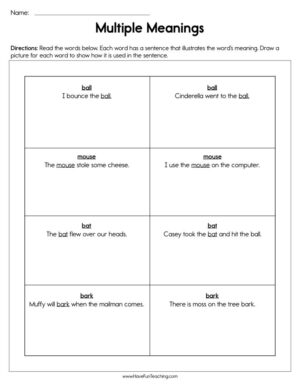
Worksheet1st GradeMultiple Meanings Worksheet

This multiple meanings worksheet has 1st grade students use sentence clues to circle the right picture and name picture pairs with one word. An answer key is included for fast, easy checking.

From our teachers' playbook

Same word, silly new meaning!

What do 1st graders learn about homonyms?

First graders learn that some words look and sound exactly the same but mean different things. A bat can fly at night, or you can swing a bat at a ball! A bark is on a tree, and it is also the sound a dog makes. Kids learn to use the other words in the sentence, the context clues, to figure out which meaning makes sense. The click is when they giggle at a sentence like "The bat hit the ball" and picture a flying bat holding a bat.

Our favorite ways to make homonyms stick

Homonyms are made for pictures and laughs. These moves let first graders see both meanings.

Draw both meanings

Fold a paper in half. Kids write a word like "ring" at the top and draw one meaning on each side: a ring on a finger and a bell that rings. Then they tell a partner a sentence for each picture.

Why it works: children learn more from words and pictures together than from words alone (Mayer, 2009).
Multiple Meanings WorksheetTry it withMultiple Meanings WorksheetWorksheetsOpen it →
Sort the sentences

Make two picture cards for a word, like a tree trunk and an elephant trunk. Read sentences aloud and kids hold up the card that matches. Five or six sentences per word is plenty for a quick, active lesson.

Why it works: kids understand an idea best when they touch it, then draw it, then write it, the order the U.S. Department of Education recommends for elementary math.

Silly sentence share

Each day, write one homonym on the board. Kids make up a silly sentence that uses both meanings, like "The duck can duck under the bridge." Read a few out loud and let the class act them out.

Why it works: shuffled practice teaches kids to choose the right strategy, not just repeat one, and it improved test scores in research (Rohrer and Taylor, 2007).

What's on this page

Teacher favorites right now: Multiple Meanings Worksheet.

Questions teachers and parents ask

What are homonyms for 1st grade?

Homonyms are words that sound the same and are spelled the same but have different meanings, like bat, bark or ring. First graders use pictures and sentences to learn both meanings.

What are some easy homonym examples?

Bat, bark, ring, fly, duck, trunk, park and right are great for first grade. Each one has two meanings kids can easily picture.

How do kids know which meaning a homonym has?

They look at the other words in the sentence. In "The dog began to bark," the word dog tells them bark is a sound, not part of a tree.

How can I teach homonyms at home?

Point them out in books and conversations, then ask your child to draw both meanings. Making up silly sentences together is a quick, fun way to practice.