
Skip to content
Start My 3 Free Days $0 today · cancel anytime

1st Grade Even and Odd Resources

1 1st grade even and odd resources: 1 activity. How teachers use these

1st Grade Even and Odd Resources

1 1st grade even and odd resources: 1 activity. How teachers use these

Activity
Activity1st GradeOdd or Even to 20 Activity

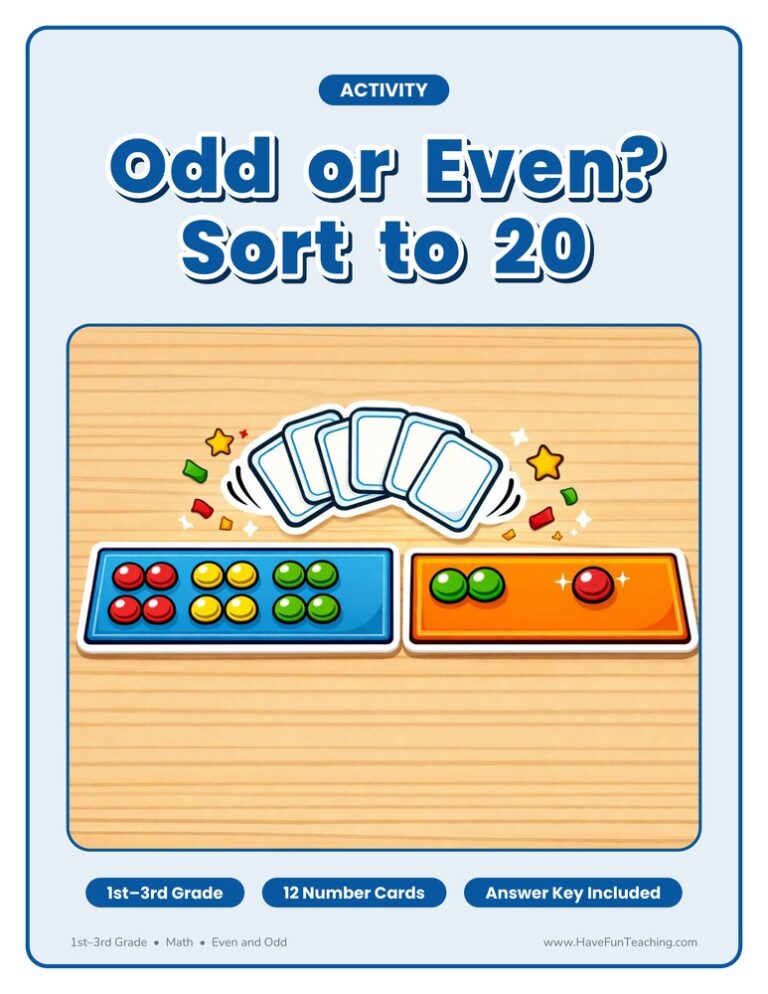
This odd or even to 20 activity lets 1st-3rd grade children pair counters on number cards and sort them onto an Odd or Even mat. Answer key included, so checking the sort is quick.

From our teachers' playbook

Partners or a leftover? Let's find out!

What do 1st graders learn about even and odd?

First graders discover that some numbers can be split into pairs with no one left out, and some always have one left over. If 8 friends pair up, everyone has a partner, so 8 is even. With 7 friends, one is left over, so 7 is odd. Kids notice the pattern when they count to 20: 2, 4, 6, 8, 10 are even, and the numbers in between are odd. The click comes when they realize they can just look at the ones digit to tell.

Our favorite ways to teach even and odd in 1st grade

Even and odd is all about pairs, so we start with things kids can pair up.

Pair it up

Give kids a handful of counters and have them line them up in pairs, two by two. If every counter has a partner, it is even. If one is left over, it is odd! Seeing the leftover makes the idea clear.

Why it works: going from real objects to pictures to symbols is a core recommendation of the U.S. Department of Education's elementary math guide.
Odd or Even to 20 ActivityTry it withOdd or Even to 20 ActivityActivitiesOpen it →

Thumbs up, thumbs down

Call out a number to 20. Thumbs up for even, thumbs down for odd. Then ask one child how they know. Fast checks like this show you right away who has the pattern.

Why it works: pulling an answer out of memory makes it stick far better than rereading it, one of the strongest findings in learning research (Dunlosky and colleagues, 2013).

Even and odd at line-up

When kids line up, have them pair off and decide if today's class count is even or odd. A tiny daily routine keeps the idea fresh for weeks.

Why it works: spreading practice out over days is one of the two most effective study methods in a major research review (Dunlosky and colleagues, 2013).

What's on this page

Teacher favorites right now: Odd or Even to 20 Activity.

Questions parents and teachers ask about even and odd

How do you explain even and odd to a 1st grader?

An even number can be split into pairs with nobody left out. An odd number always has one left over. Use socks, shoes or counters so kids can see it.

Is zero even or odd?

Zero is even. It can be split into two equal groups of zero with nothing left over, and it fits the pattern 0, 2, 4, 6.

What is a quick trick for even and odd numbers?

Look at the ones digit. If it is 0, 2, 4, 6 or 8, the number is even. If it is 1, 3, 5, 7 or 9, the number is odd.

How can I practice even and odd at home?

Pair up socks after laundry, count stairs in twos, or ask whether the number of people at dinner is even or odd. Everyday counting builds the pattern fast.


