
Skip to content
Start My 3 Free Days $0 today · cancel anytime

1st Grade Fact and Opinion Resources

2 1st grade fact and opinion resources: 1 activity and 1 Common Core Lesson. How teachers use these

1st Grade Fact and Opinion Resources

2 1st grade fact and opinion resources: 1 activity and 1 Common Core Lesson. How teachers use these

Activity
Activity1st GradeApples Fact or Fiction Activity

This apples fact or fiction activity lets Kindergarten to 2nd Grade students sort 24 apple sentence cards into true facts and make-believe fiction. A practice page and answer key included make it ready to use.

Common Core Lesson
Common Core Lesson1st GradeW.1.1 First Grade Common Core Lesson

Using W.1.1 First Grade Common Core Lesson, students state an opinion, supply a reason for the opinion, and provide some sense of closure.

From our teachers' playbook

Can you prove it?

What do 1st graders learn about fact and opinion?

First graders learn a simple test: a fact is something you can prove, and an opinion is what someone thinks or feels. Apples grow on trees. That's a fact; we can check it. Red apples are the best. That's an opinion; your friend might love green ones! Kids listen for opinion clue words like best, favorite, yummy and I think. They also start writing their own opinions with a reason. The click is when a six-year-old says, "That's just your opinion!" and is exactly right.

Our favorite ways to teach fact and opinion

First graders have plenty of opinions. Let's use them!

Apple sort

Read sentences about apples one at a time. Kids decide fact or opinion and place each card under the right apple. Then ask "How could we prove it?" for every fact. That one question is the whole skill.

Why it works: going from real objects to pictures to symbols is a core recommendation of the U.S. Department of Education's elementary math guide.
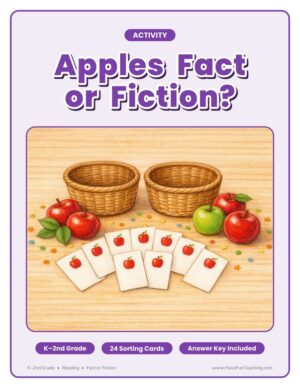
Apples Fact or Fiction ActivityTry it withApples Fact or Fiction ActivityActivitiesOpen it →

I think, because

Model an opinion sentence with a reason: "I think recess is the best part of the day because I can run." Kids say their own with a partner, then write it. A sentence frame turns opinions into real writing.

Why it works: showing first, practicing together, then letting kids try alone is the "gradual release" model teachers have relied on for decades (Pearson and Gallagher, 1983).

W.1.1 First Grade Common Core LessonTry it withW.1.1 First Grade Common Core LessonCommon Core LessonsOpen it →

Thumbs for facts

Call out silly and serious sentences: "Dogs have four legs." "Pizza is the best food." Kids show thumbs up for fact and a wiggle hand for opinion, then explain. Quick talk rounds make the difference automatic.

Why it works: playful practice with a clear goal keeps kids practicing longer, and simple learning games have been shown to build real skills (Ramani and Siegler, 2008).

Questions parents and teachers ask

How do I explain fact and opinion to a 1st grader?

A fact is something you can prove, like "The sky is blue today." An opinion is what someone thinks or feels, like "Blue is the prettiest color." Ask "Could we check it?" to tell them apart.

What are opinion clue words for kids?

Words like best, worst, favorite, beautiful, yummy, I think and I feel. These words usually signal that someone is sharing an opinion.

Can an opinion be wrong?

Not really. An opinion is someone's feeling, so it can't be proven true or false. But good opinions come with reasons, which first graders practice in writing.

How can I practice fact and opinion at home?

At dinner, take turns saying one fact and one opinion about your food. "This is a carrot." "Carrots are delicious." It turns a reading skill into conversation.



