This antonyms worksheet has 4th grade students rewrite sentences using the opposite word, then match three leftover words from the box. An answer key is included, so vocabulary practice checks itself.
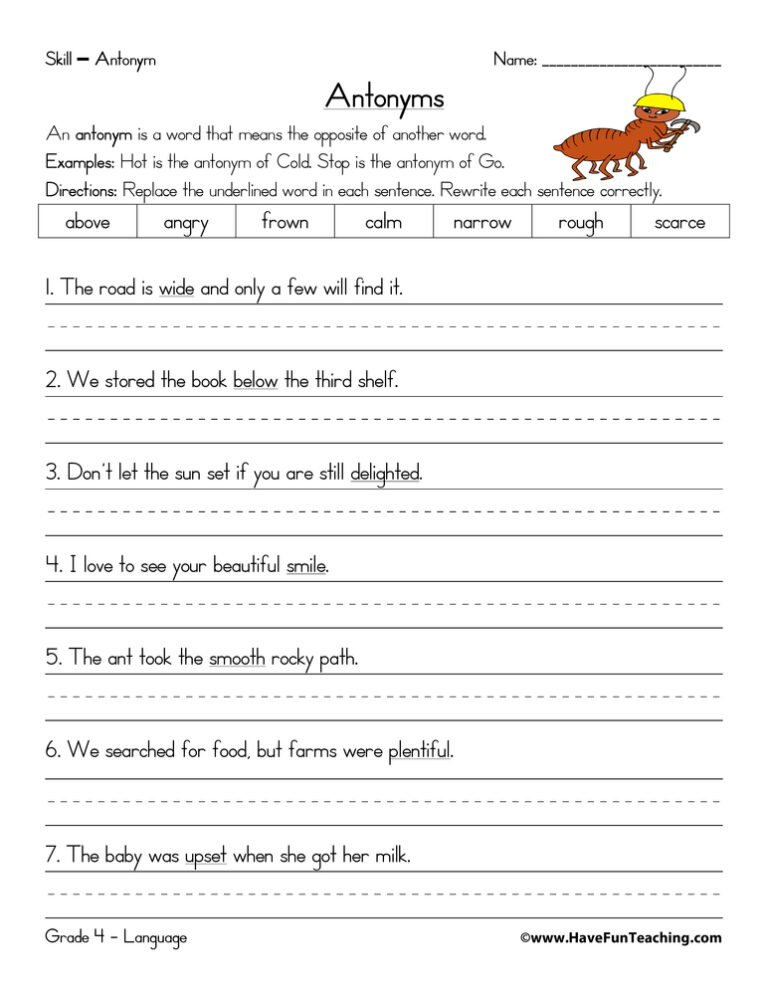
This replacing antonym worksheet gives 4th grade students seven items: rewrite four sentences using the opposite word, then supply three more antonyms. An answer key is included, so students build precise vocabulary fast.
This Antonyms Intermediate Matching Worksheet has 4th graders match eight word pairs, complete four context sentences, and write two sentences of their own. An answer key is included for fast, no-prep vocabulary practice.
Fourth graders go beyond easy pairs like up and down. They learn antonyms for richer words, like generous / selfish and expand / shrink. They see that prefixes can build antonyms: unhappy, disagree, incorrect. They also learn that some opposites come in shades, like hot, warm, cool and cold. Most important, they use antonyms as context clues: if the passage says "unlike his timid sister," they can figure out the brother is bold.
Our favorite ways to teach antonyms
At this level, antonyms are a tool for reading and writing, not just a list to memorize.
Swap and see
Write a sentence on the board and replace one word with its antonym: "The calm sea" becomes "The stormy sea." Talk about how the whole picture changes. Then kids try it with sentences from their own reading.
Why it works: handing over the work step by step, from teacher to student, is one of the most widely used teaching frameworks (Pearson and Gallagher, 1983).
Give partners one minute to match as many antonym pairs as they can, then check together. Repeat with a fresh list a few days later. Short timed rounds help kids recall tougher vocabulary quickly.
Why it works: a big review of study methods ranked quick self-quizzing among the most powerful ways to remember (Dunlosky and colleagues, 2013).
Mix pairs made with prefixes (like and dislike) with pairs that need a whole new word (ancient and modern). Kids sort them and explain. Mixing the two types helps them choose the right strategy.
Why it works: mixing different kinds of problems in one practice set helped students do far better on a later test (Rohrer and Taylor, 2007).
Words with opposite meanings. Fourth graders work with more advanced pairs, use prefixes to form antonyms, and use opposites as context clues when reading.
How do antonyms help with reading comprehension?
Writers often use contrast clues like "but," "unlike" or "instead of." If a child knows the word on one side, they can figure out the unfamiliar word on the other.
What prefixes make antonyms?
Un-, dis-, in-, im- and non- are the most common. Happy becomes unhappy, honest becomes dishonest, and possible becomes impossible.
How can I practice antonyms with my 4th grader?
While reading together, pick an interesting word and ask for its opposite. Use a thesaurus to check. Making it a quick daily game builds vocabulary fast.
Written by the Have Fun Teaching team of elementary teachers and homeschoolers. Research: Pearson, P. D., & Gallagher, M. C. (1983). The instruction of reading comprehension. Contemporary Educational Psychology, 8(3). Dunlosky, J., Rawson, K. A., Marsh, E. J., Nathan, M. J., & Willingham, D. T. (2013). Improving Students' Learning With Effective Learning Techniques. Psychological Science in the Public Interest, 14(1). Rohrer, D., & Taylor, K. (2007). The shuffling of mathematics problems improves learning. Instructional Science, 35(6).
3 days free
2:39Ready to print!
Printables · Songs · Games
Loved by 2 million teachers & families
Where learning feels like play.
Printables, songs and games for every subject, Preschool through 6th. Ready to teach today, and kids beg for more.
$0due today
then $39.97$35.97for your first year, and $39.97 a year after that.



 Try it withReplacing Antonym WorksheetWorksheetsOpen it →