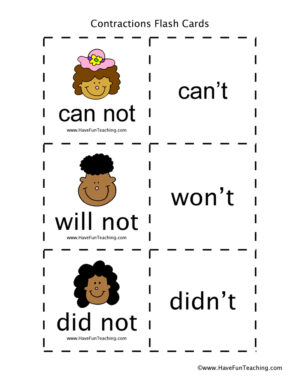
These contractions flash cards help kindergarten to 4th grade students see how two words join to make a contraction, with 24 fold-over cards and a practice page. Answer key included.
Fourth graders already know easy contractions like can't and I'm. Now they work on the trickier side. They learn the apostrophe marks the missing letters, they master odd ones like won't = will not, and they tackle the mix-ups that trip up even adults: it's vs. its, they're vs. their vs. there, and you're vs. your. They also learn when to use contractions in friendly writing and when to skip them in formal reports. The click moment comes when kids test a contraction by saying both words out loud.
Our favorite ways to teach contractions in 4th grade
Fourth graders know the basics. These moves fix the mistakes that stick around.
Flash both ways
Show a contraction and have kids say the two words, then flip it: say two words and they say the contraction. Quick rounds in both directions build the automatic recall kids need while writing.
Why it works: researchers who compared ten study methods found practice testing is one of the two that work best (Dunlosky and colleagues, 2013).
Write "Its raining" on the board and think aloud: "Can I say it is raining? Yes! So I need the apostrophe." Then try "The dog wagged its tail." Kids practice the test on five sentences with a partner.
Why it works: handing over the work step by step, from teacher to student, is one of the most widely used teaching frameworks (Pearson and Gallagher, 1983).
Mix-up sort
Give kids sentences with blanks and a word bank of its/it's, your/you're and their/they're. Mixing them together forces kids to stop and think about meaning every time, not just spot the pattern.
Why it works: shuffled practice teaches kids to choose the right strategy, not just repeat one, and it improved test scores in research (Rohrer and Taylor, 2007).
Questions about teaching contractions in 4th grade
What contractions should a 4th grader know?
Fourth graders should know common contractions with not, is, are, will, have and would, like don't, she's, we're, I'll, they've and he'd. They should also handle irregular ones like won't.
How do you teach it's vs. its?
Teach the say-it-out-loud test. If you can replace the word with "it is" or "it has," use it's. If not, use its, which shows that something belongs to it.
Should 4th graders use contractions in essays?
Contractions are great in friendly letters, stories and dialogue. In formal reports and some essays, teachers often ask students to write out both words.
How can I practice contractions at home?
Point out contractions in books, signs and texts and ask your child what two words they stand for. Quick flash card rounds and spotting mistakes together are fun too.
Written by the Have Fun Teaching team of elementary teachers and homeschoolers. Research: Dunlosky, J., Rawson, K. A., Marsh, E. J., Nathan, M. J., & Willingham, D. T. (2013). Improving Students' Learning With Effective Learning Techniques. Psychological Science in the Public Interest, 14(1). Pearson, P. D., & Gallagher, M. C. (1983). The instruction of reading comprehension. Contemporary Educational Psychology, 8(3). Rohrer, D., & Taylor, K. (2007). The shuffling of mathematics problems improves learning. Instructional Science, 35(6).
3 days free
2:39Ready to print!
Printables · Songs · Games
Loved by 2 million teachers & families
Where learning feels like play.
Printables, songs and games for every subject, Preschool through 6th. Ready to teach today, and kids beg for more.
$0due today
then $39.97$35.97for your first year, and $39.97 a year after that.


 Try it withContractions Flash CardsFlash CardsOpen it →