Skip to content
Start My 3 Free Days $0 today · cancel anytime

4th Grade Homonyms Resources

2 4th grade homonyms resources: 1 activity and 1 Common Core Lesson. How teachers use these

4th Grade Homonyms Resources

2 4th grade homonyms resources: 1 activity and 1 Common Core Lesson. How teachers use these

Activity
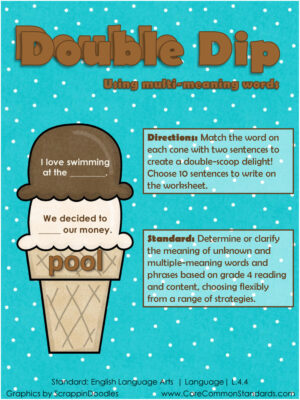
Activity4th GradeL.4.4 Common Core Activity

Using this L.4.4 Common Core Activity, students will determine or clarify the meaning of unknown or multiple meaning words.

Common Core Lesson
Common Core Lesson4th GradeL.4.1 Fourth Grade Common Core Lesson

Using L.4.1 Fourth Grade Common Core Lesson, students correctly use frequently confused words in order to clearly share their message.

From our teachers' playbook

Same sound, different meaning

What do 4th graders learn about homonyms?

Homonyms are words that sound or look alike but mean different things. Fourth graders sort them into groups: homophones sound the same but are spelled differently (there, their, they're), and multiple-meaning words look and sound the same but change meaning (bat the animal and bat for baseball). They use context clues to figure out which meaning fits a sentence and learn to pick the right spelling in their writing. The click moment comes when a student catches "to" vs "too" in their own work before you do.

Our favorite ways to teach homonyms

Homonyms trip up even adults. These moves help kids choose the right word with confidence.

Draw both meanings

Give kids a word like "bark" and have them fold paper in half to draw both meanings. Then they write a sentence for each. Pictures make the difference memorable.

Why it works: children learn more from words and pictures together than from words alone (Mayer, 2009).
L.4.4 Common Core ActivityTry it withL.4.4 Common Core ActivityActivitiesOpen it →
Commonly confused words lesson

Teach one confused set at a time, like to, too and two, with a clear example of each. Kids write their own examples and check a partner's. Focused lessons beat a long list.

Why it works: showing first, practicing together, then letting kids try alone is the "gradual release" model teachers have relied on for decades (Pearson and Gallagher, 1983).

L.4.1 Fourth Grade Common Core LessonTry it withL.4.1 Fourth Grade Common Core LessonCommon Core LessonsOpen it →

Homophone of the day

Post one homophone pair each morning and use it in the morning message with a mistake. Kids find and fix it. A daily minute builds the habit.

Why it works: the brain holds on to what it meets again and again over time; spaced practice was rated among the very best methods (Dunlosky and colleagues, 2013).

Questions parents and teachers ask about homonyms

What is a homonym for 4th graders?

A homonym is a word that sounds or looks like another word but has a different meaning. Homophones like flower and flour are one kind.

What is the difference between homonyms and homophones?

Homophones sound the same but are spelled differently, like see and sea. Homonym is a broader term that also includes words spelled the same with different meanings, like bat.

Which homophones do 4th graders mix up most?

Common ones are there, their and they're; to, too and two; your and you're; and its and it's. Practicing one set at a time helps.

How can I help my child learn homonyms?

Play riddles and jokes that use double meanings, and point out homophones when reading together. Ask which spelling fits the sentence.