Cardinal numbers tell how many: 7 apples, 2,450 fans, 1,000,000 stars. In 4th grade, kids stretch them all the way to the millions. They read and write big numbers in standard form, word form, and expanded form, like 46,203 = 40,000 + 6,000 + 200 + 3, and compare them with >, <, and =. The click moment is seeing that comparing big numbers is the same trick every time: line up the places and start on the left.
Our favorite ways to make big numbers stick
Big numbers get less scary when kids say them, sing them, and compare them every day.
Sing the comparison rules
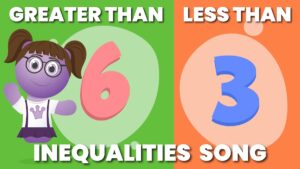
A catchy song about greater than and less than gives kids a rule they can hum during a test. Play it at the start of math for a week, then pause it and let the class finish the line. Pair each chorus with two big numbers on the board to compare.
Why it works: words set to a repeating melody are easier to recall than the same words spoken (Wallace, 1994).
Have partners read a big number to each other using place names: "Forty-six thousand, two hundred three." Then ask, "Why is there no tens?" Talking through the zero is where most misreadings get fixed.
Why it works: using clear, consistent math words out loud is one of the U.S. Department of Education's recommendations for elementary math.
Daily number of the day
Post one big number each morning. Kids write it in word form, expanded form, and compare it to yesterday's number. Five minutes of quick retrieval every day beats a long worksheet once a week.
Why it works: a big review of study methods ranked quick self-quizzing among the most powerful ways to remember (Dunlosky and colleagues, 2013).
Make it feel like play
A little competition makes giant numbers feel like a game.
A cardinal number tells how many of something there are, like 3, 58, or 2,000. Ordinal numbers tell position, like first or tenth.
How big are the numbers 4th graders work with?
Fourth graders read, write, compare, and round whole numbers up to 1,000,000. They use standard form, word form, and expanded form.
How do I teach comparing big numbers?
Line the numbers up by place value and compare from the left, starting with the biggest place. The first place where the digits differ decides which number is greater.
Why do kids struggle to read numbers with zeros?
A zero holds a place even when there is nothing there, so kids often skip it or add extra words. Practicing expanded form shows exactly which places are empty.
Written by the Have Fun Teaching team of elementary teachers and homeschoolers. Research: Wallace, W. T. (1994). Memory for music: Effect of melody on recall of text. Journal of Experimental Psychology: Learning, Memory, and Cognition, 20(6). U.S. Department of Education, What Works Clearinghouse (2021). Assisting Students Struggling with Mathematics: Intervention in the Elementary Grades. Dunlosky, J., Rawson, K. A., Marsh, E. J., Nathan, M. J., & Willingham, D. T. (2013). Improving Students' Learning With Effective Learning Techniques. Psychological Science in the Public Interest, 14(1).
3 days free
2:39Ready to print!
Printables · Songs · Games
Loved by 2 million teachers & families
Where learning feels like play.
Printables, songs and games for every subject, Preschool through 6th. Ready to teach today, and kids beg for more.
$0due today
then $39.97$35.97for your first year, and $39.97 a year after that.


 Try it withGreater Than Less Than Inequalities SongSongsOpen it →