Skip to content
Start My 3 Free Days $0 today · cancel anytime

4th Grade Order of Operations Resources

1 4th grade order of operations resources: 1 worksheet and 1 assessment. How teachers use these

4th Grade Order of Operations Resources

1 4th grade order of operations resources: 1 worksheet and 1 assessment. How teachers use these

Assessment
Assessment4th GradeRemembering Your Order of Operations Reading Comprehension Worksheet

This order of operations reading comprehension worksheet gives 4th grade students a clear nonfiction passage, bubble questions, and a written response, with an answer key so checking work is quick and easy.

From our teachers' playbook

Which step comes first?

What do 4th graders learn about order of operations?

In 4th grade, kids start solving multi-step problems and find out that math has rules about which step comes first. They learn to work inside parentheses first, then multiply and divide from left to right, then add and subtract from left to right. So 3 + 4 × 2 = 11, not 14! Many classes write expressions to match word problems, like (5 + 3) × 2. The click comes when kids see two classmates get different answers and realize the rules are there so everyone gets the same one.

Our favorite ways to make order of operations stick

These moves help kids slow down and solve in the right order every time.

Read about it first

Start with a short reading passage that explains the order of operations, then answer the questions together. Kids hear the "why" in words before they practice with numbers, and the passage gives them vocabulary they can use when they explain their steps.

Why it works: mixing different kinds of problems in one practice set helped students do far better on a later test (Rohrer and Taylor, 2007).
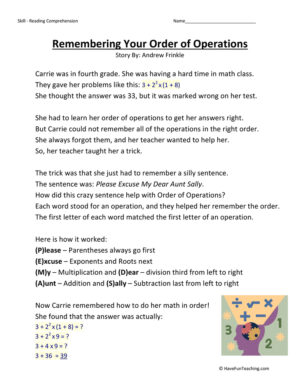
Remembering Your Order of Operations Reading Comprehension WorksheetTry it withRemembering Your Order of Operations Reading Comprehension WorksheetWorksheetsOpen it →
Two answers, one right

Write 8 + 2 × 5 on the board and show two "student" answers: 50 and 18. Partners argue which is right and why. Saying the rule out loud to convince someone else is what makes it stick.

Why it works: using clear, consistent math words out loud is one of the U.S. Department of Education's recommendations for elementary math.

Underline the step

Before solving, kids underline the first operation they will do, then rewrite the expression after each step. Seeing the expression shrink line by line catches most mistakes before they happen.

Why it works: pairing a picture with each word gives kids two ways to remember it, a well-tested principle of how people learn (Mayer, 2009).

Questions teachers and parents ask

What is the order of operations for 4th grade?

Parentheses first, then multiplication and division from left to right, then addition and subtraction from left to right. Exponents usually come later, in 5th or 6th grade.

Is order of operations taught in 4th grade?

Many 4th grade classes introduce it with multi-step problems and parentheses. It gets a deeper focus in 5th grade, when students write and evaluate longer expressions.

Why does the order of operations matter?

Without the rules, the same problem could have different answers. Following one order means everyone gets the same answer for 3 + 4 × 2, which is 11.

How can I help my child with order of operations?

Have them say each step out loud as they solve. Asking "What do you do first, and why?" helps them slow down and follow the rules.