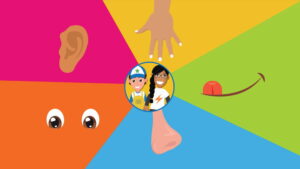
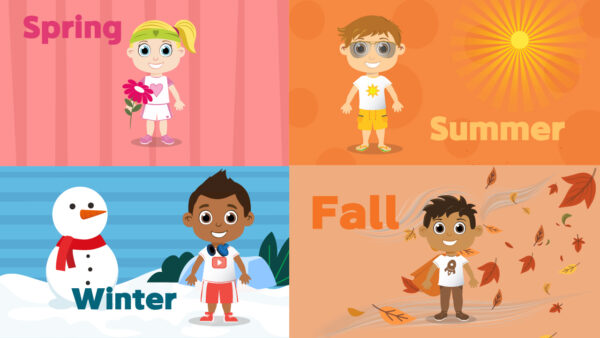
While watching the Senses Song (Animated Music Video), students learn about the five senses. The senses song teaches Touch, Taste, Smell, Sight, and Sound.
In 4th grade, the five senses grow up into a body system. Kids learn that eyes, ears, nose, tongue and skin are receptors that collect information and send it along nerves to the brain. The brain sorts it out, stores memories and tells the body how to react, like yanking a hand away from a hot pan. They compare how animals use senses to survive too: an owl's huge eyes, a dog's powerful nose, a bat's echoes. The click moment comes when kids realize the brain does the "seeing," and the eyes are just collecting light.
Our favorite ways to teach senses
Kids carry the best lab equipment around with them. These moves put it to work.
Message relay model
Line kids up as receptor, nerve, brain and muscle. The "receptor" feels a tap, passes a note along the nerve line, the "brain" decides and the "muscle" acts. Acting out the pathway makes the system concrete.
Why it works: going from real objects to pictures to symbols is a core recommendation of the U.S. Department of Education's elementary math guide.
Show an animal and kids name the sense it depends on most and why it helps it survive. Mix animals daily. Quick retrieval with new examples deepens understanding.
Why it works: a big review of study methods ranked quick self-quizzing among the most powerful ways to remember (Dunlosky and colleagues, 2013).
They learn how sense organs collect information and send it through nerves to the brain, which processes it and decides how the body responds. They also compare how animals use senses.
How do our senses send messages to the brain?
Sense organs have receptors that detect light, sound, touch, smell or taste. Nerves carry those signals to the brain, which turns them into what we see, hear and feel.
How do animals use their senses differently?
Many animals depend on one sense more than people do. Dogs track by smell, owls hunt at night with sharp eyes and hearing, and bats use echoes to find food.
What is a good senses experiment for kids?
Try a reaction-time ruler drop or a blindfolded taste test. Both show how senses and the brain work together.
Written by the Have Fun Teaching team of elementary teachers and homeschoolers. Research: U.S. Department of Education, What Works Clearinghouse (2021). Assisting Students Struggling with Mathematics: Intervention in the Elementary Grades. Dunlosky, J., Rawson, K. A., Marsh, E. J., Nathan, M. J., & Willingham, D. T. (2013). Improving Students' Learning With Effective Learning Techniques. Psychological Science in the Public Interest, 14(1). Wallace, W. T. (1994). Memory for music: Effect of melody on recall of text. Journal of Experimental Psychology: Learning, Memory, and Cognition, 20(6).
3 days free
2:39Ready to print!
Printables · Songs · Games
Loved by 2 million teachers & families
Where learning feels like play.
Printables, songs and games for every subject, Preschool through 6th. Ready to teach today, and kids beg for more.
$0due today
then $39.97$35.97for your first year, and $39.97 a year after that.



 Try it withFive Senses Mini PackWorkbooksOpen it →