
Skip to content
Start My 3 Free Days $0 today · cancel anytime

April Fools Resources

2 april fools resources: 2 worksheets. How teachers use these

April Fools Resources

2 april fools resources: 2 worksheets. How teachers use these

Worksheet
Worksheet3rd GradeApril Fools Word Search Worksheet

This April Fools word search worksheet has 3rd grade students find six silly holiday words and write each one to match its meaning. An answer key is included for quick, easy checking.

Worksheet
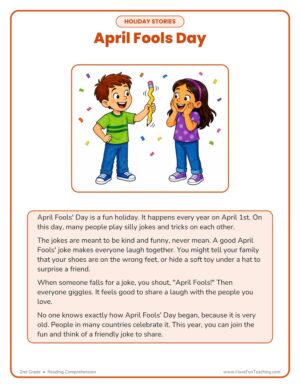
Worksheet2nd GradeApril Fools Day Reading Comprehension Worksheet

This April Fools Day reading comprehension worksheet gives 2nd graders a fun holiday passage with questions and an answer key, building confident reading one friendly joke at a time.

From our teachers' playbook

Silly jokes, kind laughs

What do kids learn about April Fools' Day?

April Fools' Day falls on April 1 every year and is a day for harmless jokes and playful tricks. Kids learn that it has been celebrated for hundreds of years in many countries, and that nobody knows for sure exactly how it started. In France, children try to stick a paper fish on someone's back, called a "poisson d'avril." The biggest lesson is the difference between a joke that everyone laughs at and a prank that hurts feelings. The click moment is when a child plans a trick and asks first, "Will they laugh too?"

Our favorite ways to celebrate April Fools' Day

This holiday is a perfect excuse for reading, writing and a lesson in kindness.

Read about the tradition

Read a short passage about April Fools' Day and answer questions about where traditions come from. Then ask kids to compare: is it more like Halloween or like a birthday? Comparing holidays builds great thinking.

Why it works: mixing different kinds of problems in one practice set helped students do far better on a later test (Rohrer and Taylor, 2007).
April Fools Day Reading Comprehension WorksheetTry it withApril Fools Day Reading Comprehension WorksheetWorksheetsOpen it →

Kind joke or mean prank?

Read a few short scenarios and sort them as a class into "everyone laughs" and "someone feels bad." Model the question to ask before any joke. It is a quick social skills lesson kids actually remember.

Why it works: showing first, practicing together, then letting kids try alone is the "gradual release" model teachers have relied on for decades (Pearson and Gallagher, 1983).

April Fools Word Search WorksheetTry it withApril Fools Word Search WorksheetWorksheetsOpen it →

Holiday words

Use a word search with April Fools' vocabulary as a warm-up, then have kids use three of the words in a silly sentence. A fun way to sneak in spelling.

Why it works: short practice spread over several days beats one long session, according to a large review of learning research (Dunlosky and colleagues, 2013).

April Fools Word Search WorksheetTry it withApril Fools Word Search WorksheetWorksheetsOpen it →

Questions parents and teachers ask

When is April Fools' Day?

April Fools' Day is on April 1 every year. It isn't an official holiday, so schools and businesses stay open.

How did April Fools' Day start?

Nobody knows for sure. Historians have several ideas, including a change in the calendar long ago, but the tradition of playing tricks on April 1 has gone on for hundreds of years.

What are good April Fools' jokes for kids?

The best ones are silly and harmless, like a googly eye on the milk carton, a backwards breakfast, or swapping the cereal into a different box. A good rule: everyone should be able to laugh, including the person who was tricked.

How do I teach kids the difference between a joke and a mean prank?

Ask, "Will everyone laugh, and will anything get hurt or broken?" If the answer is no, it's not a good joke. Role-playing a few examples helps kids see the line.

Keep exploring



