This April Fools Day reading comprehension worksheet gives 2nd graders a fun holiday passage with questions and an answer key, building confident reading one friendly joke at a time.
April Fools Day on April 1 is a day for harmless pranks and jokes, and second graders are the perfect age to enjoy it. They read about how the day is celebrated, talk about the difference between a kind joke and a mean one, and practice reading for details so they can spot what is real and what is a trick. It is also a great time to play with language: riddles, puns and silly sentences. Kids learn that the best joke is one where everyone laughs, including the person who got fooled!
Our favorite ways to teach on April Fools Day
We use the giggles to sneak in real reading and thinking. Here is how.
Read it, then prove it
After kids read the April Fools passage, ask them to answer each question and underline the sentence that proves it. Finding the evidence is retrieval practice, and it keeps the reading from feeling like a joke.
Why it works: a big review of study methods ranked quick self-quizzing among the most powerful ways to remember (Dunlosky and colleagues, 2013).
Read three pretend pranks out loud and think through each one: "Would everyone laugh? Could someone get hurt or sad?" Then let the class sort the rest. Kids learn a rule they can use all year.
Why it works: handing over the work step by step, from teacher to student, is one of the most widely used teaching frameworks (Pearson and Gallagher, 1983).
Fact or fooled?
Read silly statements, some true and some false, like "Octopuses have three hearts." Kids vote fact or fooled, then you reveal the answer. It builds careful thinking and a lot of excitement.
Why it works: playful practice with a clear goal keeps kids practicing longer, and simple learning games have been shown to build real skills (Ramani and Siegler, 2008).
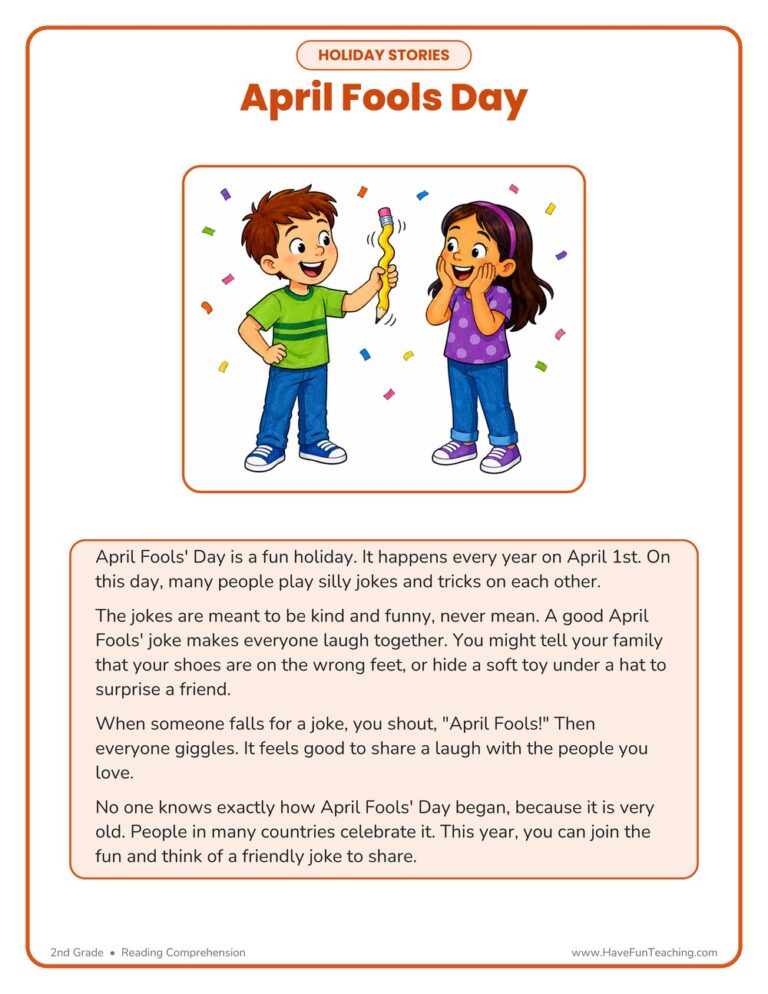
April Fools Day is on April 1, when people play harmless jokes and tricks on each other and then say "April Fools!" Explain that a good prank makes everyone laugh and never hurts anyone.
What are classroom-friendly April Fools activities?
Riddles, fact-or-fooled games, spotting silly mistakes in sentences and a reading passage about the holiday all work well. They keep the fun while practicing reading and thinking.
How do I keep April Fools jokes kind?
Set one rule before the day starts: a joke is only funny if everyone laughs, including the person fooled. Talk through examples together so kids can tell kind and unkind jokes apart.
Where did April Fools Day come from?
No one knows for sure. Historians have a few ideas, but the true origin is a mystery, which makes it a fun thing to talk about with kids.
Written by the Have Fun Teaching team of elementary teachers and homeschoolers. Research: Dunlosky, J., Rawson, K. A., Marsh, E. J., Nathan, M. J., & Willingham, D. T. (2013). Improving Students' Learning With Effective Learning Techniques. Psychological Science in the Public Interest, 14(1). Pearson, P. D., & Gallagher, M. C. (1983). The instruction of reading comprehension. Contemporary Educational Psychology, 8(3). Ramani, G. B., & Siegler, R. S. (2008). Promoting broad and stable improvements in low-income children's numerical knowledge through playing number board games. Child Development, 79(2).
3 days free
2:39Ready to print!
Printables · Songs · Games
Loved by 2 million teachers & families
Where learning feels like play.
Printables, songs and games for every subject, Preschool through 6th. Ready to teach today, and kids beg for more.
$0due today
then $39.97$35.97for your first year, and $39.97 a year after that.

 Try it withApril Fools Day Reading Comprehension WorksheetWorksheetsOpen it →



