Skip to content
Start My 3 Free Days $0 today · cancel anytime

Kindergarten Contractions Resources

1 kindergarten contractions resources: 1 flash card. How teachers use these

Kindergarten Contractions Resources

1 kindergarten contractions resources: 1 flash card. How teachers use these

Flash Cards
Flash CardsKindergartenContractions Flash Cards

These contractions flash cards help kindergarten to 4th grade students see how two words join to make a contraction, with 24 fold-over cards and a practice page. Answer key included.

From our teachers' playbook

Two little words squished into one

What do kindergartners learn about contractions?

Kindergarten is just a sneak peek at contractions. Kids already say can't, don't and it's all the time, so we show them what those words look like in print. The big idea: two words squish together and a little mark called an apostrophe takes the place of the missing letter, like do + not = don't. Kids learn to read a few common contractions in their books. Writing them comes later, mostly in 1st and 2nd grade.

Playful ways to introduce contractions

Keep it light and hands-on. These moves make the idea of a contraction visible to little learners.

Squish the words

Write "do" and "not" on two cards. Kids slide them together, then you cover the "o" in "not" with a little apostrophe sticker. Read it together: "don't!" Physically squishing the cards shows exactly what happens to the words.

Why it works: kids understand an idea best when they touch it, then draw it, then write it, the order the U.S. Department of Education recommends for elementary math.
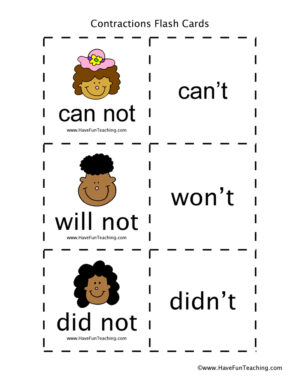
Contractions Flash CardsTry it withContractions Flash CardsFlash CardsOpen it →
Flash and say

Hold up a contraction card and kids read it, then say the two words it stands for: "Can't! Can not!" Keep it to four or five cards, two minutes a day. Short, quick rounds help them recognize these words in their books.

Why it works: pulling an answer out of memory makes it stick far better than rereading it, one of the strongest findings in learning research (Dunlosky and colleagues, 2013).

Contractions Flash CardsTry it withContractions Flash CardsFlash CardsOpen it →
Apostrophe the helper

Draw the apostrophe as a tiny character who holds the place of a missing letter. Kids love finding him in big books and pointing him out. Turning a punctuation mark into a friend makes it easy to remember.

Why it works: children learn more from words and pictures together than from words alone (Mayer, 2009).

What's on this page

Teacher favorites right now: Contractions Flash Cards.

Questions teachers and parents ask

Do kindergartners learn contractions?

Just a little. Kindergartners learn to recognize a few common contractions like can't, don't and it's in their reading. Formal contraction lessons usually come in 1st and 2nd grade.

How do I explain a contraction to a 5-year-old?

Say it's two words squished into one, like "do not" becoming "don't." The apostrophe is a little mark that holds the spot where a letter was taken out.

Which contractions should kindergartners know?

Start with the ones they say every day: can't, don't, it's, I'm and I'll. These show up often in early readers, so recognizing them helps kids read more smoothly.

How can I practice contractions at home?

When you say a contraction, point it out: "I said can't. That means can not!" Look for apostrophes together in picture books and read those words aloud.