
Skip to content
Start My 3 Free Days $0 today · cancel anytime

Circumference Resources

3 circumference resources: 3 worksheets. How teachers use these

Circumference Resources

3 circumference resources: 3 worksheets. How teachers use these

Worksheet
Worksheet6th GradeCircle Circumference Worksheet

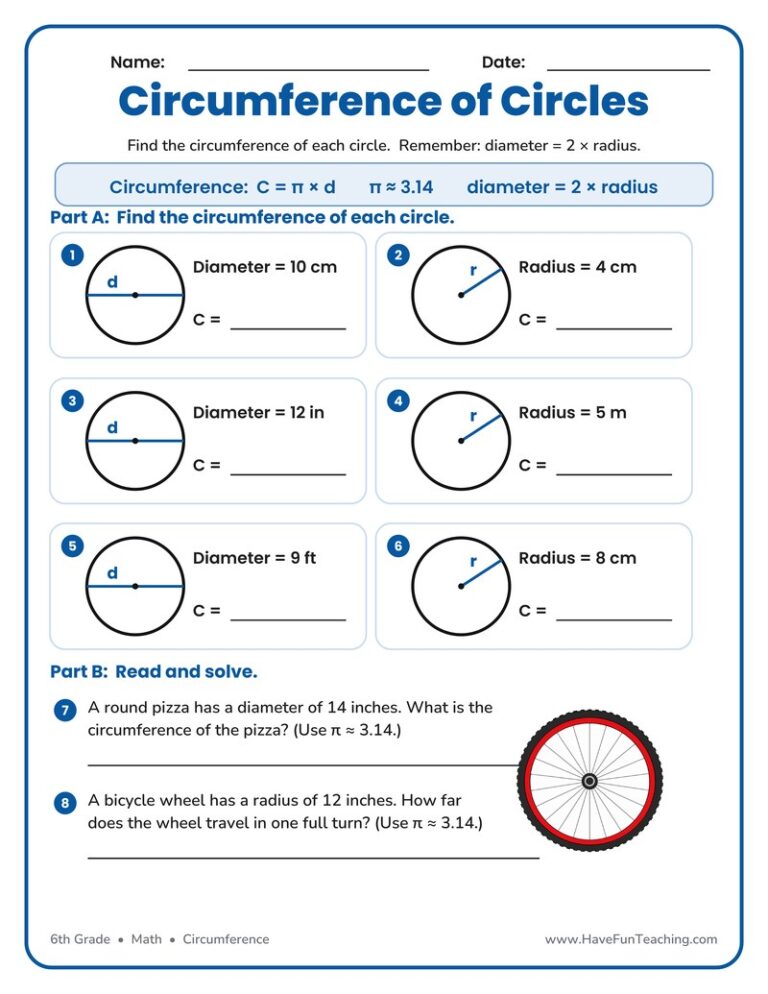
This Circle Circumference Worksheet helps 6th graders find the circumference of circles using the radius or diameter, with clear diagrams and two real-world problems. A complete answer key is included for quick, confident practice.

Worksheet
Worksheet5th GradeDrawing Circumference of Circles Worksheet

This drawing circumference of circles worksheet has 5th grade students measure true-size circles, draw one with a compass, and find each circumference. An answer key is included for quick checking.

Worksheet
Worksheet6th GradeCircumference of Circles Worksheet

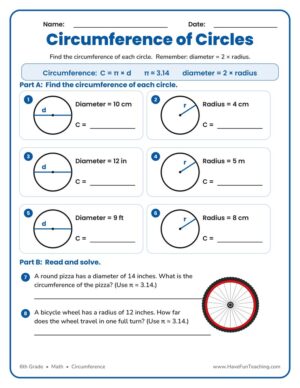
This Circumference of Circles Worksheet gives 6th graders six labeled circles to solve using C = π × d from the radius or diameter. Answer key included — perfect for no-prep circumference practice.

From our teachers' playbook

Around and around we go!

What do kids learn about circumference?

Circumference is the distance all the way around a circle, like the crust on a round pizza. Students learn the parts of a circle first: the center, the radius and the diameter, which is twice the radius. Then they discover that the circumference is always a little more than three times the diameter. That magic number is pi, about 3.14, so C = π × d. The click comes when kids wrap a string around a can, stretch it next to the diameter, and see that "just over three" for themselves!

Our favorite ways to teach circumference

Circumference makes sense when kids measure real circles first. Here's what we do.

String and soup cans

Give groups string, a ruler and three round objects. They measure the distance around and the diameter, then divide. Every group gets close to 3.14, and suddenly pi isn't a mystery anymore.

Why it works: going from real objects to pictures to symbols is a core recommendation of the U.S. Department of Education's elementary math guide.

Drawing Circumference of Circles WorksheetTry it withDrawing Circumference of Circles WorksheetWorksheetsOpen it →
Radius or diameter?

Draw a circle and label the radius and diameter in different colors. Solve one problem given the radius and one given the diameter, thinking aloud. The big mistake is forgetting to double the radius, so we name it out loud.

Why it works: showing first, practicing together, then letting kids try alone is the "gradual release" model teachers have relied on for decades (Pearson and Gallagher, 1983).

Circle Circumference WorksheetTry it withCircle Circumference WorksheetWorksheetsOpen it →

A circle a day

Start each class with one circle warm-up: find the circumference, then switch to finding the diameter. Short daily practice over two weeks keeps the formula from fading.

Why it works: spreading practice out over days is one of the two most effective study methods in a major research review (Dunlosky and colleagues, 2013).

Circumference of Circles WorksheetTry it withCircumference of Circles WorksheetWorksheetsOpen it →

Questions parents and teachers ask about circumference

What is circumference in simple terms?

Circumference is the distance around the outside of a circle. It's like the perimeter, but for a circle.

What is the formula for circumference?

C = π × d, where d is the diameter. You can also use C = 2 × π × r, where r is the radius. Pi is about 3.14.

What grade learns circumference?

Most students learn the circumference formula in 7th grade. Some advanced 6th grade classes introduce it, and younger kids can explore measuring around circles with string.

What's the difference between circumference and area?

Circumference measures the distance around a circle. Area measures the space inside it. Circumference uses units like inches, and area uses square units.

Keep exploring



