Skip to content
Start My 3 Free Days $0 today · cancel anytime

Order of Operations Resources

1 order of operations resources: 1 worksheet and 1 assessment. How teachers use these

Order of Operations Resources

1 order of operations resources: 1 worksheet and 1 assessment. How teachers use these

Assessment
Assessment4th GradeRemembering Your Order of Operations Reading Comprehension Worksheet

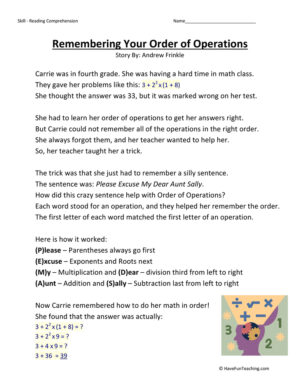
This order of operations reading comprehension worksheet gives 4th grade students a clear nonfiction passage, bubble questions, and a written response, with an answer key so checking work is quick and easy.

From our teachers' playbook

Which step comes first?

What do kids learn about the order of operations?

The order of operations is the set of rules that tells everyone which step to do first, so we all get the same answer. Kids usually meet it in 5th grade and build on it in 6th: parentheses first, then exponents, then multiplication and division from left to right, then addition and subtraction from left to right. Take 3 + 4 × 2. Multiply first: 3 + 8 = 11, not 14. The big click comes when kids realize multiplication and division are partners, so you just work left to right.

How we teach the order of operations

These moves help kids understand the rules and avoid the most common mistakes.

Circle it, solve it, rewrite it

Solve a problem on the board one step at a time. Circle the step you're doing, solve it, then rewrite the whole expression underneath. Kids copy the same routine. Rewriting after every step stops them from skipping or mixing up operations.

Why it works: showing first, practicing together, then letting kids try alone is the "gradual release" model teachers have relied on for decades (Pearson and Gallagher, 1983).
Remembering Your Order of Operations Reading Comprehension WorksheetTry it withRemembering Your Order of Operations Reading Comprehension WorksheetWorksheetsOpen it →
Find the mistake

Show a problem solved the wrong way, like adding before multiplying. Partners find the error and explain how to fix it. Hunting for mistakes makes kids think carefully about every step.

Why it works: using clear, consistent math words out loud is one of the U.S. Department of Education's recommendations for elementary math.

Questions teachers and parents ask

What is the order of operations?

It's the agreed order for solving math expressions: parentheses, exponents, multiplication and division (left to right), then addition and subtraction (left to right). Following it means everyone gets the same answer.

What does PEMDAS stand for?

Parentheses, Exponents, Multiplication, Division, Addition, Subtraction. Many kids learn it as "Please Excuse My Dear Aunt Sally." Remind them that multiplication and division share a step, and so do addition and subtraction.

What grade learns the order of operations?

Most kids learn it in 5th grade with parentheses and brackets, then add exponents in 6th grade. It's used in every math class after that.

What is the most common order of operations mistake?

Doing multiplication before division, or addition before subtraction, every time. In 12 ÷ 3 × 2, you work left to right: 4 × 2 = 8, not 12 ÷ 6 = 2.

Keep exploring