Skip to content
Start My 3 Free Days $0 today · cancel anytime

2nd Grade Groundhog Day Resources

1 2nd grade Groundhog Day resources: 1 worksheet and 1 assessment. How teachers use these

2nd Grade Groundhog Day Resources

1 2nd grade Groundhog Day resources: 1 worksheet and 1 assessment. How teachers use these

Assessment
Assessment2nd GradeGroundhog Day Reading Comprehension Worksheet

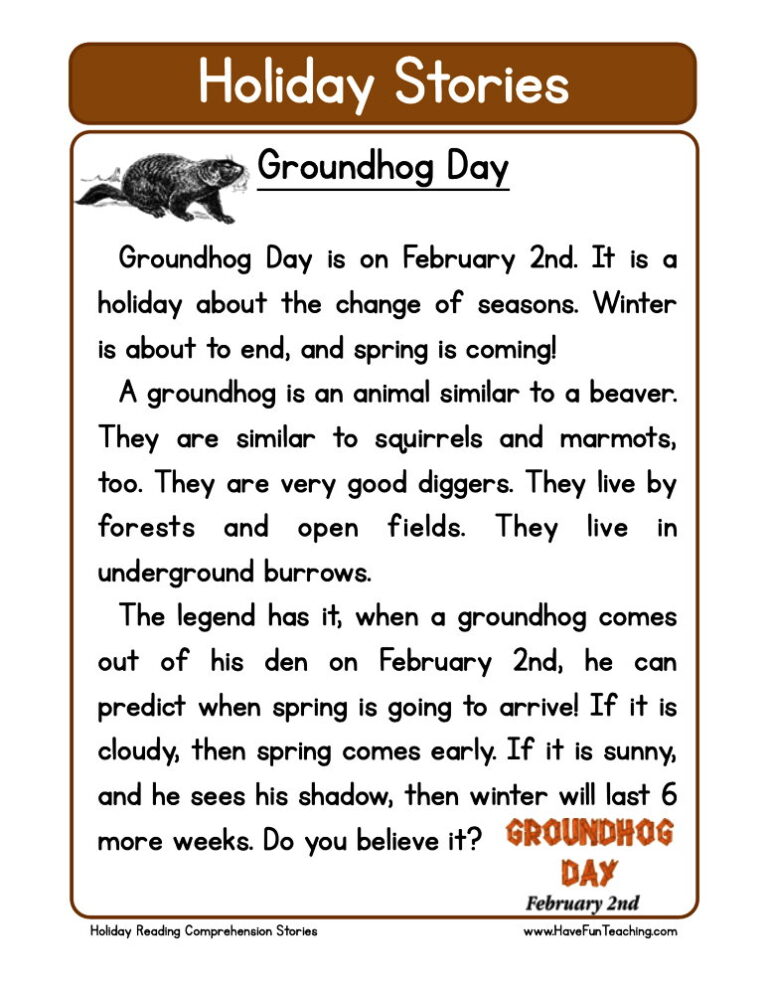
This Groundhog Day Reading Comprehension Worksheet gives 2nd graders a fun nonfiction passage about Groundhog Day plus multiple-choice, fill-in-the-blank, and short-response questions. A complete answer key is included for quick, no-prep reading practice.

From our teachers' playbook

Shadow or no shadow? Let's predict!

What do 2nd graders learn about Groundhog Day?

Groundhog Day falls on February 2. The fun tradition says that if a groundhog sees its shadow, there will be six more weeks of winter, and if not, spring comes early. Second graders read about the holiday, learn real facts about groundhogs, and connect it to science: shadows form when something blocks sunlight. They also practice making predictions and checking them later. The click comes when kids realize a shadow depends on the sun, not on the groundhog.

Our favorite ways to teach Groundhog Day

This little holiday packs in reading, science and math. Here is how we make the most of it.

Read and answer

Read a short passage about Groundhog Day together, then kids answer questions on their own. Ask them to point to the sentence that proves each answer. It builds careful reading.

Why it works: a big review of study methods ranked quick self-quizzing among the most powerful ways to remember (Dunlosky and colleagues, 2013).
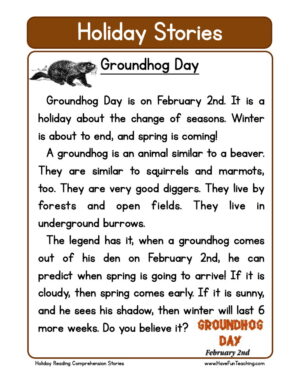
Groundhog Day Reading Comprehension WorksheetTry it withGroundhog Day Reading Comprehension WorksheetAssessmentsOpen it →
Make a shadow

Take kids outside on a sunny day, or use a flashlight inside. Kids stand where they can see their shadow, then find a spot where they cannot. Now they know exactly what the groundhog needs!

Why it works: going from real objects to pictures to symbols is a core recommendation of the U.S. Department of Education's elementary math guide.

Prediction graph

Before February 2, kids vote: shadow or no shadow? Make a class picture graph and count the votes. Check the news together and talk about who predicted right.

Why it works: pairing a picture with each word gives kids two ways to remember it, a well-tested principle of how people learn (Mayer, 2009).

What's on this page

Teacher favorites right now: Groundhog Day Reading Comprehension Worksheet.

Questions teachers and parents ask about Groundhog Day

What is Groundhog Day?

Groundhog Day is February 2. Tradition says a groundhog that sees its shadow means six more weeks of winter, and no shadow means an early spring.

Can a groundhog really predict the weather?

No. It is a fun tradition, not real science. Kids enjoy it most when they learn what actually causes shadows and seasons.

How do you explain shadows to 2nd graders?

A shadow forms when an object blocks light. On a sunny day the groundhog blocks sunlight and makes a shadow. On a cloudy day there is no strong light, so no shadow.

What are good Groundhog Day activities for 2nd grade?

Read a passage about the holiday, make shadow experiments, graph class predictions and count six weeks on the calendar.