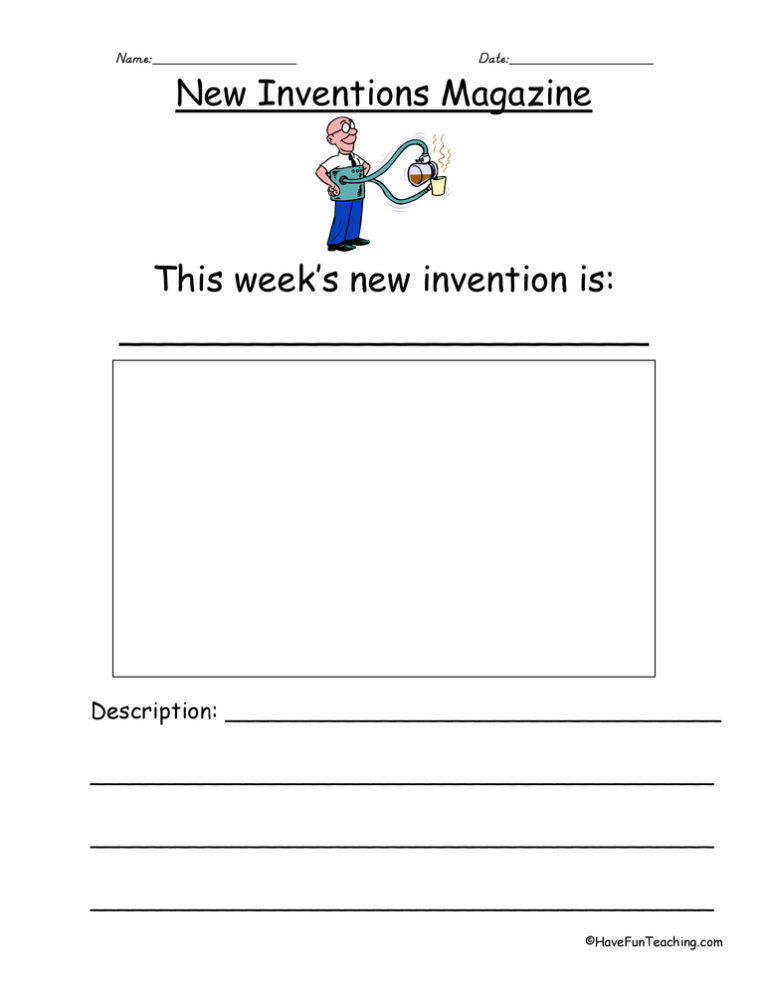
The New Inventions Magazine Worksheet lets 2nd graders name, draw and describe an invention of their own. An open-ended science and writing page that turns curiosity about inventors into real explaining practice.
What do 2nd graders learn about the scientific method?
Second graders learn that scientists have a plan for finding answers. They ask a question, make a guess called a hypothesis, test it, watch what happens and share what they learned. A simple test like Which melts faster: ice in the sun or in the shade? turns the steps into something real. They also learn to change just one thing at a time so the test is fair. The click moment is when a child's guess turns out wrong and they say, "Let's test it again!"
Our favorite ways to teach the scientific method
Seven-year-olds are full of questions. These moves give them a real way to answer them.
Sing the steps
The steps are easy to mix up, so put them to music. Play the song before each experiment and have kids hold up one finger per step as they sing. By the third experiment, they're reciting the steps without the music.
Why it works: a catchy, repeating tune gives the brain a hook to hang words on, so sung text is remembered better (Wallace, 1994).
Run the first experiment as a class and think out loud at each step: "My question is… My guess is… Now I'll test it." Then let small groups run the next one with you nearby. Watching the whole process first helps kids follow it on their own.
Why it works: showing first, practicing together, then letting kids try alone is the "gradual release" model teachers have relied on for decades (Pearson and Gallagher, 1983).
Instead of one big science fair, try a tiny five-minute experiment each week, like which paper towel soaks up the most water. Repeating the steps often, in small doses, makes the method automatic.
Why it works: the brain holds on to what it meets again and again over time; spaced practice was rated among the very best methods (Dunlosky and colleagues, 2013).
Questions parents and teachers ask about the 2nd grade scientific method
What are the steps of the scientific method for 2nd grade?
Ask a question, make a hypothesis or guess, test it with an experiment, observe what happens and share the results. Some classes add "research" after asking the question.
What is a hypothesis for kids?
A hypothesis is a smart guess about what will happen. For example, "I think the ice in the sun will melt first." The experiment checks whether the guess was right.
What are good scientific method experiments for 2nd graders?
Try sink or float, melting ice in sun and shade, growing beans with and without light or testing which paper towel holds the most water. Each one is quick and easy to set up.
Is it OK if a child's hypothesis is wrong?
Yes! A wrong guess is still good science. Scientists learn just as much from guesses that don't work out, and kids should feel proud of testing their ideas.
Written by the Have Fun Teaching team of elementary teachers and homeschoolers. Research: Wallace, W. T. (1994). Memory for music: Effect of melody on recall of text. Journal of Experimental Psychology: Learning, Memory, and Cognition, 20(6). Pearson, P. D., & Gallagher, M. C. (1983). The instruction of reading comprehension. Contemporary Educational Psychology, 8(3). Dunlosky, J., Rawson, K. A., Marsh, E. J., Nathan, M. J., & Willingham, D. T. (2013). Improving Students' Learning With Effective Learning Techniques. Psychological Science in the Public Interest, 14(1).
3 days free
2:39Ready to print!
Printables · Songs · Games
Loved by 2 million teachers & families
Where learning feels like play.
Printables, songs and games for every subject, Preschool through 6th. Ready to teach today, and kids beg for more.
$0due today
then $39.97$35.97for your first year, and $39.97 a year after that.



 Try it withScientific Method Song (MP3)SongsOpen it →





