
Skip to content
Start My 3 Free Days $0 today · cancel anytime

Music Resources

10 music resources: 5 worksheets, 2 assessments, 2 activities and more. How teachers use these

Music Resources

10 music resources: 5 worksheets, 2 assessments, 2 activities and more. How teachers use these

Assessment
Assessment5th GradeMusical Instruments Reading Comprehension Worksheet

This Musical Instruments Reading Comprehension Worksheet gives 5th grade readers an original story about choosing an instrument, plus seven questions and a complete answer key for quick, no-prep comprehension practice.

Worksheet
WorksheetKindergartenMusical Instrument Matching Worksheet

A kindergarten musical instrument matching worksheet where students draw a line to match each instrument to its name. Includes a complete answer key for quick, no-prep music practice.

Worksheet
Worksheet2nd GradeWriting about a Creative Experience Worksheet

Writing about a Creative Experience Worksheet gives 2nd Grade writers a describing-word bank and a full page of ruled space to tell the story of something they made. No-prep personal narrative practice.

Worksheet
Worksheet2nd GradeMusical Instrument Comparison Chart Worksheet

Use this musical instrument comparison chart worksheet to help 2nd graders sort facts about a guitar and a drum into a diagram. Includes an answer key and builds strong compare and contrast thinking.

Flash Cards
Flash CardsPreschoolMusical Instruments Flash Cards

These musical instruments flash cards help preschool to 3rd grade students name twelve instruments and sort them into strings, woodwinds, brass and percussion. Answer key included.

Activity
ActivityPreschoolMusical Instrument Sort Activity

This musical instrument sort activity for PreK to 1st grade has children sort 12 picture cards into wind, strings and percussion. Answer key included.

Activity
ActivityPreschoolMusical Instruments BINGO

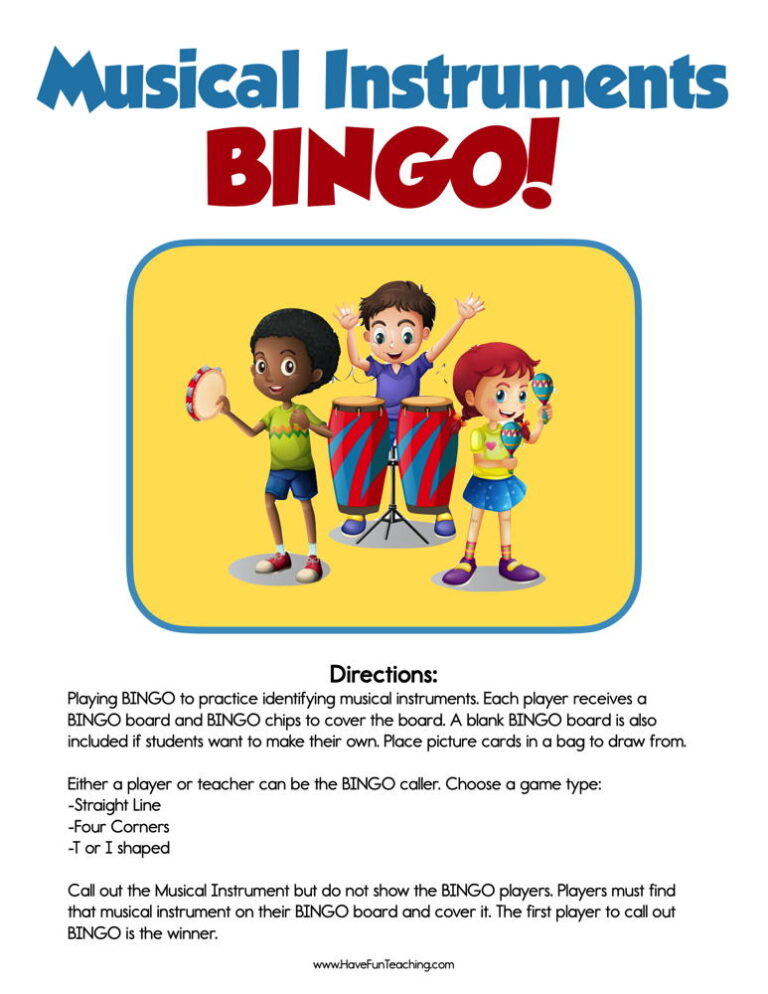
Using this Musical Instruments BINGO, students play BINGO to identify and learn the names of different musical instruments. 

Assessment
Assessment4th GradeTina Turner Reading Comprehension Worksheet

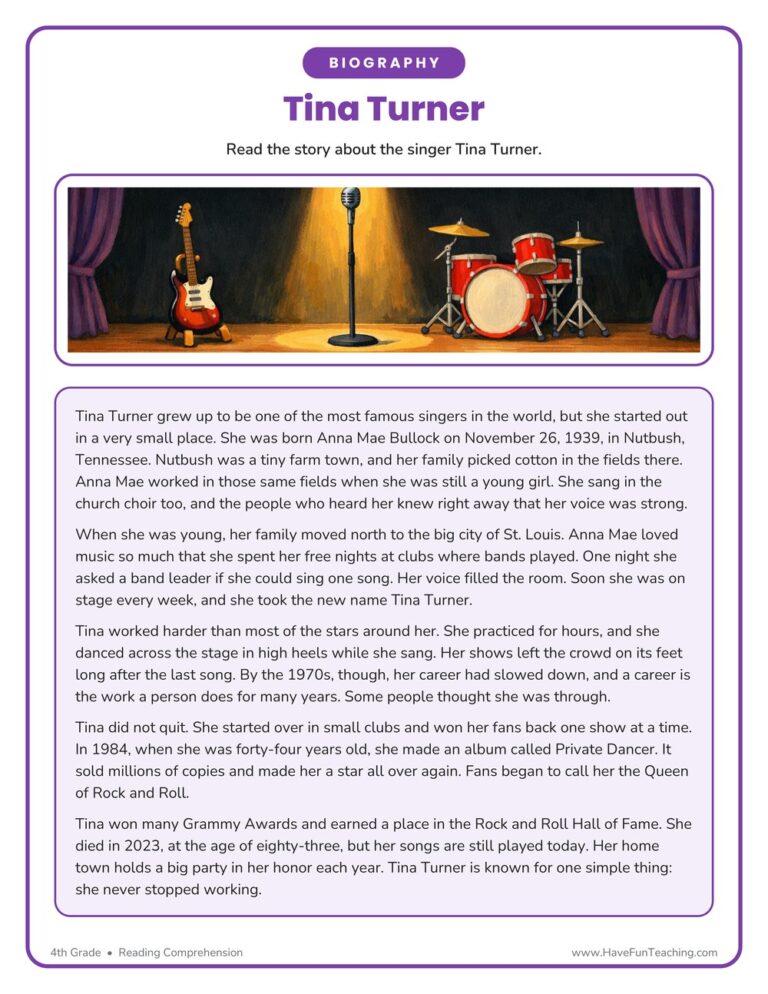
This Tina Turner Reading Comprehension Worksheet tells the story of a singer who never gave up, then asks 4th Grade readers to find the main idea, use context clues, and explain what happened. Answer key included.

PreschoolMarvelous Musician Reward Certificate

Using the Marvelous Musician Reward Certificate, your student will feel celebrated and recognized for their marvelous musical skills.

From our teachers' playbook

Strum it, drum it, name it

What do kids learn in music?

Elementary music starts with feeling the steady beat and clapping rhythms, then grows into the big ideas musicians use: tempo (fast or slow), dynamics (loud or soft) and pitch (high or low). Kids learn the instrument families, strings, woodwinds, brass and percussion, and how each one makes its sound: a violin vibrates a string, a trumpet buzzes the player's lips. Older kids read simple notes and rests and write about music they hear. The click moment is hearing a tuba and a flute and explaining why one sounds so low and the other so high.

Our favorite ways to make music stick

Kids remember music when they can see it, sort it and hear it. These are the moves we use again and again.

See it, hear it, name it

Show an instrument flash card, then play a short clip of how it sounds. Kids name the instrument and its family. After a week, flip it: play the sound first and let them guess the card. Pairing picture and sound locks it in.

Why it works: pairing a picture with each word gives kids two ways to remember it, a well-tested principle of how people learn (Mayer, 2009).

Musical Instruments Flash CardsTry it withMusical Instruments Flash CardsFlash CardsOpen it →

Sort the orchestra

Kids sort instrument cards into four families and explain their choices: "The drum is percussion because you hit it." Then they rebuild the sort as a seating chart for a pretend orchestra. Sorting by how sound is made is the real lesson.

Why it works: the U.S. Department of Education's guide for teaching elementary math recommends moving from hands-on objects to drawings to numbers.

Musical Instrument Sort ActivityTry it withMusical Instrument Sort ActivityActivitiesOpen it →

Instrument BINGO

Call out a clue like "I'm brass and I have a slide" and kids find the trombone on their card. Mix picture calls and sound calls. A game that needs listening is perfect practice for music class.

Why it works: in a well-known study, a few short sessions of a simple number board game measurably boosted young children's number skills (Ramani and Siegler, 2008).

Musical Instruments BINGOTry it withMusical Instruments BINGOActivitiesOpen it →

Questions teachers and parents ask

What do elementary students learn in music class?

They learn steady beat, rhythm, tempo, dynamics and pitch, sing songs, play simple instruments, and learn the four instrument families. Older students begin reading basic music notation.

What are the four families of instruments?

Strings (violin, cello), woodwinds (flute, clarinet), brass (trumpet, tuba) and percussion (drums, xylophone). Each family makes sound in a different way.

How do I teach instruments to kids?

Show a picture, play the sound, and talk about how it makes music. Sorting games and listening guessing games help kids remember both the name and the family.

How can I teach music if I'm not a music teacher?

Start with beat and listening. Clap along to songs, talk about whether music is fast or slow, loud or soft, and use instrument cards and videos. You don't need to play an instrument yourself.

Keep exploring



