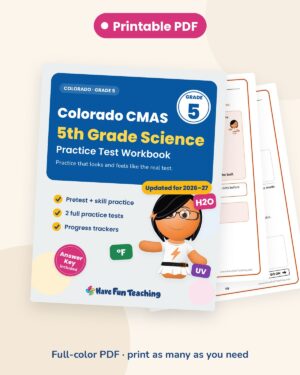
Fifth grade science asks a lot. Students model matter as particles too small to see, show that weight stays the same when substances mix, trace energy in food back to the sun, follow matter through food webs, explain shadows and star patterns, and describe how Earth’s land, water, air and living things work together. All of it shows up on one spring test. If you want every standard covered in one place, this workbook was made for you.
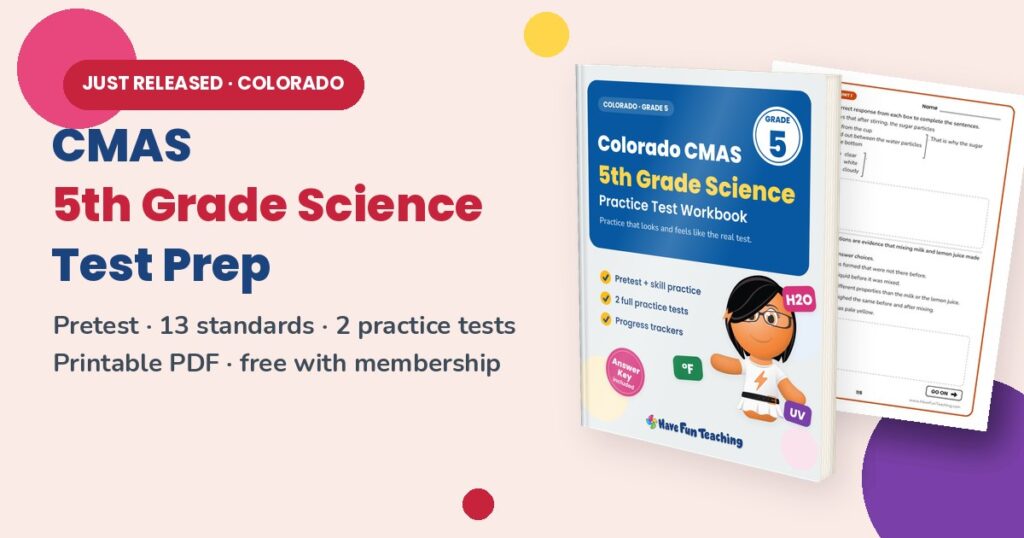
The Colorado CMAS 5th Grade Science Practice Test Workbook is aligned to the 2020 Colorado Academic Standards for Science and built from the CMAS science framework published by the Colorado Department of Education. Every question is original, written in the formats your students will see in the spring, and reviewed by a certified teacher.
It’s a Printable PDF, so you can print the pages you need for whole-class lessons, small groups, centers or homework. Below you’ll find what’s inside, a look-inside video and a simple plan for the months before testing.
- A 15-question pretest, a Learn It lesson + test-style practice for all 13 standards, mixed review, test-taking strategies, 2 full-length practice tests and a 214-answer key.
- Each practice test has 39 questions worth 51 points in three units, just like the three units of the real CMAS science test.
- Printable PDF, 238 full-color pages, $9.99.
- A rubric and a sample full-credit answer for every written question, plus bubble answer sheets, progress trackers and class data sheets.
- Free with a Have Fun Teaching membership.
What’s inside the CMAS 5th grade science test prep workbook
The workbook follows the order you’d teach it. Find out what students already know, teach the gaps one standard at a time, mix everything together, then rehearse the real thing twice.
Pretest + scoring guide
15 questions and a guide that shows which standards to teach first.
Learn It + practice
A worked example and a tip, then test-style practice, for all 13 standards.
Every big 5th grade idea
Matter and its changes, gravity, energy in food, plants and food webs, the sun and stars, Earth’s systems and water.
Mixed review + strategies
12 mixed questions in science stories and five pages of test-taking tips for the big day.
2 full-length practice tests
39 questions each, split into Unit 1, Unit 2 and Unit 3 like the real test.
Answer key + trackers
214 answers, rubrics for written answers, progress trackers, class data sheets and a certificate.
The question types match the real test: multiple choice, “choose two” questions, inline choices, check-mark tables, hot spots where students mark part of a figure, drag-and-drop lists, a bar graph to finish and written answers where students explain their thinking. Most questions come in clusters that start with a short science story, a data table or a model, just like the CMAS. Written answers are scored by hand and carry a lot of points, so every one in the book comes with a rubric and a sample answer. Once 5th graders have met every format, test day is about the science, not the question style.
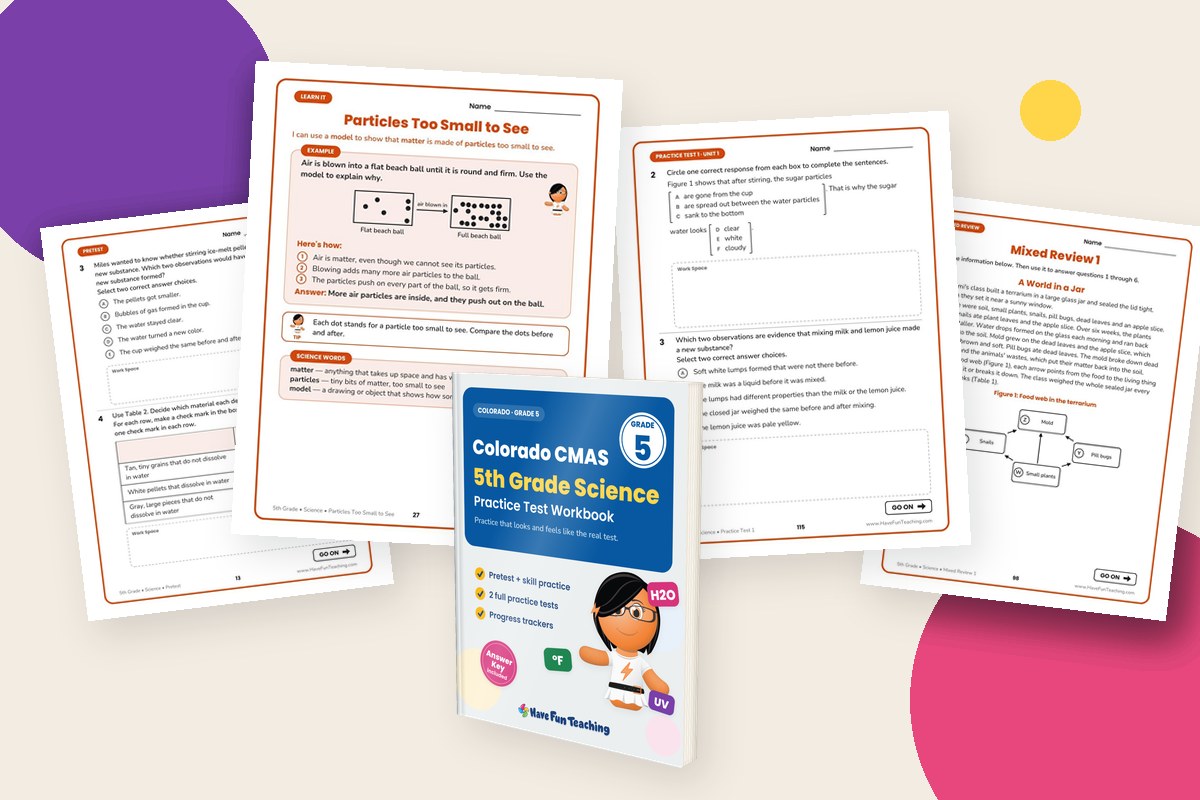
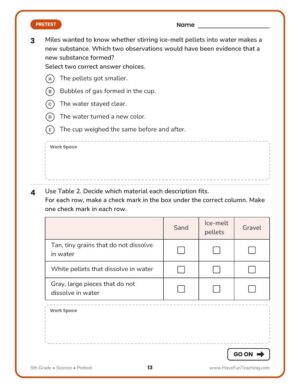 Inside · PretestPretestFind each student’s starting point in one sitting.
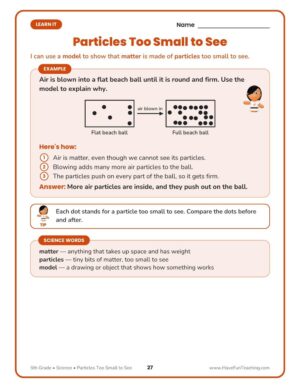 Inside · Learn ItLearn It pagesA worked example and a tip before every practice set.
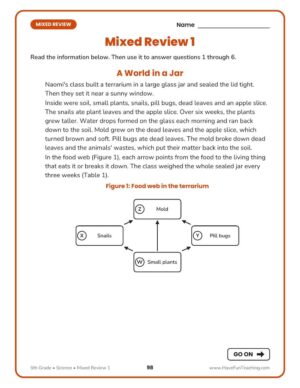 Inside · ReviewMixed ReviewEvery reporting category mixed together, like the real test.
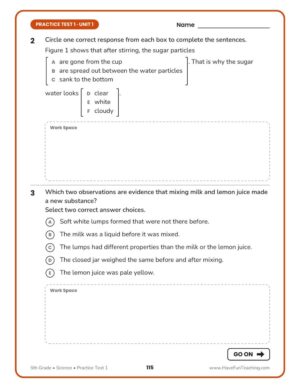 Inside · Practice testFull practice testsTwo 39-question tests, each in three units.
Take a look inside (video)
Want to flip through it before you buy? This short look-inside video walks through the whole workbook, from the pretest to the class data sheets at the back.
What’s on the CMAS 5th grade science test?
The CMAS (Colorado Measures of Academic Success) science test is taken on the computer, with a paper form available. It’s a fixed form, so every student sees the same questions and the test doesn’t adapt to answers. Fifth graders take it in three units of 65 minutes each, 3 hours and 15 minutes in all, and the whole test is worth 51 points.
The points come from three reporting categories: Physical Science (matter and its interactions and gravity, about 35%), Physical/Life Science (energy from the sun in food, how plants grow and how matter moves through ecosystems, about 24%) and Earth and Space Science (stars and patterns in the sky, Earth’s systems, water and protecting resources, about 41%). Nearly half of the points come from written answers, where students explain what a model or a set of data shows. The online test has a four-function calculator with a percent key built in. The Colorado Department of Education doesn’t publish the number of questions, so each practice test in the book has 39 questions worth 51 points, split into three units.
Every skill page is labeled with its 2020 Colorado Academic Standards for Science code, so you can match it to your own scope and sequence.
How to use the printable workbook in class
Because it’s a PDF, you print only what you need, when you need it. Here’s how teachers tend to use each part.
Print the pretest
One sitting shows you which standards each student needs most.
Small groups + centers
Pull the Learn It and practice pages for the standards your groups need.
Test day rehearsal
Give a practice test with the bubble answer sheets, one 65-minute unit at a time.
Track the growth
Score with the answer key, then fill in the progress trackers and class data sheets.
Printable PDF: $9.99, or free with a membership
The workbook comes as one Printable PDF with all 238 full-color pages. Print as many copies as your students need, year after year.
Already a member? The Printable PDF is included with your Have Fun Teaching membership, so you can download it today at no extra cost.
When do 5th graders take the CMAS science test?
CMAS is a spring test. For the 2026–27 school year, the tentative statewide window runs from April 5 to April 23, 2027, and each district schedules its own days inside it. Here’s an easy way to spread your CMAS 5th grade science test prep across the year so spring never turns into a cram session.
Now: give the pretest
Score it with the guide and circle the standards each student needs most.
Fall into winter: teach the gaps
Use one Learn It + practice set a few times a week, in the order your pretest points to.
Winter: mix it up
Mixed review keeps matter, energy, ecosystems and Earth’s systems fresh while you teach new units.
Early spring: Practice Test 1
Run it like test day, all three units, then reteach what slipped.
A few weeks later: Practice Test 2
A second full run builds stamina and shows real growth.
Test day: celebrate
They’ve seen every question type already. Tell them so.
Check your school calendar for your district’s dates. To see exactly what 5th graders are expected to learn, read the Colorado Academic Standards. Our Colorado test prep page has the state’s testing details and every CMAS workbook in one place.
Members: it’s already yours
With a Have Fun Teaching membership, the Printable PDF of this workbook is included, along with every other state test prep workbook PDF and the whole resource library. See membership plans.
5th grade science worksheets to pair with it
When the pretest flags a standard, a single-page worksheet is an easy way to add one more round of practice. These three line up with big 5th grade science ideas on the test.
 5th · WorksheetPhysical Changes MatterSort physical changes in matter, a Physical Science idea on the test.
 5th · WorksheetChemical Changes MatterSpot new substances when things mix, a matter skill on the test.
 5th · WorksheetWeight and GravityGravity pulls objects down, one of the Physical Science standards.
Keep exploring
Try a sample question: CMAS 5th grade science
These are new practice questions written by Have Fun Teaching in the style of the CMAS — not real test items. Think it through, then tap to check your answer.
1. Sugar dissolves in water and seems to disappear. Is the sugar still there?
Yes — the sugar breaks into tiny particles too small to see. The water tastes sweet, and the total weight stays the same.
2. In a food web, a hawk eats snakes and snakes eat mice. Where did the energy in the hawk's food first come from?
The Sun — plants use sunlight to make food, mice eat plants, and the energy passes up the chain.
3. Why does a ball fall back down after you throw it up?
Gravity — Earth's gravity pulls objects down toward its center.
Get it included with a membership
This workbook, plus 6,600+ resources
Members get the Printable PDF of every state test prep workbook, plus the whole library. Try it free for 3 days.
- CMAS 5th Grade Science: Printable PDF included
- Every printable, song and video, Preschool–6th
- Every state test prep workbook PDF
- Unlimited downloads, new resources added every week
CMAS 5th grade science test prep: questions teachers ask
Is this workbook made by the Colorado Department of Education?
No. Have Fun Teaching wrote every question from scratch, and a certified teacher reviewed the book. It is aligned to the 2020 Colorado Academic Standards for Science and built from the published CMAS science framework, but it is an independent practice resource and does not use real test items.
How long is the CMAS 5th grade science test?
Fifth graders take the science test in three units of 65 minutes each, 3 hours and 15 minutes in all, and the test is worth 51 points. The Colorado Department of Education doesn’t publish the number of questions, so each practice test in this workbook has 39 questions worth 51 points, split into Unit 1, Unit 2 and Unit 3.
How much does the workbook cost?
The Printable PDF is $9.99 for all 238 full-color pages, and you can print as many copies as your students need. With a Have Fun Teaching membership, the PDF is included at no extra cost, along with the Printable PDF of every other state test prep workbook and the rest of the library.
Can 5th graders use a calculator on the CMAS science test?
Yes. The online science test has a four-function calculator with a percent key built in, and a handheld one may be used. Students can also use scratch paper as the school allows. Many science questions ask students to read a table, a graph or a model, so the workbook practices those skills on every test page.
When should I start CMAS 5th grade science test prep?
Start with the pretest in the fall, then teach the standards it flags a few times a week through winter. Give Practice Test 1 in early spring and Practice Test 2 a few weeks later. The tentative 2026–27 testing window runs from April 5 to April 23, 2027.
Walk into test day ready.
Start with the pretest this week, and have every standard covered by spring.
CMAS (Colorado Measures of Academic Success) is the state assessment of the Colorado Department of Education. Have Fun Teaching, LLC is not affiliated with or endorsed by the Colorado Department of Education. Not an official test.