
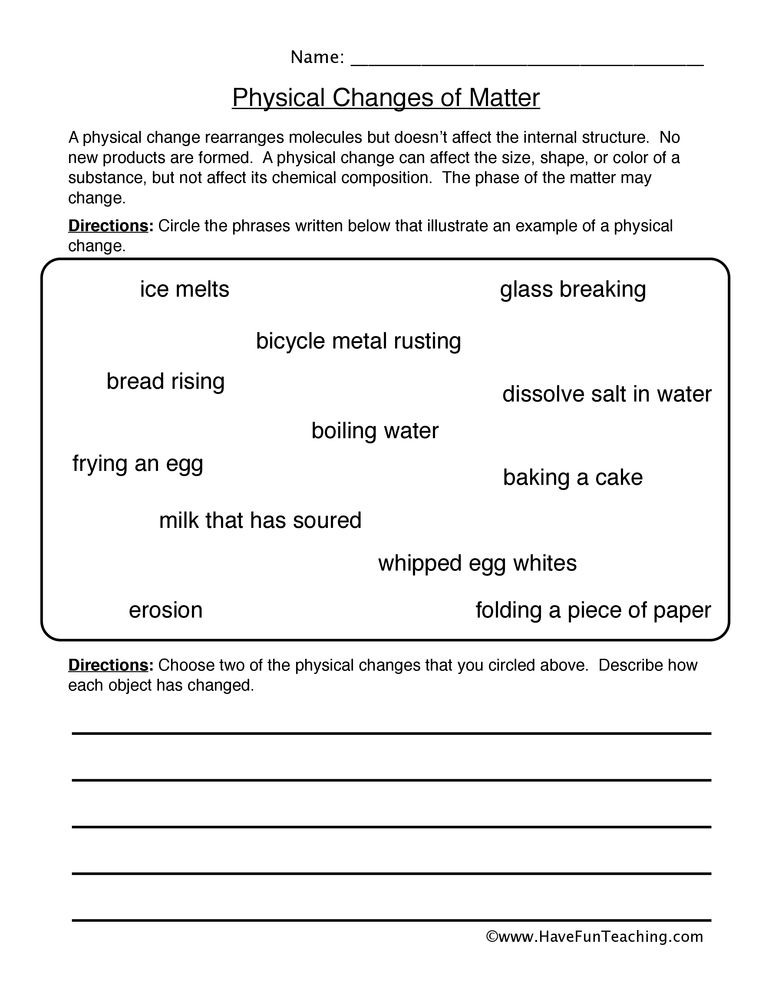
Physical Changes Matter Worksheet
This physical changes matter worksheet asks 5th Grade students to sort eight everyday changes, label three states of matter, and explain their thinking, with an answer key included for fast grading.
$6.97
Or free with a membership — members pay $3.33/mo for all 10,000+ resources. See plans
Want this one free?
Tell us where to send it and it’s yours — no card, no catch.
One free resource per teacher. We’ll also send free teaching ideas each week — unsubscribe anytime.
Teaching is easier with a membership
Unlimited printables, games & videos for PreK–6th — for your classroom or homeschool. Cancel anytime.
Start your 3-day free trial$0 today · cancel anytime · Instant access to 10,000+ resources
About this resource
Description
Matter is always changing, and one of the first big ideas a science student has to sort out is whether a change made something new or only made the same stuff look different. This physical changes matter worksheet gives fifth graders eight everyday changes to judge, three pictures of matter to name, and two questions to answer in their own words. Boiling water, folding paper, and dissolving sugar all look dramatic, but the substance is unchanged, while a rusting nail, a burning log, and souring milk have quietly become something else. Learning to tell those two apart is the heart of the fifth grade matter standard.
The printable is two pages. Page one holds all three activities and page two is the answer key. Students start by circling P or C beside eight short statements, then look at a glass of water, a steaming kettle, and an ice cube and write solid, liquid, or gas on the line under each picture. They finish by explaining, in complete sentences, how a physical change differs from a chemical change and why boiling water is only a physical change. Use this 5th grade matter worksheet as a lesson warm-up, a science center, homework, a review before a unit test, or a quick check of who is ready to move on.
What’s Included
- Eight everyday changes to classify as physical or chemical, with fill-in-the-bubble P and C choices
- Three illustrated states of matter to label as solid, liquid, or gas on a writing line
- Two short-response questions with ruled lines for a written explanation
- A full answer key on the second page, including sample written responses
- A clean, printer-friendly two-page PDF in black, white, and one accent color
Three Reasons This Helps Kids
- Everyday examples make an abstract idea concrete, so students reason from things they have actually watched happen in a kitchen or a backyard.
- The three parts move from recognizing to labeling to explaining, which is exactly the ladder a state science assessment climbs.
- Writing the answer in a full sentence forces students to name their evidence instead of guessing, and that habit carries into every science unit that follows.
Ideas for Teachers and Parents
Before handing out the page, melt an ice cube and burn a match at the front of the room and ask students which one could be undone. Have partners trade papers and defend one answer each. For an extension, ask students to walk through the kitchen at home and bring back two physical changes and one chemical change they saw. Struggling students can keep a two-column chart of physical and chemical clues taped inside their science notebook while they work. Print the physical changes matter worksheet double-sided so the answer key travels with it.
Related Resources
What teachers say
Reviews
You must be logged in to post a review.

This Classifying Matter Worksheet helps 5th graders sort substances into elements, compounds, and mixtures using a handy reference chart. Includes an answer key — perfect for no-prep physical science practice at home or in class.

The Matter Song teaches all about matter and the states of matter. With this states of matter song, students learn about solid, liquid, and gas, as well as the phases of matter, properties of matter, physical changes, chemical changes, and so much more. Matter has mass and takes up space.…

This Physical Changes Examples Worksheet gives 5th Grade students six sorting items and two written-response questions on physical and chemical change, answer key included, so classifying matter becomes second nature.
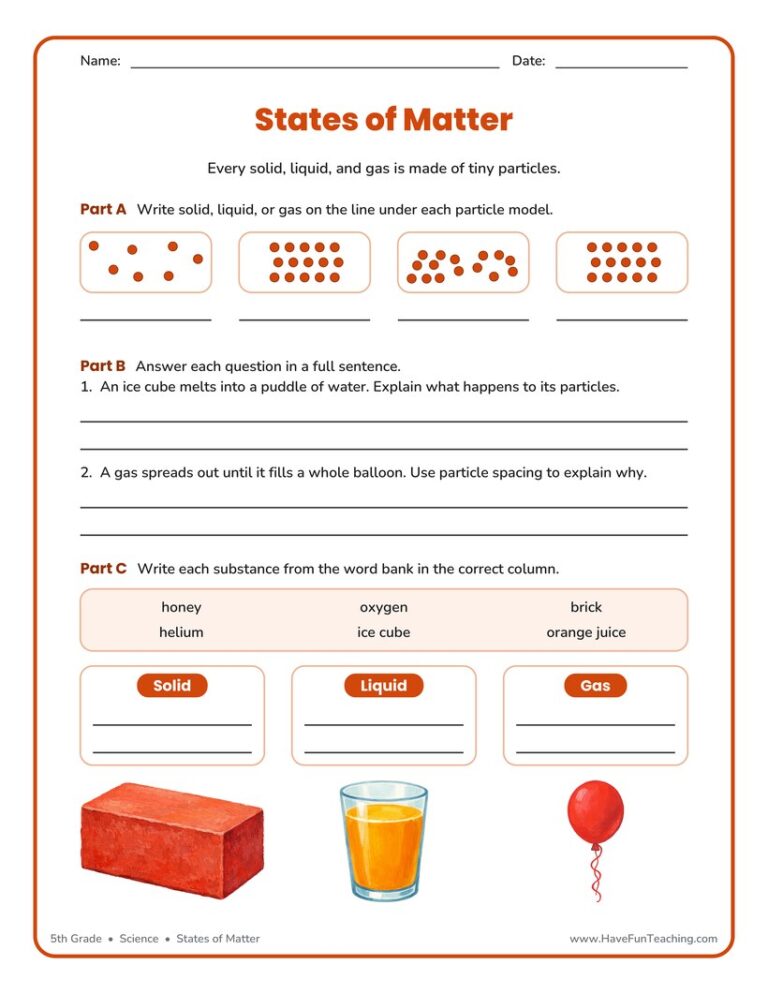
This Identifying States of Matter Worksheet has 5th graders read particle models, explain melting and gas expansion, and sort six everyday substances into solids, liquids, and gases. An answer key is included for fast, confident grading.
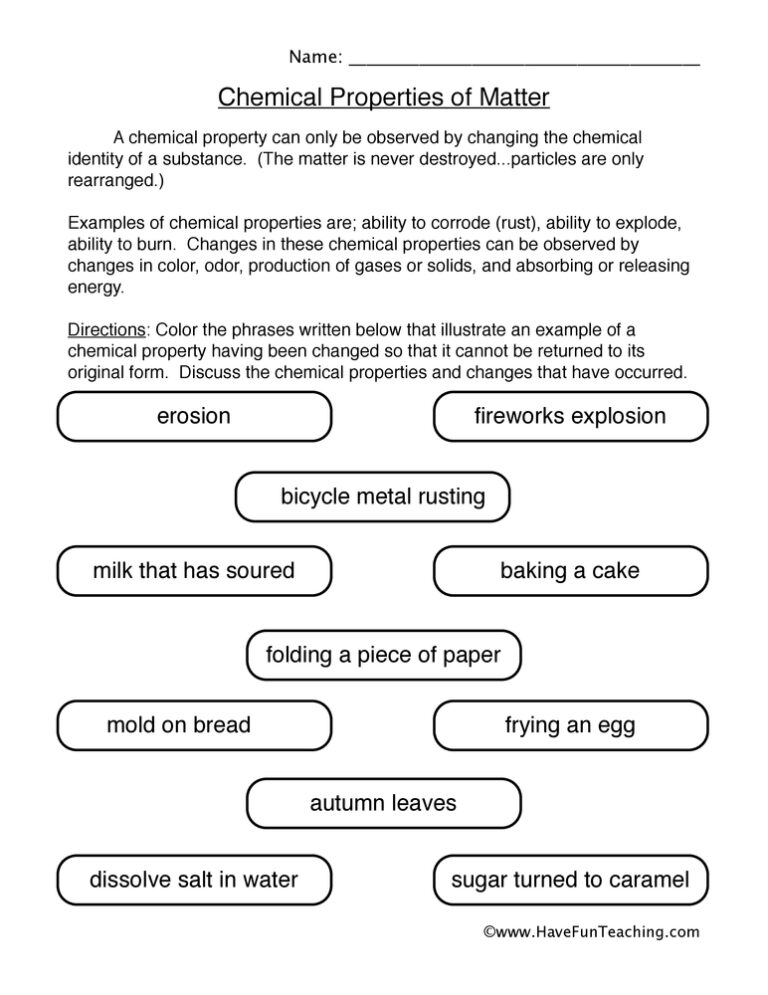
This chemical properties matter worksheet has 5th grade students sort eight everyday events into chemical and physical changes, then explain their reasoning with evidence. An answer key is included for fast, no-prep science practice.

This Chemical Changes Examples Worksheet gives 5th graders vocabulary practice, picture sorting, and a written explanation task for telling physical changes from chemical ones. An answer key is included, so checking work takes seconds.
While listening to the Matter Song (MP3), students learn about the states of matter, phases of matter, properties of matter, physical changes, chemical changes, solid, liquid, and gas and more.
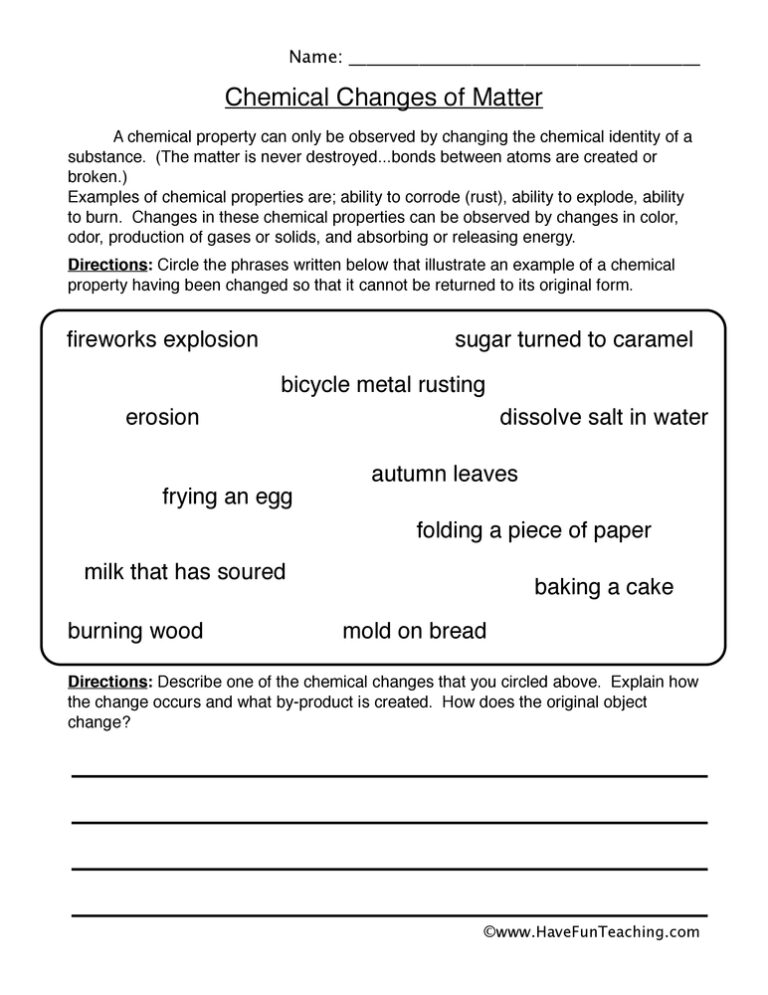
This chemical changes matter worksheet has 5th grade students name the signs of a chemical change and explain their thinking with evidence. An answer key is included for quick, easy checking.

Use this matter worksheet to help 5th grade students decide what is and is not matter and explain mass, volume, and particles in writing. A full answer key is included.
Using this Matter Word Wall, students use these common States of Matter terms in your science word wall to build their vocabulary.

Using Physical Changes Observation Worksheet, studentsobserve a physical change, then draw and write to record the changes you saw.

UsingLet's Make Some Noise Worksheet, studentswork with a partner todecipher what the items are by the sounds being made.

Reviews
There are no reviews yet