Read a second grader “The dog rolled in the mud, so he needed a bath” and ask what happened. Half the class will say the mud, half will say the bath, and they’re both a little right. That’s the tricky part of cause and effect: “what happened?” fits both events. A good cause and effect lesson gives kids a clearer question to ask.
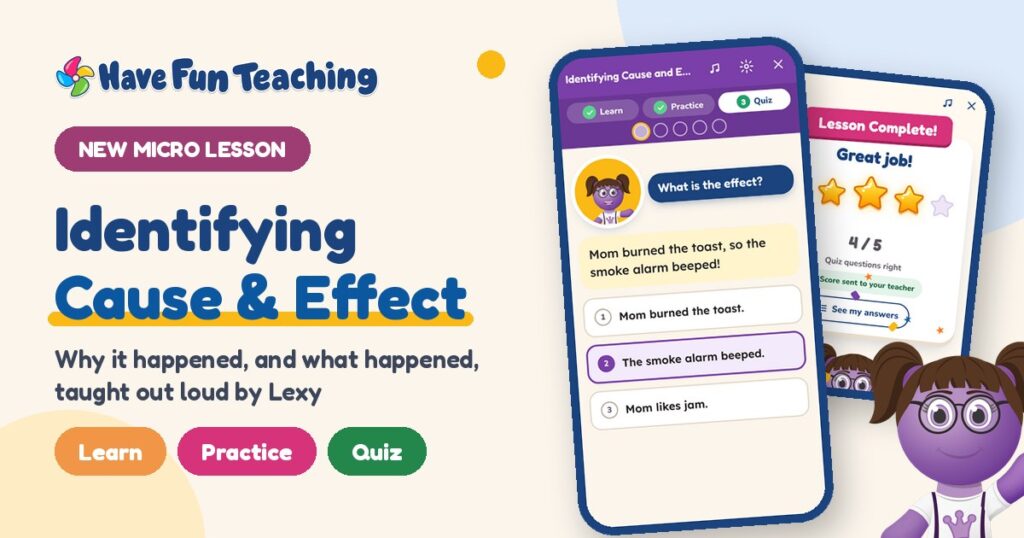
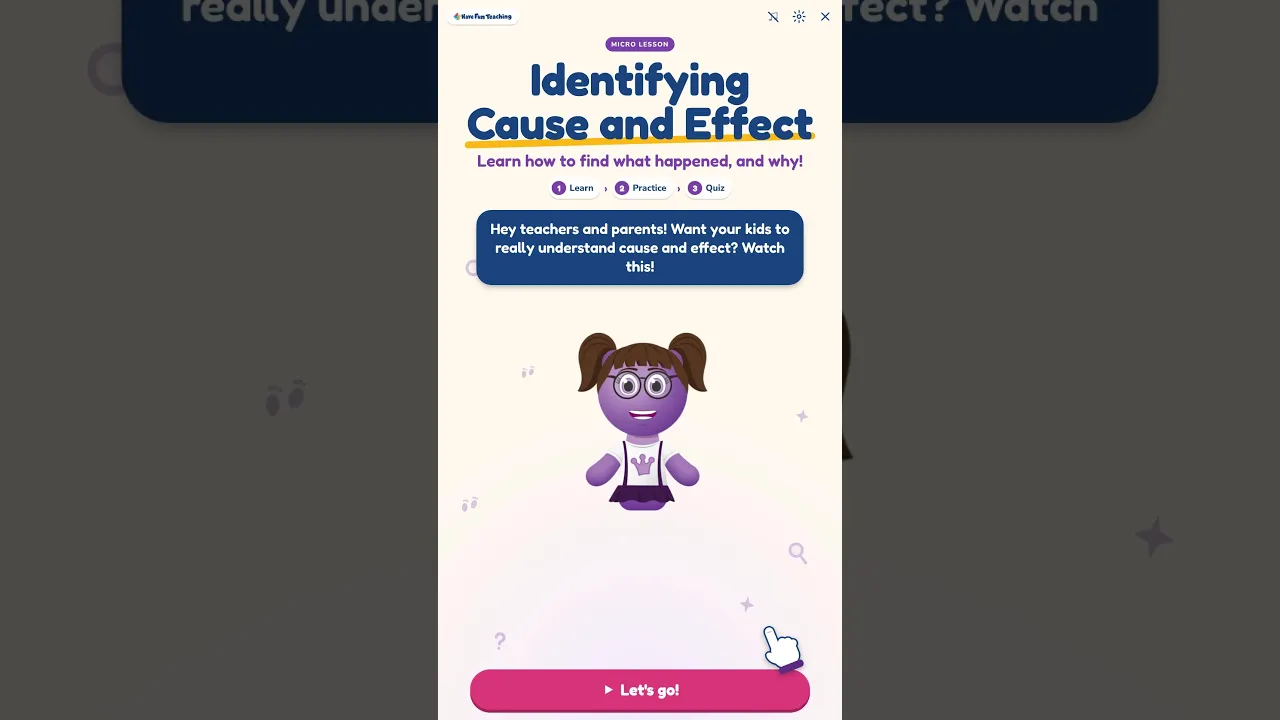
That’s exactly what our new Identifying Cause and Effect Micro Lesson does. Lexy, one of our Funzy friends, teaches that the cause happens first and the effect happens next, and she reads every word out loud so even early readers can follow along.
Below you’ll find what a Micro Lesson is, what’s inside this one, a quick video tour, and simple ways to use it in class or at home.
- One skill, start to finish: the cause is why it happened, and the effect is what happened.
- Three short parts: Learn (with silly stories), Practice (with hints that explain why), and a 5-question Quiz with stars at the end.
- Lexy reads directions, stories and answer choices aloud.
- Works on phones, tablets, Chromebooks, computers and interactive whiteboards.
- Included with a Have Fun Teaching membership. Assign it in HFT Classroom and quiz scores come right back to you.
What is a Micro Lesson?
A Micro Lesson is a short, complete lesson on one skill. It doesn’t just quiz kids on something they haven’t been taught. It teaches first, lets them try with support, and then checks what stuck. Every part is narrated, so a child can work through it on their own while you pull a small group.
Learn
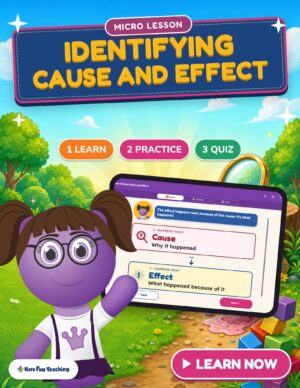
Lexy explains the skill step by step, with a Cause box first, an arrow, and an Effect box next.
Practice
Kids answer a few questions. A wrong answer gets a friendly hint that explains why, then another try.
Quiz
Five questions in mixed styles, then a stars screen that celebrates the score.
HFT Classroom
Assign it to your class and every quiz score is sent back to you automatically.
Inside this cause and effect lesson
The lesson starts with one big idea: cause comes first, effect comes next. Lexy puts the Cause box on top, draws an arrow, and puts the Effect box underneath, so kids can see the order. Then she works a silly example out loud: “My dog rolled in the mud. That’s the cause. He needed a bath. That’s the effect.”
Next come the clue words. The effect comes right after so, and the cause comes right after because. Kids also learn the because check: “He needed a bath because he rolled in the mud” makes sense, but “He rolled in the mud because he needed a bath” is just silly. That one giggle does a lot of teaching.
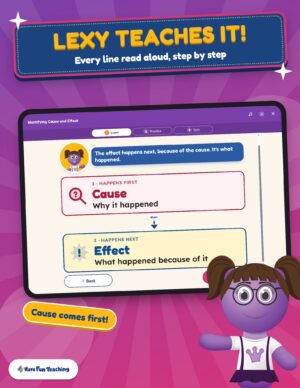 Part 1 · LearnLearn with LexyCause first, effect next, with clue words so and because.
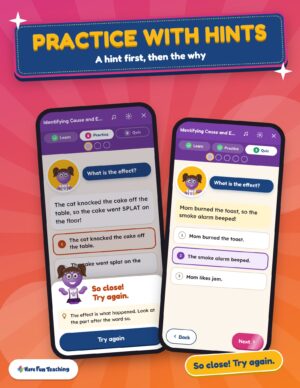 Part 2 · PracticePractice with hintsEvery wrong answer gets a hint that explains why.
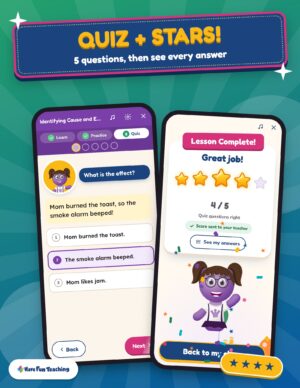 Part 3 · Quiz5-question QuizTap, match, fill in the blank, then earn up to five stars.
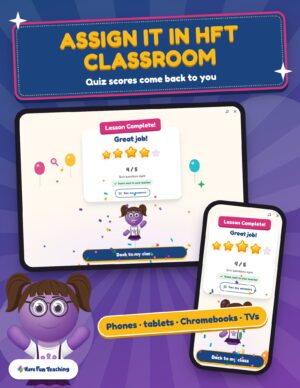 For teachersScores in HFT ClassroomSee each student’s quiz score and their answers in words.
Practice keeps the support on. A cat knocks a cake off the table, so the cake goes SPLAT on the floor. What’s the effect? If a child picks the cat, Lexy doesn’t just say “try again.” She gives a hint, like “Look at the part after the word so,” and then explains the answer.
The quiz mixes five question styles so kids show what they know, not just what they can guess: picking the cause or the effect, matching causes to their effects, filling in a blank with the word that makes sense, and tapping the part of a sentence that is the cause. Every story is silly on purpose, from burned toast to a whoopee cushion. Then the stars come out.
See it in action (video)
This short tour shows each part of the lesson, from Lexy’s first example to the stars screen. If your class loves to sing, the second video is our Cause and Effect Song, a catchy way to remember which part is which.
How do you teach cause and effect to 2nd graders?
Kids already know cause and effect from real life. They know the toast burns and then the smoke alarm beeps. The hard part is finding it in a sentence. In second grade, the standards ask kids to describe how events and ideas in a text connect (Common Core RI.2.3). Here’s a simple order that works, with or without the Micro Lesson.
Start with real life
Knock over a cup of pencils. Ask “What happened?” and “Why did it happen?” Kids get it right away.
Teach first and next
The cause happens first and the effect happens next. Draw an arrow between them on the board.
Hunt for clue words
Start with so sentences, where the events come in order. Then add because, where the effect is said first.
Use the because check
Put because between the two parts. If the sentence sounds silly, the cause and effect are flipped.
Watch for tricky details
“The puppy was brown” is true, but it didn’t make anything happen. Ask, “Did this make it happen?”
Check it, then practice it
A short quiz shows who has it. Follow up with a worksheet or a game so the skill sticks.

Ways to use it in class and at home
Small-group rotation
One station runs the Micro Lesson on tablets while you work with a reading group at the table.
Whole-class mini-lesson
Put the Learn pages on the board, and let kids shout “cause!” or “effect!” before Lexy does.
Homework or homeschool
Every word is read aloud, so kids can do it at the kitchen table without a grown-up reading to them.
Quick check
Assign it in HFT Classroom before a reading test and see who still mixes up the two.
Members: assign it in HFT Classroom
With a Have Fun Teaching membership, Micro Lessons are included. Assign this cause and effect lesson to your class, and students join with a class link and a picture, with no student emails. When they finish the quiz, you see each score and their answers in words. See how HFT Classroom works.
Practice cause and effect with worksheets, an activity and a game
The Micro Lesson teaches the skill. These give kids more practice with the same idea, on paper and on a screen.
 2nd · WorksheetIdentifying Cause and Effect WorksheetFind the cause and the effect in short sentences.
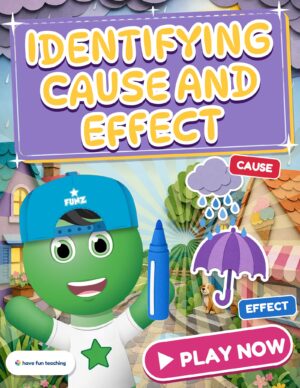 2nd · GameIdentifying Cause and Effect GamePlay on any device and match causes to effects.
 2nd · WorksheetWhat Happened? Cause and Effect WorksheetMatch four causes to their effects, then write two.
 1st–3rd · ActivityCause and Effect Sequencing ActivityPut events in order and explain why each one happened.
You’ll find even more practice, including graphic organizers for older readers, on the cause and effect resources page.
More Micro Lessons
We’re building a whole library of Micro Lessons, one skill at a time, each with its own Funzy teacher. Math teachers, this one is for you.
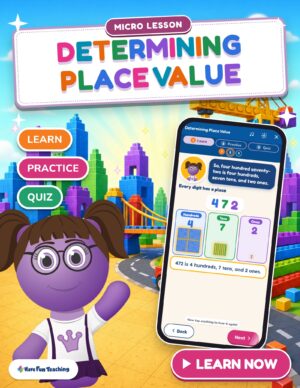 Math · Micro LessonDetermining Place ValueHundreds, tens and ones, with blocks kids can count.
- All grades · Micro LessonsAll Micro LessonsSee every Micro Lesson in one place.
Keep exploring
Get it included with a membership
Every Micro Lesson, plus 6,500+ resources
Members get every Micro Lesson, game, printable, song and video. Try it free for 3 days.
- The Identifying Cause and Effect Micro Lesson, included
- Every printable, song and video, Preschool–6th
- Assign Micro Lessons and games in HFT Classroom
- Unlimited downloads, new resources added every week
Cause and effect lesson: questions teachers ask
What grade is the Identifying Cause and Effect Micro Lesson for?
It is made for 1st, 2nd and 3rd grade, and it fits second grade best, when kids start explaining how events in a story connect. First graders who already know because and so can do it with a little help, and third graders get a quick, friendly review before longer reading passages.
How long does a Micro Lesson take?
Most kids finish in one sitting of about five to ten minutes. There are three short Learn pages, a few Practice questions and a 5-question Quiz. Lexy reads everything aloud and gives a hint right after a wrong answer, so kids keep moving instead of getting stuck.
What clue words help kids find cause and effect?
The two big ones for young readers are so and because. The effect comes right after so, and the cause comes right after because. The Micro Lesson teaches both, plus the because check: if the sentence still makes sense with because in the middle, you found the right cause.
Is the Micro Lesson included in a Have Fun Teaching membership?
Yes. Micro Lessons are included with every Have Fun Teaching membership, along with games, printables, songs and videos. Members can start the lesson right away and assign it in HFT Classroom. Anyone can open the free preview first, and memberships start with 3 free days.
How does HFT Classroom show me my students’ scores?
Assign the Micro Lesson to your class in HFT Classroom. Students join with a class link and a picture, with no student emails. When a student finishes the quiz, the score comes back to you, and you can see each answer in words, so you know who mixes up the cause and the effect.
Let Lexy teach cause and effect tomorrow.
Open the free preview tonight, or start the full lesson with your membership.