

Adding Thousands Thousandths Worksheet
This Adding Thousands Thousandths Worksheet gives 5th graders six column problems, two measurement word problems, and an error to analyze. Answer key included, so decimal alignment practice is ready to hand out.
$6.97
Or free with a membership — members pay $3.33/mo for all 10,000+ resources. See plans
Want this one free?
Tell us where to send it and it’s yours — no card, no catch.
One free resource per teacher. We’ll also send free teaching ideas each week — unsubscribe anytime.
Teaching is easier with a membership
Unlimited printables, games & videos for PreK–6th — for your classroom or homeschool. Cancel anytime.
Start your 3-day free trial$0 today · cancel anytime · Instant access to 10,000+ resources
About this resource
Description
Place value does not stop at the decimal point. By 5th grade students are expected to add numbers that run all the way from the thousands place down to the thousandths place, and the only way to keep every digit in its correct column is to line up the decimal points before adding. This Adding Thousands Thousandths Worksheet gives students six column problems, two real-world questions, and one error to analyze, so they practice the procedure and the reasoning behind it at the same time.
Adding decimals to the thousandths place is where careless alignment shows up fastest, because a number like 720.35 and a number like 912.9 do not have the same number of digits after the point. This printable worksheet asks students to write each sum below the equation bar, solve two measurement word problems set in kilometers and grams, and then study a worked example that is wrong and explain what went astray. Use it as an independent practice page, a math-center task, an exit ticket, or homework, and check every answer against the included key.
What’s Included
- 1 print-ready PDF worksheet
- Answer key
- 3 sections: 6 column-addition problems, 2 measurement word problems, and 1 error-analysis question
There are three reasons this Adding Thousands Thousandths Worksheet helps children learn the skill. First, the six column problems deliberately mix one-, two-, and three-place decimals, so students cannot succeed by right-aligning the digits out of habit; they have to think about place value on every item. Second, the word problems attach the numbers to real measurements, which is where decimals actually live for a fifth grader, so the arithmetic carries meaning instead of floating free. Third, the error-analysis question flips the task: instead of producing an answer, students have to evaluate one, name the mistake in words, and correct it. That is the reasoning the standards ask for and the part a plain drill page never reaches.
There is plenty more you can do with this skill. Have students estimate each sum before they add, then compare the estimate with the exact answer to see whether it is reasonable. Bring in grocery receipts, race times, or a bathroom scale and let children add the real numbers they find. Use graph paper so every digit gets its own square, which makes alignment automatic. Ask students to write their own tricky problem for a partner, and to write the wrong answer a careless mathematician would get.
Related Resources
What teachers say
Reviews
You must be logged in to post a review.
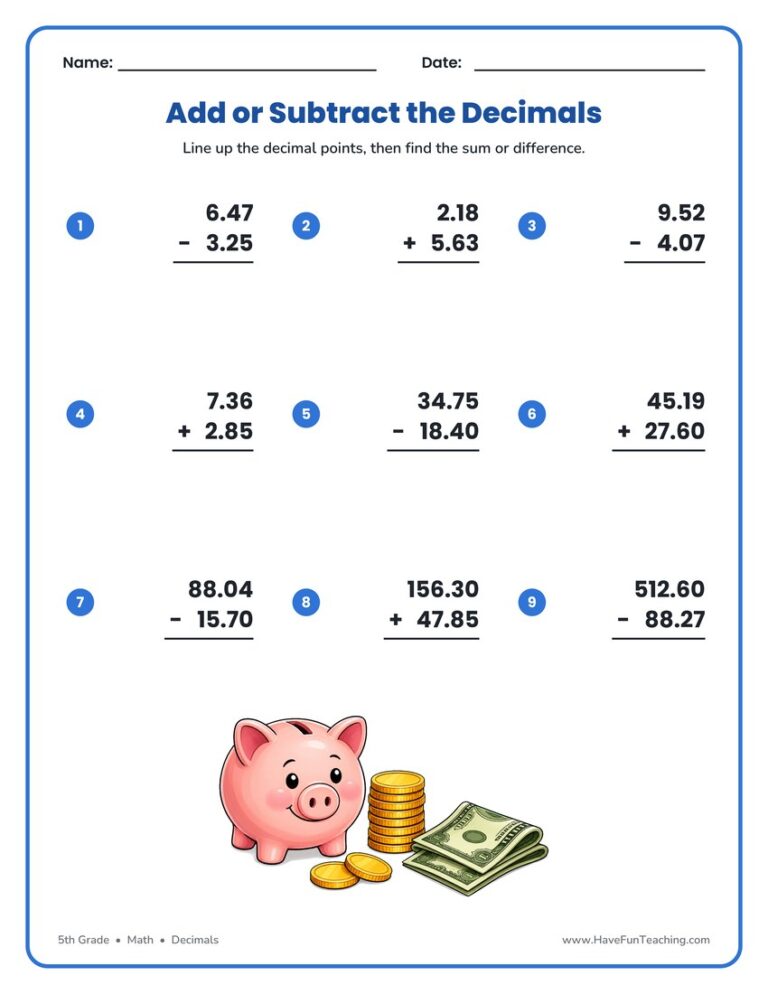
Fifth graders practice adding and subtracting decimals on this add/subtract decimals worksheet with nine aligned column problems. Includes a complete answer key for quick, no-prep math practice.

This adding millions no regrouping worksheet gives 5th graders six column-addition problems reaching into the millions plus two real-world word problems. An answer key is included, so place-value practice is ready to print.
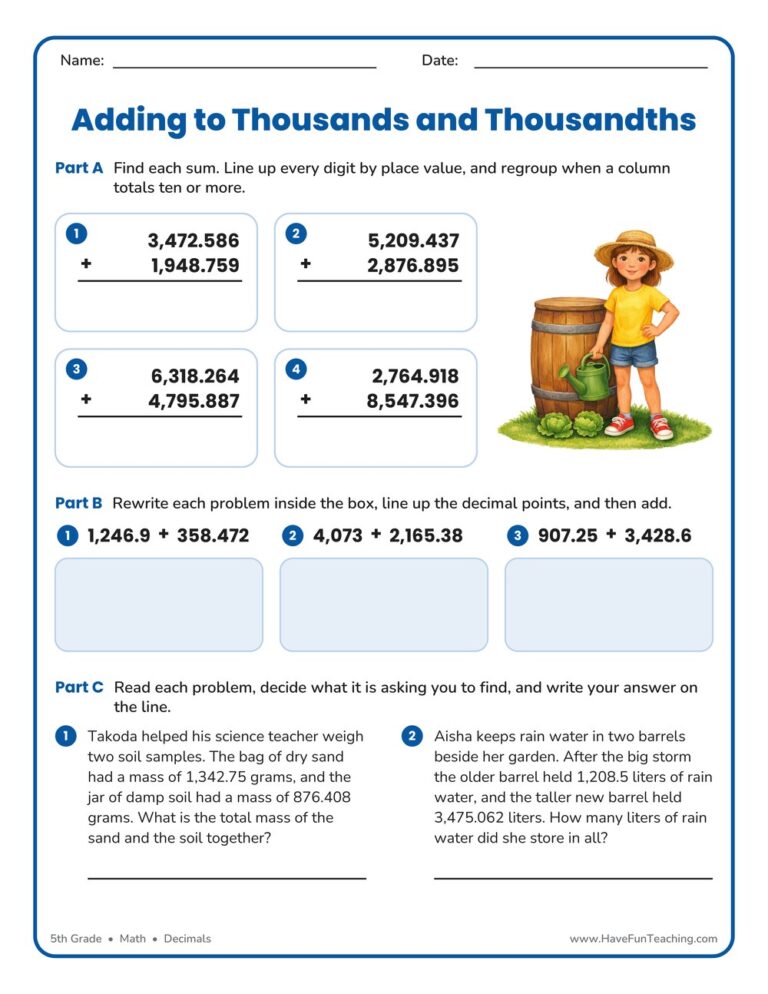
An add thousands thousandths worksheet for 5th grade, with stacked column problems, rewrite-and-align practice, and two measurement word problems. Answer key included, so decimal place value practice is ready to print.
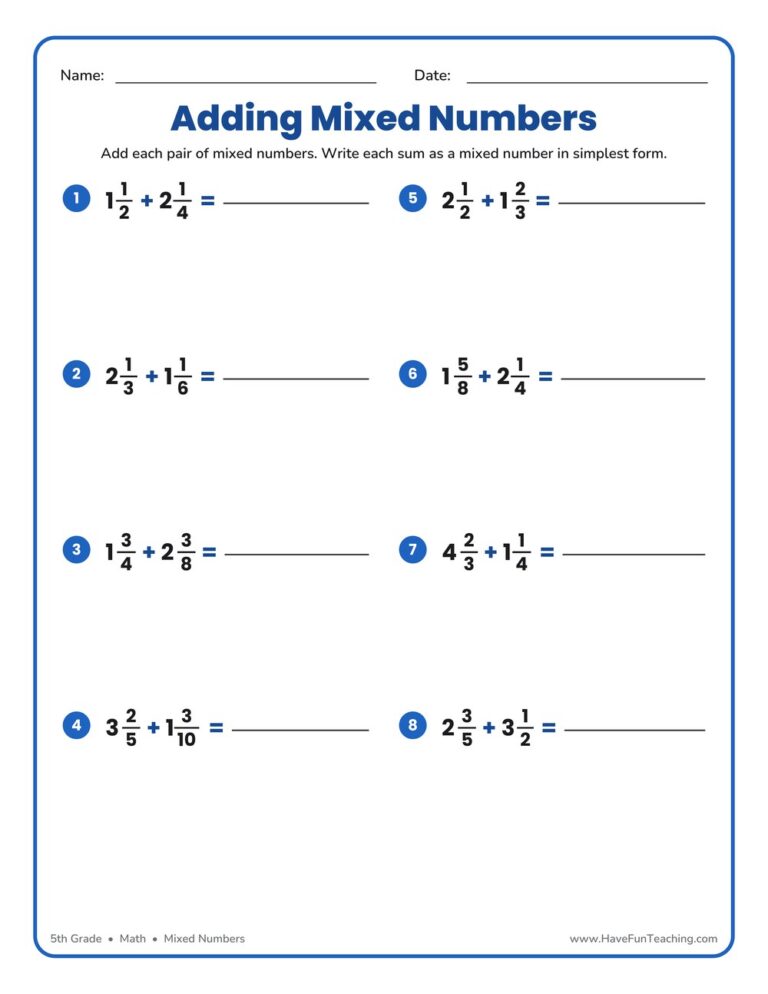
This Add Mixed Numbers Worksheet gives 5th graders eight problems adding mixed numbers with unlike denominators and simplifying each sum. A complete answer key is included — perfect for no-prep fraction practice at home or school.

This adding fractions pictures worksheet helps 5th graders add fractions with unlike denominators by reading fraction-circle models and finding a common denominator. Includes an answer key for quick, no-prep practice.
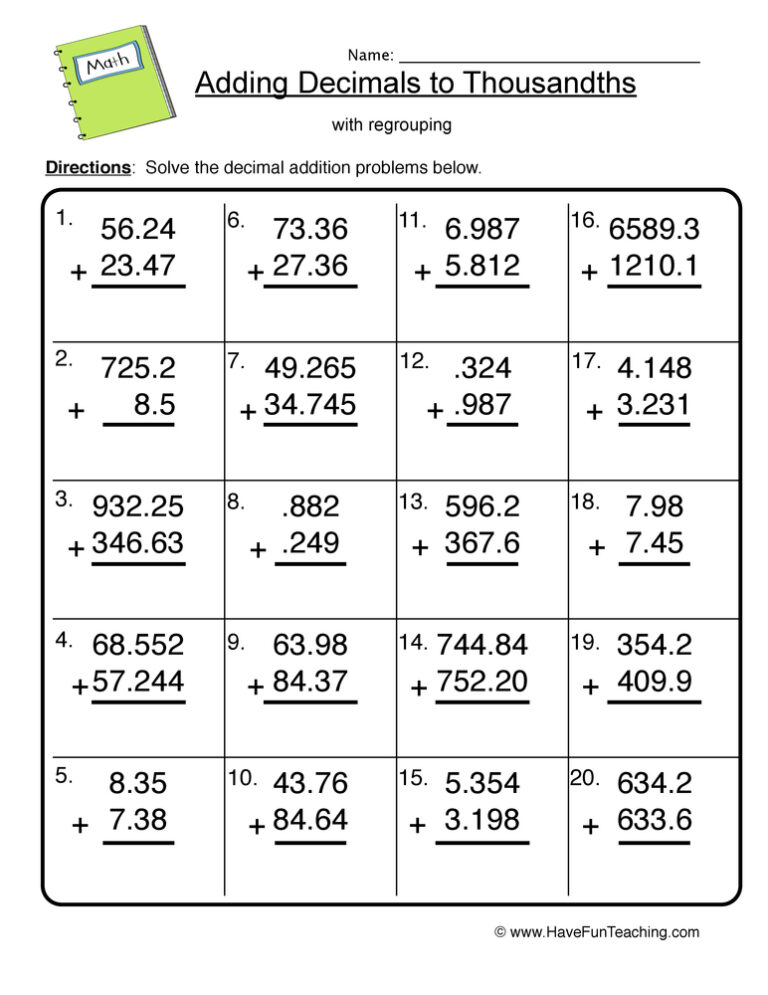
This Add Thousandths Decimal Worksheet gives 5th graders six stacked decimal sums plus three word problems, with an answer key included, so place value practice takes no prep at all.

An adding decimals equations worksheet for 5th grade, with six column-form sums, three problems to rewrite in column form, and a hiking word problem. Answer key included, so students can check their own decimal alignment.
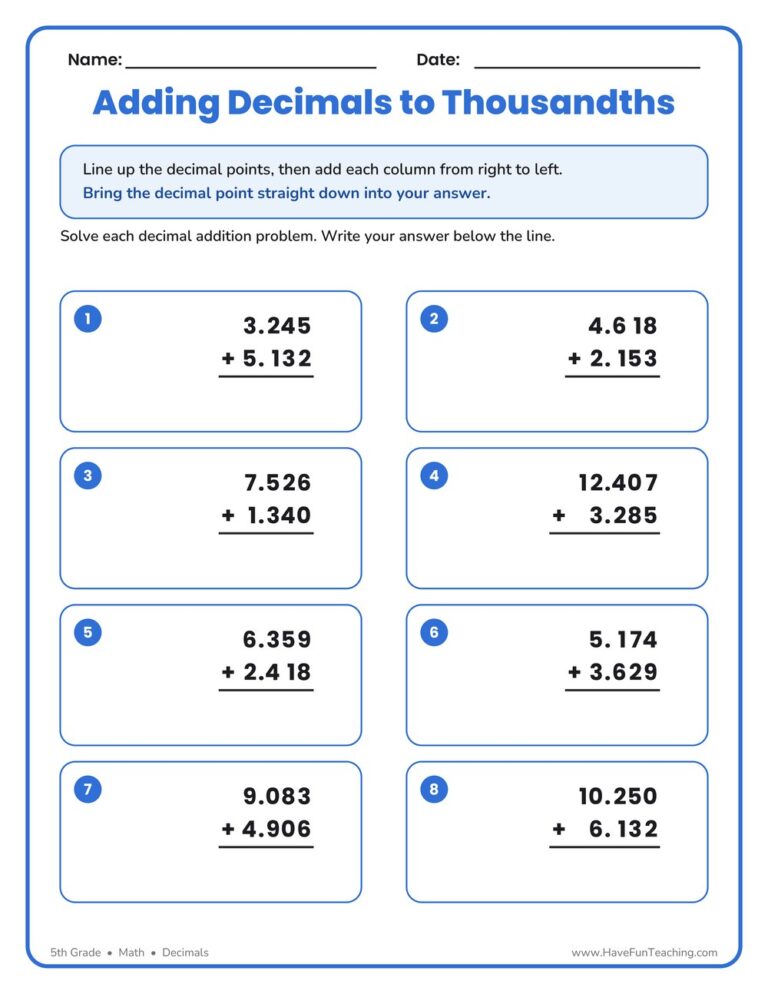
This adding thousandths decimal worksheet gives 5th graders eight column-addition problems to solve by lining up the decimal points. Includes a complete answer key for fast, no-prep decimal practice.
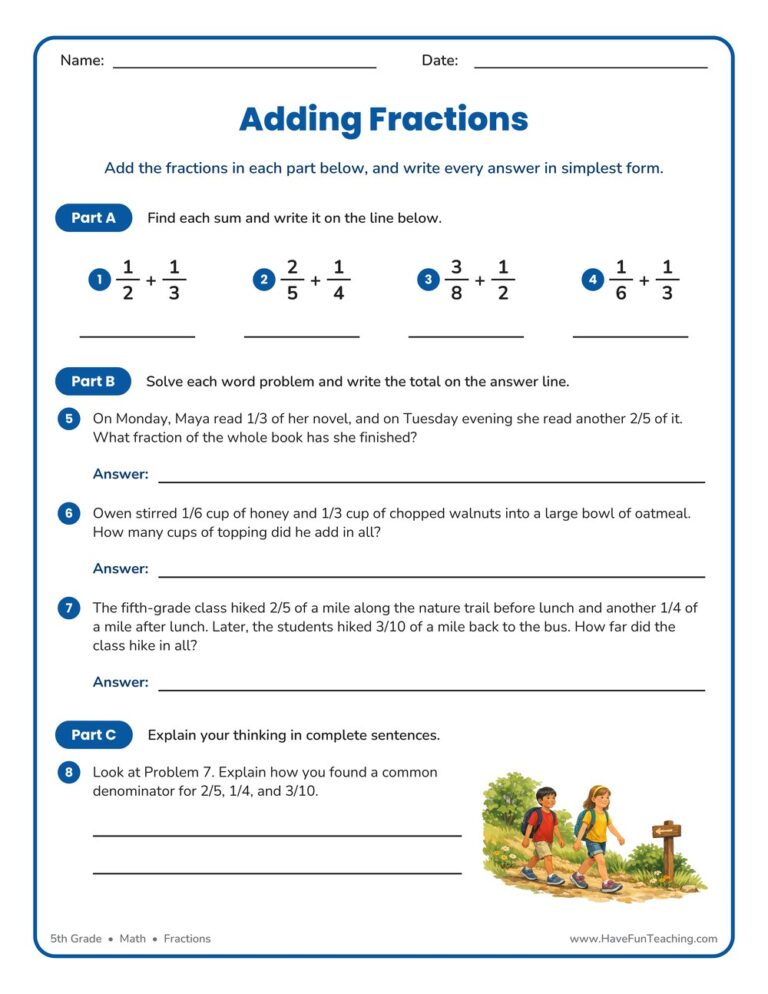
This adding fractions word problems worksheet gives 5th Grade students three real-world problems plus warm-up sums with unlike denominators, all in simplest form. An answer key is included, so practice checks itself.

This Adding Decimals Word Problems Worksheet gives 5th Grade students five real-world problems plus a training log to solve by lining up the decimal points. An answer key is included, so checking work takes seconds.

This Adding Mixed Numbers Worksheet gives 5th grade students ten problems adding mixed numbers with unlike denominators and simplifying each sum. Answer key included — perfect for fraction practice at home or school.

This adding fractions equations worksheet gives 5th Grade students six unlike-denominator sums, two word problems and a written response. An answer key is included, so every step can be checked quickly.




Reviews
There are no reviews yet