

Constructing 2-D and 3-D Shapes Worksheet
This constructing 2-D and 3-D shapes worksheet has 3rd graders count sticks, balls, and faces on four solid models, then solve building problems. An answer key is included for fast checking.
$6.97
Want this one free?
Tell us where to send it and it’s yours — no card, no catch.
One free resource per teacher. We’ll also send free teaching ideas each week — unsubscribe anytime.
Free teacher account · no credit card
Membership
Get every game, song, & printable
- Every game, on any device
- 6,500+ resources
- Assign online with HFT Classroom
Then $39.97/year · cancel anytime · See plans
- Instant digital download
- Printable PDF + answer key
- Made by real teachers
Teacher / Family membership
Teaching is easier with every resource
One membership for your whole year: 6,500+ worksheets, games, songs and videos for Preschool–6th, for your classroom or homeschool.
- Unlimited printables & downloads
- Every game, on any device
- Assign online with HFT Classroom
- Cancel anytime
Teacher / Family membership · 3 days free
Yearly
Monthly would be $119.64 a year
$3.33/month
Billed $39.97 once a year
You save $79.67 every year
Start My 3 Free Days$0 today · cancel anytime
Monthly
$9.97/month
Flexible, month to month
Yearly is just $3.33/mo. Switch and save $79.67
Start My 3 Free Days$0 today · cancel anytime
About this resource
Description
How to Teach Constructing Shapes
This Constructing 2-D and 3-D Shapes Worksheet helps third graders see how a solid shape is put together. When students build a shape out of sticks and clay balls, every stick becomes an edge and every ball becomes a vertex, or corner. The flat 2-D shapes that close in the sides of a solid are its faces. Counting edges, vertices, and faces lets children describe a solid by its parts and reason about which shapes can be built from a given set of materials.
About This Worksheet
On this constructing 2-d and 3-d shapes worksheet, students study four stick-and-ball models: a triangular prism, a rectangular prism, a square pyramid, and a triangular pyramid. For each solid they count the sticks, the balls, and the flat faces and write each number in a box. Then they use those counts to solve three short problems: finding which solid was built from 12 sticks and 8 clay balls, working out how many sticks and balls three separate squares need, and figuring out how many more sticks are needed to finish a square pyramid. Every model is drawn as an exact figure, so each part can be counted.
What’s Included
- One worksheet page with four stick-and-ball solid models to count
- Three word problems about building 2-D and 3-D shapes
- A complete answer key with every count and answer
Why This Worksheet Helps Kids
First, it turns geometry vocabulary into numbers students can check, so edges, vertices, and faces stop being words to memorize. Second, it asks students to use their counts to reason and solve problems, which builds the multi-step thinking expected on a 3rd grade geometry worksheet. Third, comparing prisms and pyramids side by side helps students notice patterns, such as how a pyramid always comes to a point at the top.
Ideas for Teachers and Parents
Before the worksheet, give students toothpicks or straws and small balls of clay and let them build a cube and a square pyramid. Ask them to count the parts as they go. After the worksheet, challenge partners to build the triangular prism and check that their sticks, balls, and faces match the numbers they wrote. Students can also invent their own “how many sticks?” problem for a classmate to solve.
Related Resources
What teachers say
Reviews
Write a review, earn store credit
Get 25¢ in credit for every approved review of a resource you’ve downloaded, played or purchased — up to 15 a month. Credit applies automatically to your membership payments, so your reviews can help pay for your membership.
Honest reviews only — any star rating earns the same. Program rules
Log in to write a review and earn store credit.
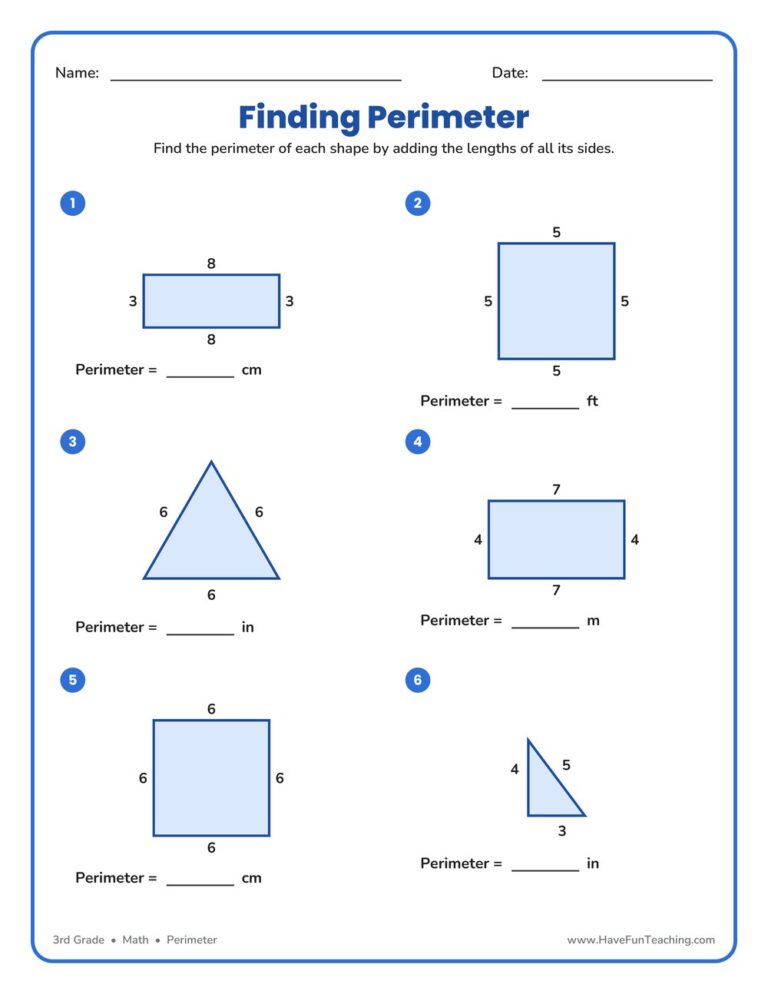
A 3rd grade finding shape perimeter worksheet where students add the side lengths of rectangles, squares, and triangles to find each shape’s perimeter. Includes a complete answer key for quick, no-prep geometry practice.

This 3rd grade Finding the Area of Grid Shapes Worksheet has students count unit squares to find the area of rectangles and L-shapes. Answer key included.
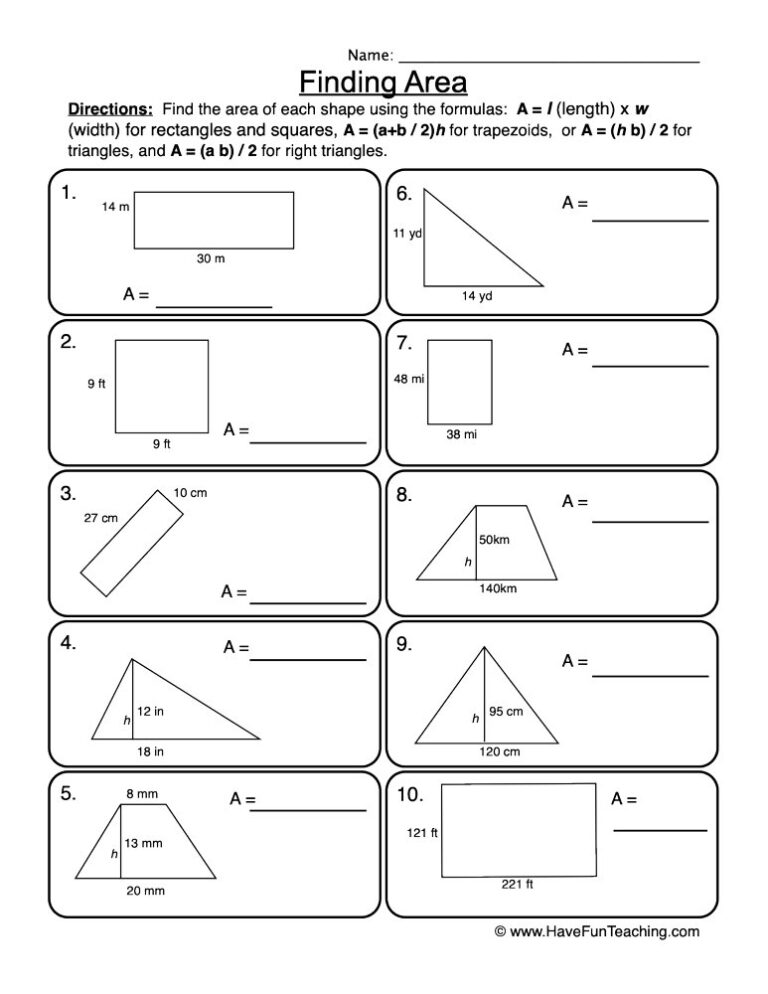
A Finding Different Shapes Area Worksheet where 3rd graders find the area of rectangles, squares, and composite shapes in square units. Answer key included—great for no-prep area practice.

This Finding the Area by Multiplying Worksheet gives 3rd graders six labeled rectangles on a unit grid to practice finding area by multiplying length by width. An answer key is included for easy, no-prep geometry practice.
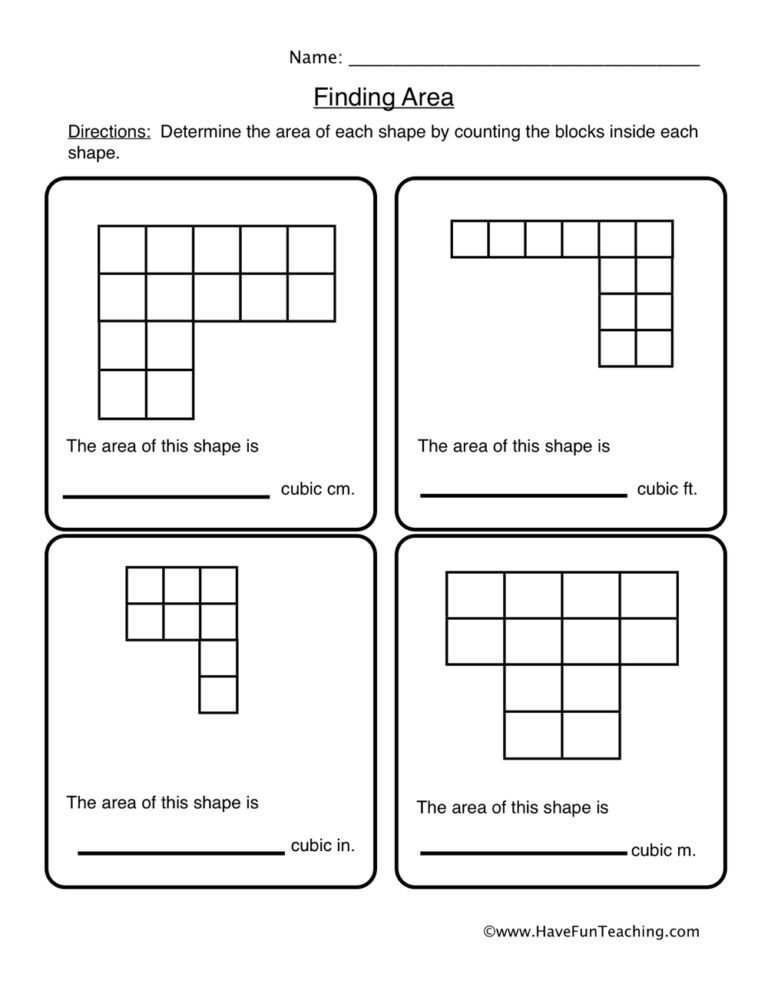
A count-the-squares finding area of irregular shapes worksheet that helps 3rd graders measure area by counting unit squares on six grid figures. Answer key included, perfect for no-prep area practice at home or school.

Using the Shapes Song, students learn all about shapes, including Shape Names and Shape Recognition. The Shapes Song by Have Fun Teaching is a song that teaches the shapes. Shapes have names their made of angles and lines, there are flat shapes and solid shapes we see them all the…
A Florida FAST 3rd grade math practice test workbook for teachers, with a pretest, skill practice for all 34 benchmarks, mixed review and 2 full-length practice tests. Answer key included, so test prep is ready to go.

This Finding the Area in Square Units Worksheet lets 3rd graders count same-size squares inside six shapes to measure area. Includes a complete answer key—great for hands-on, no-prep geometry practice at home or school.

Using the Square Song (MP3), students learn all about squares, including Shape Names and Shape Recognition through a catchy song!

This Area in Square Units Worksheet gives 3rd graders six grid figures to count, two garden word problems, and a write-about-it prompt. An answer key is included, so checking student work takes seconds.
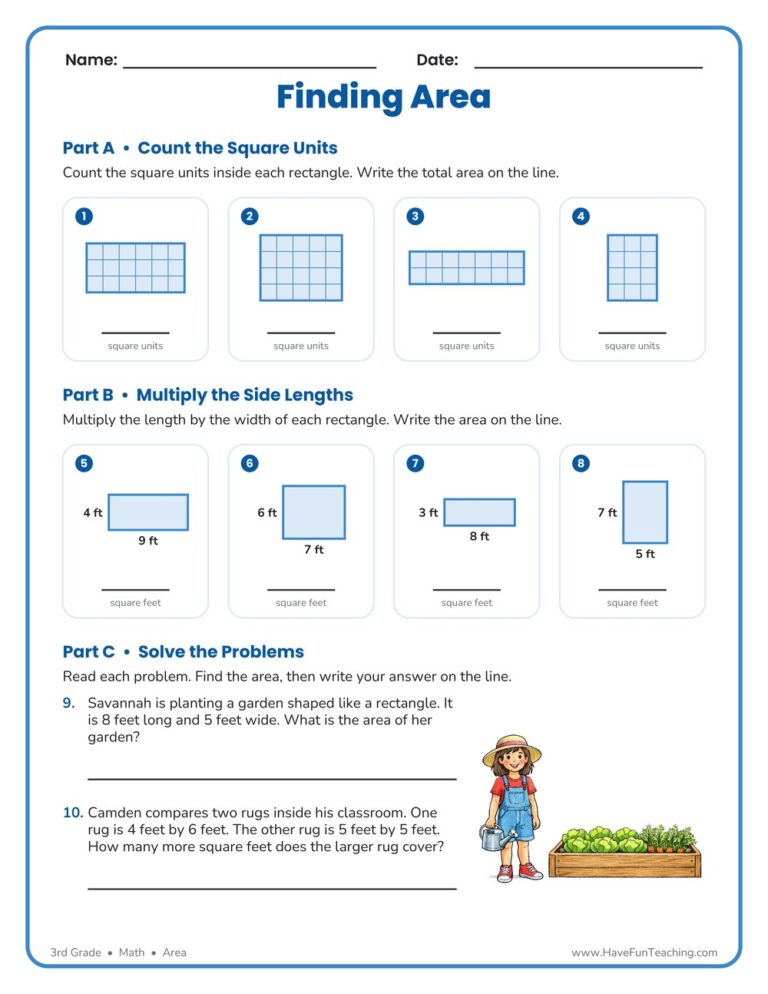
This Rectangles Area Worksheet helps 3rd graders find area by counting unit squares and by multiplying side lengths, then apply the skill to two word problems. An answer key is included, so practice is ready in a single print.

A Solving Perimeter Word Problems Worksheet that gives 3rd graders five real-world problems, including one missing-side challenge with a written explanation. Answer key included for fast, no-prep perimeter practice.




Reviews
There are no reviews yet