
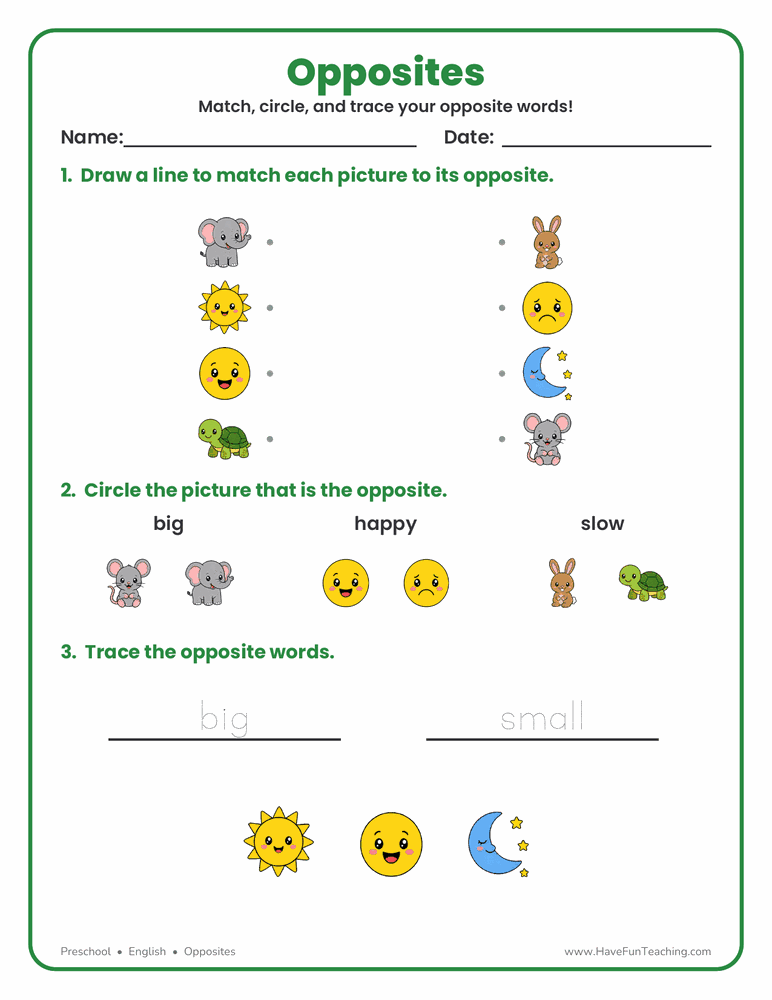
Opposites Worksheet
$6.97
Or free with a membership — members pay $3.33/mo for all 10,000+ resources. See plans
Want this one free?
Tell us where to send it and it’s yours — no card, no catch.
One free resource per teacher. We’ll also send free teaching ideas each week — unsubscribe anytime.
Teaching is easier with a membership
Unlimited printables, games & videos for PreK–6th — for your classroom or homeschool. Cancel anytime.
Start your 3-day free trial$0 today · cancel anytime · Instant access to 10,000+ resources
About this resource
Description
Understanding opposites is one of the first big thinking skills preschoolers build, and this opposites worksheet makes that learning playful and clear. Opposites like big and small, happy and sad, and day and night help young children compare, sort, and describe the world around them. When little learners can name a pair of opposites, they are also growing their vocabulary, their listening skills, and their ability to notice how things are different.
This opposite words worksheet gives preschoolers three gentle, picture-based activities on a single page. First, children draw a line to match each picture to its opposite. Next, they look at a word and circle the picture that shows the opposite. Finally, they trace the opposite words “big” and “small” to connect the idea to early handwriting. The friendly clipart, large directions, and plenty of white space are designed for little hands and short attention spans, so the page feels fun instead of overwhelming.
What’s Included
- 1 print-ready PDF worksheet
- Answer key
- 3 picture-based opposites activities: match, circle, and trace
There are three reasons this opposites worksheet helps children learn so well. First, it uses real, familiar pictures, so kids connect the idea of opposites to things they already know like an elephant and a mouse or a smiling and a frowning face. Second, it moves from matching to choosing to writing, which builds confidence one small step at a time. Third, it pairs each activity with simple words, so children begin to link spoken opposites with their printed forms while practicing careful tracing.
Teachers and parents can stretch the learning in lots of fun ways. Play an “opposite” game while you read a book together, calling out a word and asking your child for its opposite. Act out opposites with your bodies, such as fast and slow or up and down, during clean-up time or outdoor play. Hunt for opposites around the house, like an open door and a closed drawer, and let your child point them out. These quick, hands-on moments make the opposites on this page stick.
Related Resources
What teachers say
Reviews
You must be logged in to post a review.

UsingLeft and Right Simon Says Opposites Activity, studentsplay this fun game to practice identifying left and right.

Using Top and Bottom Toys Edition Opposites Activity Board Game, students practice identifying the positions top, middle, and bottom.
The Sight Word Songs Volume 1 (MP3 Album) will help students recognize 22 sight words as they are repeated, spelled, and used in sentences put to a catchy tune.

Using the Science Songs (MP3 Album), students learn about different science concepts while listening to these upbeat and catchy songs.

The I Song (Animated Music Video) will help students recognize the sight word I when it is repeated, spelled, and used in sentences put to a catchy tune.

The THE Song (Animated Music Video) will help students recognize the sight word THE when it is repeated, spelled, and used in sentences put to a catchy tune.

Using this School Subjects Word Wall, students use these common school terms in your word wall to build their vocabulary.

The Letter C Song will help teach the Letter C Sound, Uppercase and Lowercase Letter C, Vocabulary words with the C sound, Letter C handwriting practice.
The FOR Song (MP3) will help students recognize the sight word FOR when it is repeated, spelled, and used in sentences put to a catchy tune.
The Alphabet Animals Song (Animated Music Video) will help students review the alphabet as well as learn new animals in a new and memorable way.

The ASK Song (Animated Music Video) will help students recognize the sight word ASK in a snap to build reading speed and and fluency while watching this fun video!




Reviews
There are no reviews yet