Skip to content
Start My 3 Free Days $0 today · cancel anytime

5th Grade Temperature Resources (Math)

2 5th grade temperature resources: 2 worksheets. How teachers use these

5th Grade Temperature Resources (Math)

2 5th grade temperature resources: 2 worksheets. How teachers use these

Worksheet
Worksheet5th GradeCelsius to Fahrenheit Worksheet

This Celsius to Fahrenheit worksheet gives 5th Grade students eight conversion problems, a dual scale thermometer to read in both units, and a temperature word problem. An answer key is included.

Worksheet
Worksheet5th GradeThermometer Reading Worksheet

This thermometer reading worksheet has 5th grade students read Celsius and Fahrenheit thermometers and solve multi-step temperature problems. An answer key is included for quick checking.

From our teachers' playbook

Hot math, cold math, just right

What do 5th graders learn about temperature?

Fifth graders read thermometers in both Fahrenheit and Celsius, including scales marked in 2s or 5s, and find the change in temperature between two readings. They work with temperatures below zero and learn benchmark facts: water freezes at 32°F = 0°C and boils at 212°F = 100°C. Many classes also try converting with the formula F = C × 9/5 + 32, which is great multiplication practice. The click moment is seeing the thermometer as a vertical number line.

Our favorite ways to teach temperature

Temperature is number line math in disguise. These moves make that connection plain.

Read the scale first

Before any reading, ask "What does each little line count by?" Kids label a few marks on a thermometer picture before they answer. Most mistakes come from skipping this step, so make it a habit.

Why it works: pairing a picture with each word gives kids two ways to remember it, a well-tested principle of how people learn (Mayer, 2009).

Thermometer Reading WorksheetTry it withThermometer Reading WorksheetWorksheetsOpen it →
Cold cup, warm cup

Set out cups of ice water and warm tap water with thermometers. Groups record the reading every five minutes and find how much each one changed. Real data makes "the temperature rose 12 degrees" mean something.

Why it works: kids understand an idea best when they touch it, then draw it, then write it, the order the U.S. Department of Education recommends for elementary math.

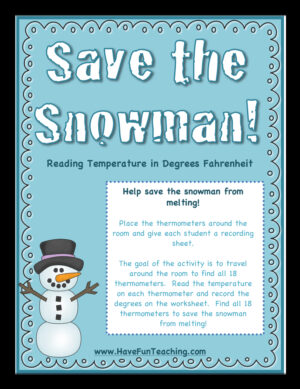
Save the Snowman Temperature ActivityTry it withSave the Snowman Temperature ActivityActivitiesOpen it →

Convert with benchmarks

Model the formula once with 20°C, then have kids check their answers against benchmarks they know. If they get 98°F for a cool day, the 32-and-212 anchors tell them something went wrong.

Why it works: handing over the work step by step, from teacher to student, is one of the most widely used teaching frameworks (Pearson and Gallagher, 1983).

Celsius to Fahrenheit WorksheetTry it withCelsius to Fahrenheit WorksheetWorksheetsOpen it →

What's on this page

Teacher favorites right now: Celsius to Fahrenheit Worksheet and Thermometer Reading Worksheet.

Questions about teaching temperature

What do 5th graders learn about temperature?

They read thermometers in Fahrenheit and Celsius, find the change between two temperatures, and work with readings below zero. Many also practice converting between the two scales.

How do you convert Celsius to Fahrenheit?

Multiply the Celsius temperature by 9/5 and add 32. For example, 25°C × 9/5 = 45, and 45 + 32 = 77°F.

Why do kids struggle to read thermometers?

Usually because the lines don't count by ones. Have kids find what each mark is worth before reading, and practice with scales that count by 2s and 5s.

How can I practice temperature at home?

Check the outdoor temperature each morning and guess how much it will change by afternoon. Comparing the guess to the real reading is quick, daily number sense practice.