
Skip to content
Start My 3 Free Days $0 today · cancel anytime

1st Grade Arrays Resources

1 1st grade arrays resources: 1 activity. How teachers use these

1st Grade Arrays Resources

1 1st grade arrays resources: 1 activity. How teachers use these

Activity
Activity1st GradeSharing Chocolate Rows and Columns Activity

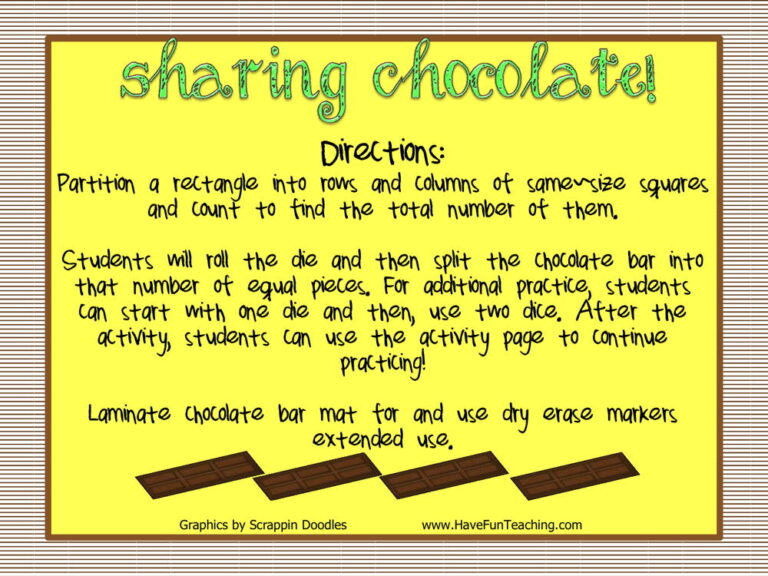
Using this Sharing Chocolate Rows and Columns Activity, students partition a rectangle into rows and columns of same-size squares and count to find the total number of them.

From our teachers' playbook

Rows, columns and a lot of counting

What do 1st graders learn about arrays?

In 1st grade, arrays are an early sneak peek at multiplication. Kids learn that an array is objects lined up in neat rows and columns, like eggs in a carton or seats on a bus. They count the rows, count how many are in each row, and find the total by counting or adding: 3 rows of 4 = 4 + 4 + 4 = 12. Arrays also help with skip counting and with seeing equal groups. Full multiplication comes later, so the goal now is noticing the pattern. The click moment is when kids realize they do not have to count every single one.

Hands-on ways to teach arrays in 1st grade

Six-year-olds learn arrays by building them, finding them and talking about what they see.

Build it in rows

Give kids a handful of counters and say "Make 2 rows of 5." They line them up, then count. Next, turn the paper sideways and ask if the total changed. Building first makes rows and columns real before kids ever draw them.

Why it works: kids understand an idea best when they touch it, then draw it, then write it, the order the U.S. Department of Education recommends for elementary math.

Sharing Chocolate Rows and Columns ActivityTry it withSharing Chocolate Rows and Columns ActivityActivitiesOpen it →

How did you count?

Show an egg carton and ask "How many eggs? How did you figure it out?" Some kids count by ones, some by twos, some add rows. Sharing strategies helps everyone see a faster way.

Why it works: when kids say the precise math words, their understanding gets sharper, a recommendation of the U.S. Department of Education's elementary math guide.

Array hunt

Walk the classroom or hallway looking for arrays: window panes, tiles, crayon boxes. Kids draw what they find as dots in rows. Spotting arrays in real life helps the idea stick.

Why it works: pairing a picture with each word gives kids two ways to remember it, a well-tested principle of how people learn (Mayer, 2009).

What's on this page

Teacher favorites right now: Sharing Chocolate Rows and Columns Activity.

Questions about teaching arrays in 1st grade

Do 1st graders learn arrays?

Many 1st grade classes introduce arrays as a way to see equal groups and practice counting and adding. Arrays become a bigger focus in 2nd grade, when they connect to repeated addition and early multiplication.

What is an array in simple words?

An array is a set of objects arranged in equal rows and columns. An egg carton with 2 rows of 6 eggs is a great example. Kids can count rows and columns to find the total.

How do arrays help with math later?

Arrays are the picture behind multiplication. Counting rows of the same size builds skip counting and repeated addition, which make multiplication easier in later grades.

How can I practice arrays at home?

Look for arrays in muffin tins, egg cartons and window panes. Ask your child how many rows, how many in each row and how many in all. Snack arrays are always a hit.


