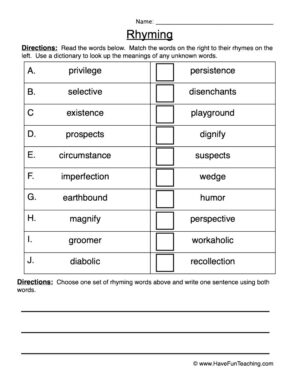
This matching rhyming words worksheet gives 4th grade students practice pairing multi-syllable rhymes, completing sentences, and writing their own. An answer key is included to make checking quick and easy.
In 4th grade, rhyming moves into poetry. Kids learn that words rhyme when their ending sounds match, even if the spelling doesn't: bear / chair / where. They identify rhyme scheme by labeling line endings with letters, like AABB or ABAB, and they notice how rhyme gives a poem rhythm and makes it fun to read aloud. The click moment is when they write their own short poem and hear it bounce.
Our favorite ways to make rhyming stick
Rhyme lives in the ear. These moves get kids listening, sorting and writing.
Match by sound
Give kids a mixed set of words and have them match rhyming pairs, then circle pairs that rhyme but are spelled differently, like "phone" and "loan". It trains them to trust their ears over the spelling.
Why it works: a big review of study methods ranked quick self-quizzing among the most powerful ways to remember (Dunlosky and colleagues, 2013).
Project a short poem and read it aloud. Write A next to the first line ending, then think aloud: "Does line two rhyme with line one? No, so it gets B." Then pairs label the scheme of a new poem on their own.
Why it works: handing over the work step by step, from teacher to student, is one of the most widely used teaching frameworks (Pearson and Gallagher, 1983).
Rhyme in a song
Play a favorite kid-friendly song and pause before a rhyming word so the class fills it in. Then have small groups write a new verse with the same rhyme scheme. Music makes the pattern easy to hear.
Why it works: words set to a repeating melody are easier to recall than the same words spoken (Wallace, 1994).
In 4th grade, rhyming is part of reading and writing poetry. Students study rhyme scheme and how rhyme adds rhythm and meaning to a poem.
What is a rhyme scheme?
A rhyme scheme is the pattern of rhymes at the end of each line in a poem, shown with letters. Lines that rhyme get the same letter, so a poem where lines 1 and 2 rhyme and lines 3 and 4 rhyme is AABB.
Can words rhyme if they are spelled differently?
Yes. Rhyming is about sound, not spelling. "Blue" and "shoe" rhyme even though their endings are spelled differently.
How can I help my child with rhyming at home?
Read poems aloud together and pause before the rhyming word. You can also take turns writing silly two-line rhymes about your day.
Written by the Have Fun Teaching team of elementary teachers and homeschoolers. Research: Dunlosky, J., Rawson, K. A., Marsh, E. J., Nathan, M. J., & Willingham, D. T. (2013). Improving Students' Learning With Effective Learning Techniques. Psychological Science in the Public Interest, 14(1). Pearson, P. D., & Gallagher, M. C. (1983). The instruction of reading comprehension. Contemporary Educational Psychology, 8(3). Wallace, W. T. (1994). Memory for music: Effect of melody on recall of text. Journal of Experimental Psychology: Learning, Memory, and Cognition, 20(6).
3 days free
2:39Ready to print!
Printables · Songs · Games
Loved by 2 million teachers & families
Where learning feels like play.
Printables, songs and games for every subject, Preschool through 6th. Ready to teach today, and kids beg for more.
$0due today
then $39.97$35.97for your first year, and $39.97 a year after that.


 Try it withMatching Rhyming Words WorksheetWorksheetsOpen it →