
Skip to content
Start My 3 Free Days $0 today · cancel anytime

4th Grade Arrays Resources

1 4th grade arrays resources: 1 activity. How teachers use these

4th Grade Arrays Resources

1 4th grade arrays resources: 1 activity. How teachers use these

Activity
Activity4th GradeFall into Multiplication Activity

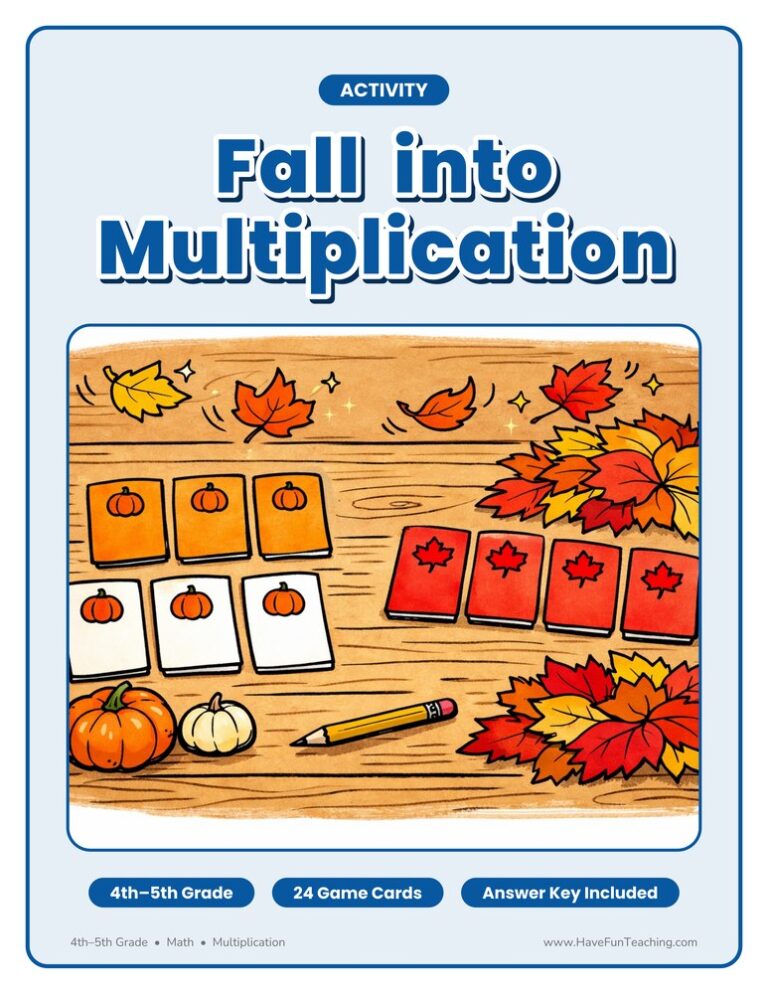
This fall into multiplication activity has 4th and 5th graders solve pumpkin problems with area models and match each product to a leaf. Answer key included.

From our teachers' playbook

Rows, columns and bigger numbers

What do 4th graders learn about arrays?

In 4th grade, arrays become the secret tool behind bigger multiplication. Kids already know 3 × 4 as 3 rows of 4. Now they stretch an array into an area model and split it into friendly parts: 6 × 23 = 6 × 20 + 6 × 3 = 120 + 18 = 138. Arrays also show every factor pair of a number, so kids can see why 12 makes rectangles of 1 × 12, 2 × 6 and 3 × 4. The click comes when a hard problem turns into two easy ones.

How we teach arrays in 4th grade

These moves walk kids from dots and tiles to the area model, so multi-digit multiplication makes sense instead of feeling like magic.

Tile it, then split it

Kids build a 4 × 14 rectangle with square tiles, then slide a ruler between the tenth and eleventh columns. Now it's 4 × 10 and 4 × 4. They write both parts and add. Building the split first makes the area model feel obvious later.

Why it works: the U.S. Department of Education's guide for teaching elementary math recommends moving from hands-on objects to drawings to numbers.
Fall into Multiplication ActivityTry it withFall into Multiplication ActivityActivitiesOpen it →

Graph paper area models

On grid paper, kids shade an array like 7 × 16, then draw a line to split it into 7 × 10 and 7 × 6. Next week, drop the grid and draw a plain rectangle. Going from grid to sketch is the bridge to multi-digit multiplication.

Why it works: pairing a picture with each word gives kids two ways to remember it, a well-tested principle of how people learn (Mayer, 2009).

How many rectangles?

Give each pair 24 tiles and ask, "How many different rectangles can you make?" Pairs record every factor pair they find and explain how they know they got them all. The math talk about "1 × 24 and 24 × 1" is gold.

Why it works: using clear, consistent math words out loud is one of the U.S. Department of Education's recommendations for elementary math.

What's on this page

Teacher favorites right now: Fall into Multiplication Activity.

Questions teachers and parents ask

How are arrays used in 4th grade math?

They help kids multiply bigger numbers by splitting them into parts. A 5 × 32 array can be broken into 5 × 30 and 5 × 2, which leads straight into the area model and partial products.

What is the difference between an array and an area model?

An array shows every object in rows and columns. An area model is a rectangle that stands for the array without drawing each piece, so it works for big numbers like 34 × 26.

How do arrays help with factors?

Every rectangle you can build from a number of tiles shows a factor pair. If 18 tiles make 1 × 18, 2 × 9 and 3 × 6 rectangles, those are all the factor pairs of 18.

How can I practice arrays at home?

Use muffin tins, egg cartons or rows of cereal. Ask "How many rows? How many in each row? How many altogether?" and then try splitting the array into two smaller ones.


