Skip to content
Start My 3 Free Days $0 today · cancel anytime

Kindergarten Capacity Resources

1 kindergarten capacity resources: 1 worksheet. How teachers use these

Find the perfect resource in seconds

Kindergarten Capacity Resources

1 kindergarten capacity resources: 1 worksheet. How teachers use these

Worksheet
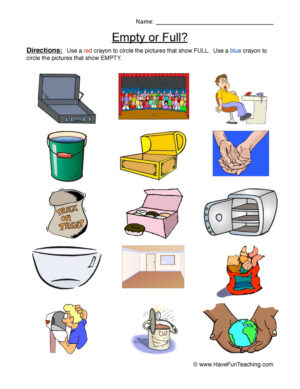
WorksheetKindergartenCircling Empty Full Examples Worksheet

This circling empty full examples worksheet lets kindergarten students find the full container in each row of pictures. An answer key is included, making it a quick, fun way to build early measurement words.

From our teachers' playbook

Full, empty, and everything in between

What do kindergartners learn about capacity?

Capacity is simply how much a container can hold, and kindergartners meet it through their hands, not a measuring cup. They learn the words full, empty, holds more and holds less, and they compare two containers by pouring one into the other. If the water spills over, the second cup holds less! The click comes when kids realize a tall, skinny glass does not always hold more than a short, wide bowl. Seeing is not the same as knowing, and they love proving it.

Our favorite ways to teach capacity

Capacity is a pour-it-and-see skill. These moves keep kids talking, comparing and checking their guesses.

Pour, compare, then circle

Set out a pitcher of rice and three cups. Kids fill one, pour it into the next, and say "This one holds more!" or "This one holds less!" After the pouring, the worksheet asks them to circle the empty and full pictures, so the words match what their hands just did.

Why it works: kids understand an idea best when they touch it, then draw it, then write it, the order the U.S. Department of Education recommends for elementary math.
Circling Empty Full Examples WorksheetTry it withCircling Empty Full Examples WorksheetWorksheetsOpen it →
Guess before you pour

Hold up two containers and ask kids to point to the one they think holds more. Snap a quick photo or sketch of their guess on the board, then pour to check. Comparing the picture to the result is where the real thinking happens.

Why it works: pairing a picture with each word gives kids two ways to remember it, a well-tested principle of how people learn (Mayer, 2009).

Sensory bin minutes

Leave scoops, cups and bottles in a sand or water bin all month. Every few days, give one new challenge: "Find a cup that holds less than the yellow one." Short, repeated play builds the vocabulary far better than one big measuring day.

Why it works: the brain holds on to what it meets again and again over time; spaced practice was rated among the very best methods (Dunlosky and colleagues, 2013).

What's on this page

Teacher favorites right now: Circling Empty Full Examples Worksheet.

Questions about teaching capacity

What is capacity in kindergarten?

Capacity is how much a container can hold. Kindergartners compare containers using words like full, empty, holds more and holds less. They do not use cups or liters yet; they pour and compare.

How do you teach capacity to kindergarten?

Start with real containers and something pourable, like water, rice or sand. Have kids pour from one container to another and describe what happens. Then move to pictures where they circle full or empty.

Does a taller container always hold more?

No, and this is the big idea kids discover! A short, wide bowl can hold more than a tall, thin glass. Pouring to check helps kids see that height alone can fool them.

How is capacity different from weight?

Capacity is how much fits inside something. Weight is how heavy something is. A big box of feathers has a large capacity but is light, which makes a fun comparison for kids.