Skip to content
Start My 3 Free Days $0 today · cancel anytime

Capacity Resources

13 capacity resources: 10 worksheets, 2 activities and 1 Common Core Lesson. How teachers use these

Capacity Resources

13 capacity resources: 10 worksheets, 2 activities and 1 Common Core Lesson. How teachers use these

Worksheet
Worksheet4th GradeMass and Volume Worksheet

A fourth grade mass and volume worksheet where students fill in the bubble to choose the best unit of measure for weight and capacity. Includes an answer key — perfect for quick, no-prep measurement practice at home or school.

Worksheet
Worksheet3rd GradeDensity and Volume in Metric Worksheet

This Density and Volume in Metric Worksheet asks 3rd graders to choose the best metric unit—grams, kilograms, milliliters, or liters—for ten everyday objects. Answer key included for fast, no-prep measurement practice.

Worksheet
WorksheetKindergartenCircling Empty Full Examples Worksheet

This circling empty full examples worksheet lets kindergarten students find the full container in each row of pictures. An answer key is included, making it a quick, fun way to build early measurement words.

Worksheet
Worksheet4th GradeMeasuring Metric Word Problems Worksheet

A measuring metric word problems worksheet where 4th graders solve five real-world grams, kilograms, milliliters and liters problems, including two that need a unit conversion first. Answer key included, so practice is quick and no-prep.

Worksheet
Worksheet4th GradeChoosing Milliliter or Liter Worksheet

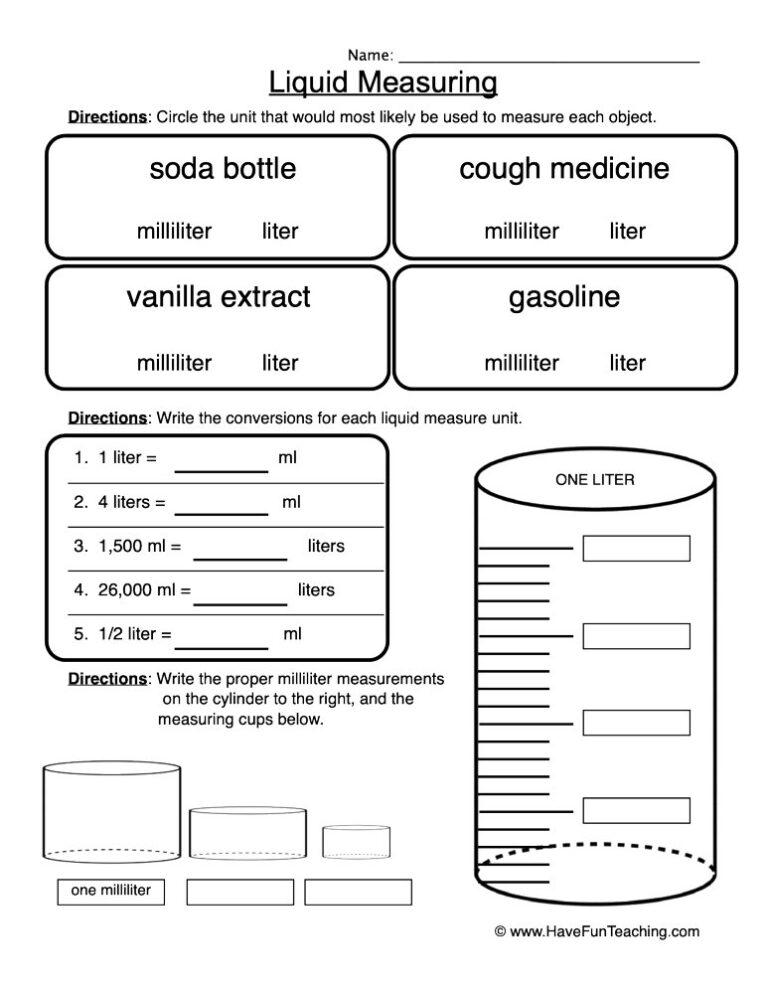
This Choosing Milliliter or Liter Worksheet has 4th graders pick the right metric unit for six everyday containers, convert liters and milliliters, and solve a word problem. Answer key included.

Worksheet
Worksheet4th GradeCup Pint Quart Gallon Worksheet

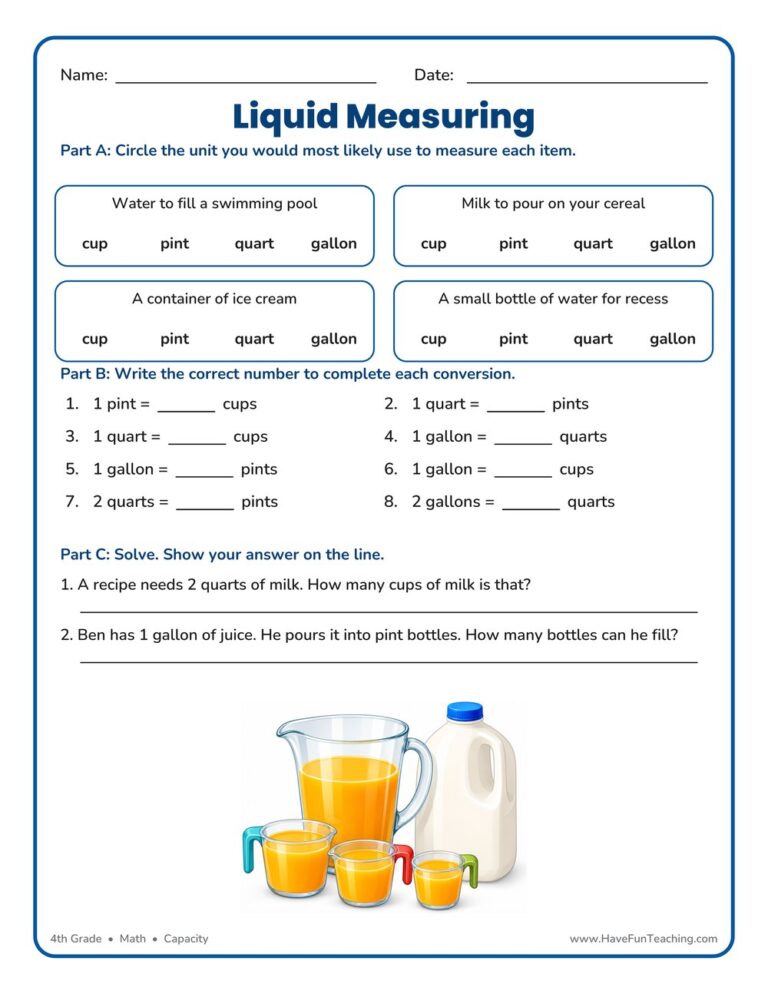
This cup pint quart gallon worksheet gives 4th graders practice choosing units and converting between cups, pints, quarts, and gallons. Includes an answer key—a no-prep way to build customary capacity skills.

Worksheet
Worksheet3rd GradeUnits of Measurement Worksheet

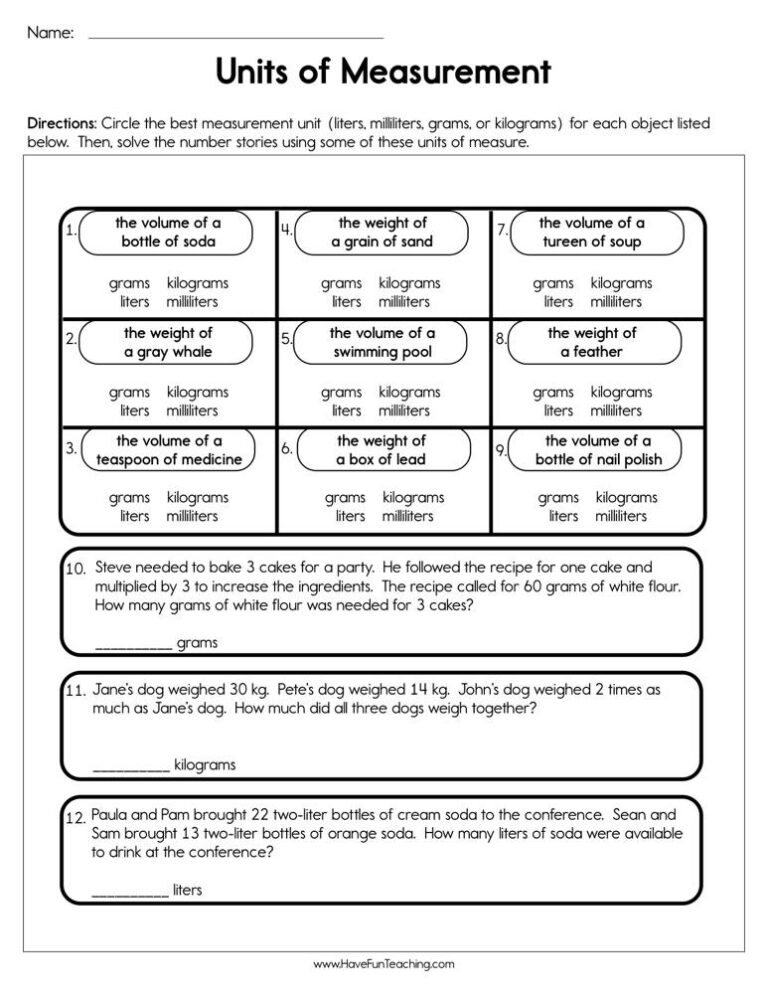
A units of measurement worksheet where 3rd graders choose grams, kilograms, milliliters, or liters for everyday objects, then solve two metric number stories. Answer key included for fast, no-prep practice.

Activity
Activity4th GradeMeasurement Conversion Activity

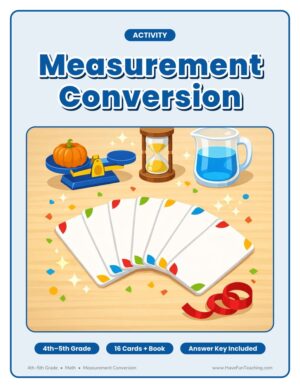
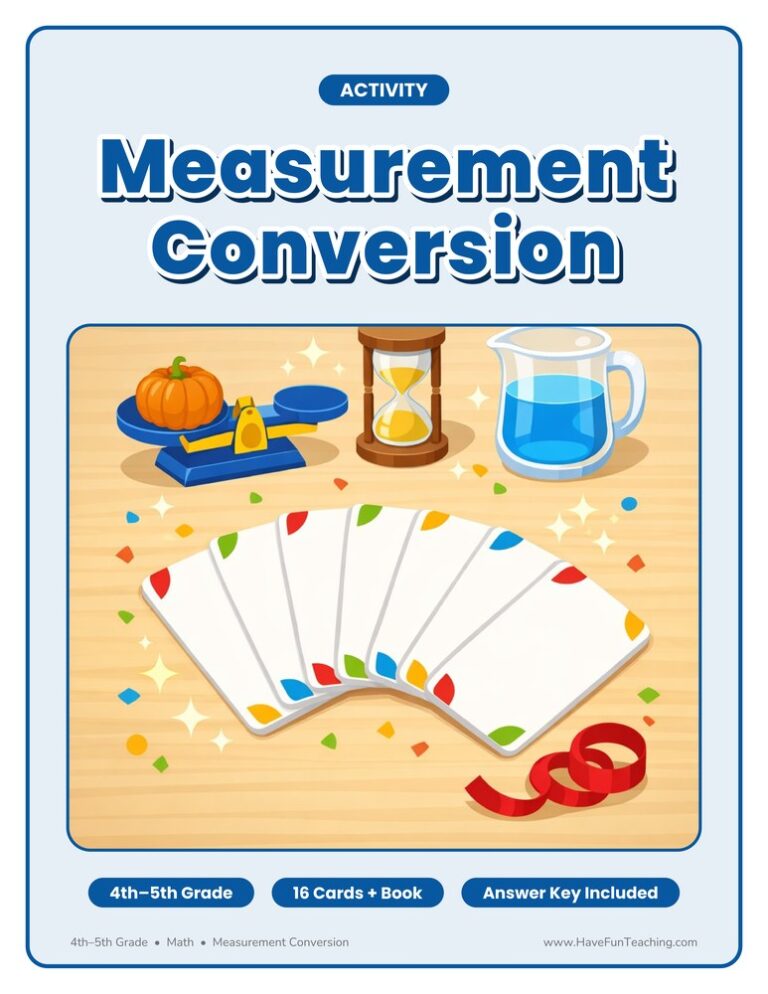
This measurement conversion activity helps 4th-5th grade students change kilometers, kilograms, liters, hours and more into smaller units with cards, tables and a poster. Answer key included.

Activity
Activity4th GradeHow Much Will It Absorb Diaper STEAM Activity

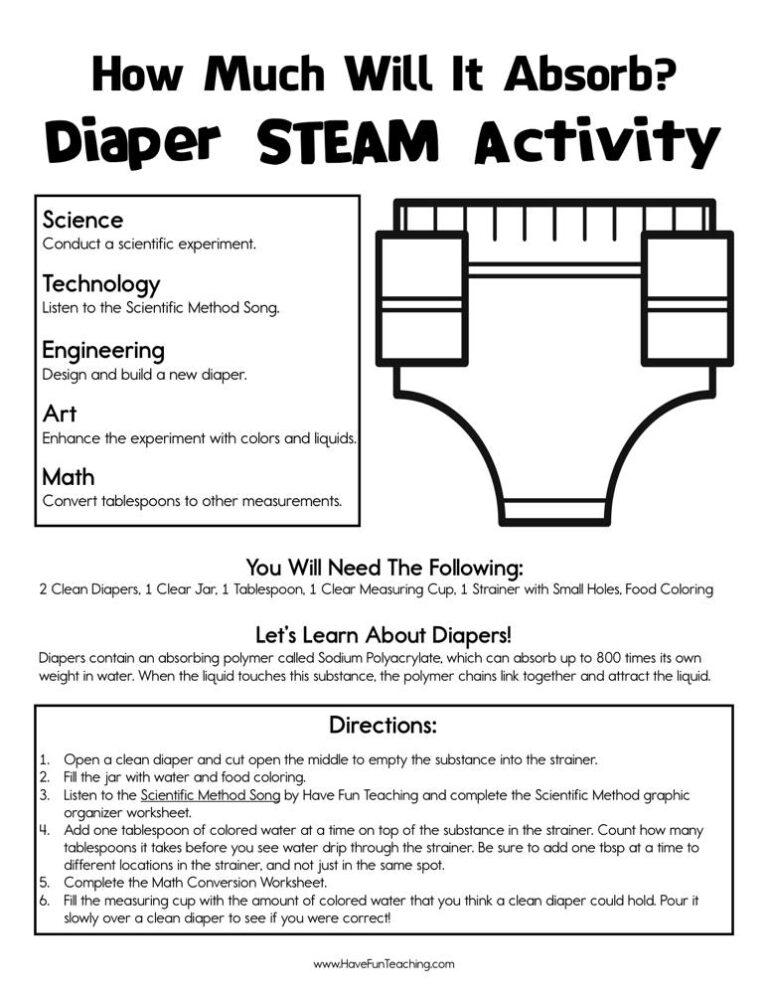
Run the How Much Will It Absorb Diaper STEAM Activity as a real lab for 4th to 6th grade: test diaper gel, convert capacity units, and design a diaper, with an answer key included.

Worksheet
Worksheet5th GradeLiquid Measurement Scenarios Worksheet

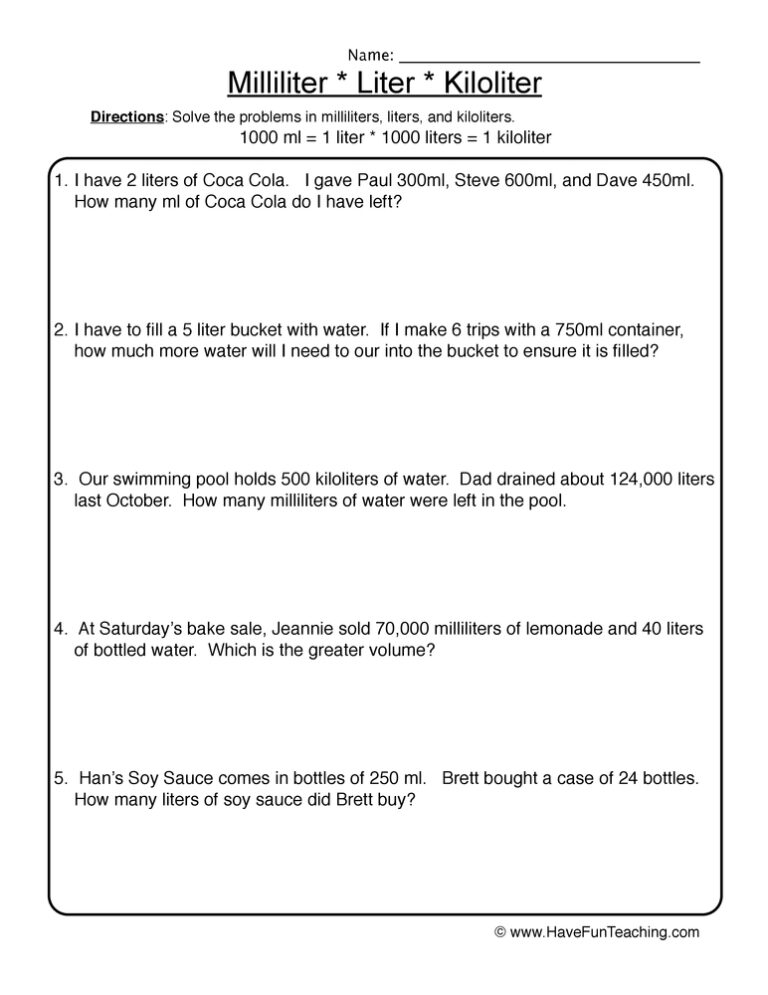
This liquid measurement scenarios worksheet gives 5th grade students four two-step word problems that convert milliliters, liters, and kiloliters. An answer key is included, so every step is easy to check.

Worksheet
Worksheet1st GradeWriting Empty Full Examples Worksheet

This writing empty full examples worksheet asks 1st graders to look at six containers and write full or empty for each. An answer key is included for fast checking.

Common Core Lesson
Common Core Lesson5th Grade5.MD.1 Fifth Grade Common Core Lesson

In this 5.MD.1 Fifth Grade Common Core Lesson, students convert among different-sized standard measurement units within a system tosolve multi-step, real world problems.

Worksheet
Worksheet5th GradeMeasurement Conversions Worksheet

This measurement conversions worksheet has 5th grade students scale a fruit punch recipe and solve capacity word problems with cups, pints, quarts, and gallons. An answer key is included for easy checking.

From our teachers' playbook

Pour it, fill it, measure it!

What do kids learn about capacity?

Capacity is how much a container can hold. Little learners start with words like full, empty, more and less, comparing a cup to a bucket. In the middle grades kids measure with real units, cups, pints, quarts and gallons, or milliliters and liters, and learn to pick the right one: a spoonful of medicine is milliliters, a swimming pool is liters. By 4th and 5th grade they convert between units, like 1 gallon = 4 quarts = 8 pints = 16 cups. The aha comes when kids pour 4 quarts into a gallon jug and it fills right to the top!

Our favorite ways to make capacity stick

Capacity is a pouring topic, not a pencil topic. Start with water (or rice, if you're brave), then move to paper.

Fill the gallon

Set out a cup, a pint, a quart and a gallon container with a tub of water or rice. Kids predict how many cups fill the quart, then pour to check. Afterward, they record what they found on paper. Pour first, write second.

Why it works: kids understand an idea best when they touch it, then draw it, then write it, the order the U.S. Department of Education recommends for elementary math.
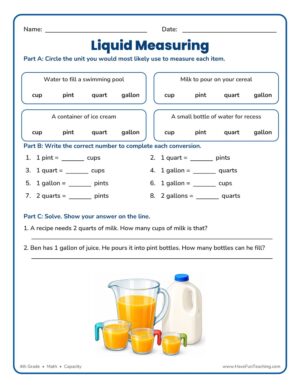
Cup Pint Quart Gallon WorksheetTry it withCup Pint Quart Gallon WorksheetWorksheetsOpen it →

Milliliter or liter? Defend it!

Show a picture, like a bathtub or an eyedropper, and kids hold up mL or L. Then call on someone to explain why. Hearing classmates reason out loud ("a raindrop is tiny, so milliliters!") builds a feel for size that rules alone never do.

Why it works: using clear, consistent math words out loud is one of the U.S. Department of Education's recommendations for elementary math.

Choosing Milliliter or Liter WorksheetTry it withChoosing Milliliter or Liter WorksheetWorksheetsOpen it →

Walk through conversions

For older kids, model one conversion step by step out loud: "A gallon is 4 quarts, so 3 gallons is 3 groups of 4." Then do one together and let them try one alone. Seeing the thinking first makes the multiplication make sense.

Why it works: showing first, practicing together, then letting kids try alone is the "gradual release" model teachers have relied on for decades (Pearson and Gallagher, 1983).

5.MD.1 Fifth Grade Common Core LessonTry it with5.MD.1 Fifth Grade Common Core LessonCommon Core LessonsOpen it →

Questions teachers and parents ask

What is capacity in math?

Capacity is the amount a container can hold, usually a liquid. Kids measure it in cups, pints, quarts and gallons, or in milliliters and liters.

What is the difference between capacity and volume?

They are close cousins. Capacity is how much a container can hold, while volume is how much space an object takes up. In elementary school, capacity usually means liquids and volume often means counting cubes.

How do kids remember cups, pints, quarts and gallons?

Many teachers draw a "Gallon Man" or a big G with 4 Qs inside, 2 Ps in each Q and 2 Cs in each P. Pouring real containers into each other makes the picture stick even better.

What grade learns capacity?

Kindergarten compares full and empty, and 2nd and 3rd grade start measuring with units. Converting between units, like quarts to cups, usually comes in 4th and 5th grade.

Keep exploring