
Skip to content
Start My 3 Free Days $0 today · cancel anytime

2nd Grade Abbreviations Resources

2 2nd grade abbreviations resources: 2 worksheets. How teachers use these

2nd Grade Abbreviations Resources

2 2nd grade abbreviations resources: 2 worksheets. How teachers use these

Worksheet
Worksheet2nd GradeAbbreviations Worksheet

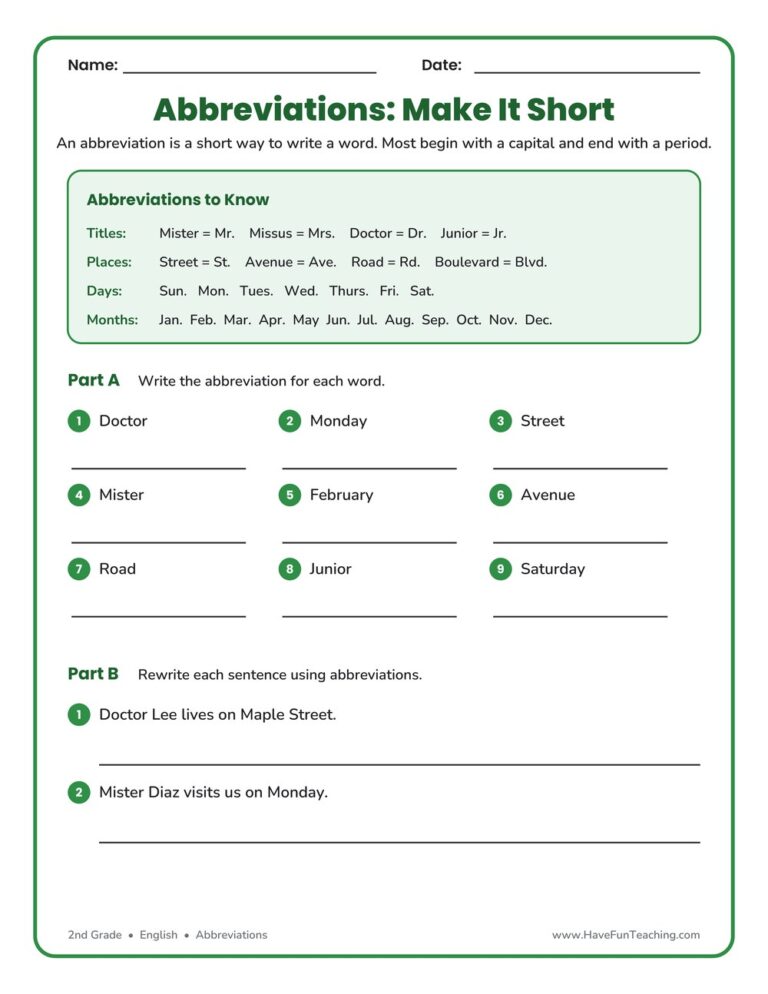
This 2nd grade abbreviations worksheet helps students shorten titles, places, days, and months the right way, then practice by rewriting full sentences. Includes a reference chart and a complete answer key for fast, no-prep grammar practice.

Worksheet
Worksheet2nd GradeCreating Abbreviations Worksheet

This Creating Abbreviations Worksheet has 3rd graders build the short form of eight words, rewrite three sentences using them, and explain why abbreviations help. Answer key included for fast, no-prep practice.

From our teachers' playbook

Short words with a dot at the end

What do 2nd graders learn about abbreviations?

An abbreviation is a short way to write a longer word. Second graders learn the common ones they see every day: titles like Mr., Mrs. and Dr., days like Mon. and Fri., months like Jan. and Oct., and address words like St. for Street and Ave. for Avenue. They learn that most abbreviations start with a capital letter and end with a period. The click comes when a kid spots "Dr." on a sign at the doctor's office and reads it as "Doctor" without thinking.

Our favorite ways to make abbreviations stick

Abbreviations are everywhere in real life. These moves connect the worksheet to the world.

Match the short and the long

Flash an abbreviation and have kids say the whole word: "Tues." "Tuesday!" Then flip it around. Three minutes a day for a week covers days, months and titles.

Why it works: pulling an answer out of memory makes it stick far better than rereading it, one of the strongest findings in learning research (Dunlosky and colleagues, 2013).
Abbreviations WorksheetTry it withAbbreviations WorksheetWorksheetsOpen it →

Make your own

Give kids a list of long words and have them create the abbreviation, remembering the capital and the period. Then compare with the real one. Building them helps kids see the pattern instead of memorizing a list.

Why it works: the U.S. Department of Education's guide for teaching elementary math recommends moving from hands-on objects to drawings to numbers.

Creating Abbreviations WorksheetTry it withCreating Abbreviations WorksheetWorksheetsOpen it →

Address an envelope

Model writing your school's address on an envelope using St., Ave. or Rd. Then kids address an envelope to a family member. A real letter in the mail is a big motivator.

Why it works: handing over the work step by step, from teacher to student, is one of the most widely used teaching frameworks (Pearson and Gallagher, 1983).

What's on this page

Teacher favorites right now: Abbreviations Worksheet and Creating Abbreviations Worksheet.

Questions parents and teachers ask

What are abbreviations for 2nd grade?

Abbreviations are short forms of words. Second graders learn titles (Mr., Mrs., Dr.), days of the week (Mon., Wed.), months (Jan., Sept.) and address words (St., Ave., Rd.).

Do abbreviations always have a period?

Most abbreviations second graders learn end with a period, like Dr. and Feb. Two-letter state abbreviations on mail, like NY and TX, are the big exception: no periods.

Do abbreviations start with a capital letter?

Titles, days, months and street names start with capital letters because the full words are proper nouns or titles. Measurement abbreviations, like in. and ft., do not.

How can I practice abbreviations at home?

Point them out on calendars, mail and road signs. Have your child write the date with the abbreviated day and month, or help address an envelope.


