
Skip to content
Start My 3 Free Days $0 today · cancel anytime

6th Grade Economics Resources

1 6th grade economics resources: 1 worksheet. How teachers use these

6th Grade Economics Resources

1 6th grade economics resources: 1 worksheet. How teachers use these

Worksheet
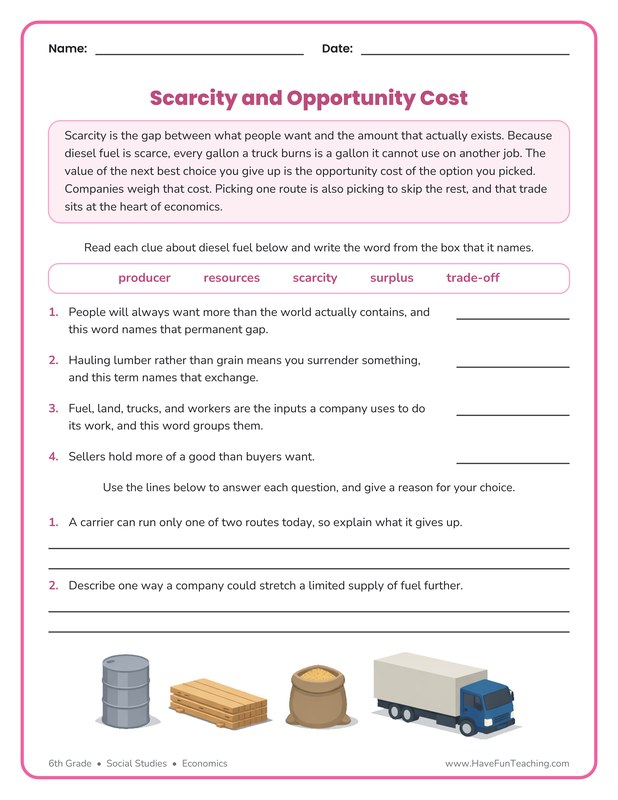
Worksheet6th GradeDiesel Fuel Scarcity and Opportunity Cost Worksheet

This scarcity and opportunity cost worksheet asks 6th graders to define economic trade-offs and justify what a carrier gives up when fuel is limited. An answer key is included for no-prep practice.

From our teachers' playbook

Every choice has a cost

What do 6th graders learn about economics?

In 6th grade, economics is all about choices. Students learn about scarcity, the idea that resources are limited, so people, businesses and countries must decide how to use them. Every choice has an opportunity cost: the next best thing you give up. They explore supply and demand, how prices change, and how different economic systems (traditional, command, market and mixed) answer the big questions of what to make and for whom. A quick example: pick soccer camp → opportunity cost = art camp. The click moment is when kids see opportunity cost in their own weekend plans.

Our favorite ways to teach economics

Economics clicks when kids feel the choices. These moves make abstract ideas personal.

Real-world scarcity cases

Give students a short case about a shortage, like diesel fuel or a popular toy. They identify what is scarce, who is affected and what choices must be made. Real headlines make scarcity feel urgent.

Why it works: kids understand an idea best when they touch it, then draw it, then write it, the order the U.S. Department of Education recommends for elementary math.
Diesel Fuel Scarcity and Opportunity Cost WorksheetTry it withDiesel Fuel Scarcity and Opportunity Cost WorksheetWorksheetsOpen it →

Decision trees

Students map a choice with a few options, listing costs and benefits for each. Then they name the opportunity cost of their pick. Partners compare and debate. It turns a vocabulary word into a thinking tool.

Why it works: using clear, consistent math words out loud is one of the U.S. Department of Education's recommendations for elementary math.

Vocabulary check-ins

Start class with three quick questions: "Is this a want or a need? A good or a service? What is the opportunity cost?" Short, repeated checks make the terms automatic.

Why it works: pulling an answer out of memory makes it stick far better than rereading it, one of the strongest findings in learning research (Dunlosky and colleagues, 2013).

What's on this page

Teacher favorites right now: Diesel Fuel Scarcity and Opportunity Cost Worksheet.

6th grade economics questions

What is economics in 6th grade?

It is the study of how people make choices when resources are limited. Sixth graders learn about scarcity, opportunity cost, supply and demand and different economic systems.

What is opportunity cost?

Opportunity cost is the value of the next best choice you give up when you make a decision. If you spend your money on a game instead of a book, the book is your opportunity cost.

What are the four types of economic systems?

Traditional, command, market and mixed. Each one answers what to produce, how to produce it and who gets it in a different way.

How can I teach economics at home?

Talk through everyday decisions like grocery shopping or saving for a toy. Ask what your child gives up with each choice, and let them manage a small budget.


