
Skip to content
Start My 3 Free Days $0 today · cancel anytime

3rd Grade Abbreviations Resources

2 3rd grade abbreviations resources: 2 worksheets. How teachers use these

3rd Grade Abbreviations Resources

2 3rd grade abbreviations resources: 2 worksheets. How teachers use these

Worksheet
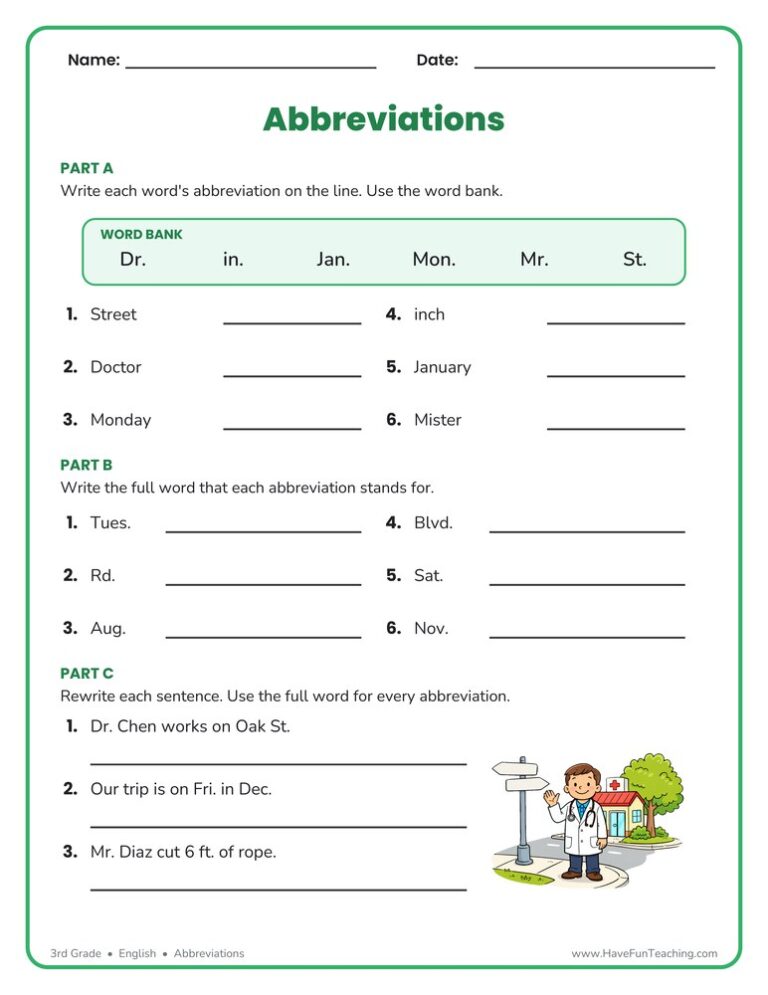
Worksheet3rd GradeAbbreviations Fill in the Blank Worksheet

This abbreviations fill in the blank worksheet gives 3rd Grade students two-way practice writing abbreviations, expanding them into full words, and rewriting sentences. Answer key included, so students build accuracy fast.

Worksheet
Worksheet3rd GradeCreating Abbreviations Worksheet

This Creating Abbreviations Worksheet has 3rd graders build the short form of eight words, rewrite three sentences using them, and explain why abbreviations help. Answer key included for fast, no-prep practice.

From our teachers' playbook

Write less, say the same thing

What do 3rd graders learn about abbreviations?

Third graders already know Mr., Dr. and the days of the week, so now the list grows. They learn measurement abbreviations like in., ft., yd., lb. and oz., name endings like Jr. and Sr., and the two-letter state codes used on mail, like CA and FL, which have no periods. They also learn when to use abbreviations: great for addresses, charts and notes, but in a story you usually write the full word. The click comes when a student reads "3 ft. 2 in." on a measuring chart without slowing down.

Our favorite ways to make abbreviations stick

Third graders can handle a bigger list. These moves keep it organized and meaningful.

Fill in the right one

Give sentences that mix titles, days, months and measurements, each with a blank for the abbreviation. Kids have to read for meaning to know which one fits. Mixing the types keeps them from just copying a pattern.

Why it works: mixing different kinds of problems in one practice set helped students do far better on a later test (Rohrer and Taylor, 2007).

Abbreviations Fill in the Blank WorksheetTry it withAbbreviations Fill in the Blank WorksheetWorksheetsOpen it →

Create and check

Kids make their own abbreviations for a list of words, then look up the real ones and compare. Talk about the rule they used: first letters? first syllable? It turns a list into a puzzle.

Why it works: kids understand an idea best when they touch it, then draw it, then write it, the order the U.S. Department of Education recommends for elementary math.

Creating Abbreviations WorksheetTry it withCreating Abbreviations WorksheetWorksheetsOpen it →

A measurement chart

Build a class chart that pairs each measurement word with its abbreviation and a small picture: a ruler for in., a scale for lb. Leave it up for math class too. Seeing it daily makes it automatic.

Why it works: children learn more from words and pictures together than from words alone (Mayer, 2009).

Questions parents and teachers ask

What abbreviations do 3rd graders learn?

They review titles, days and months and add measurement abbreviations (in., ft., yd., mi., lb., oz.), name endings (Jr., Sr.), address words and two-letter state postal codes.

Do state abbreviations have periods?

The two-letter postal codes, like TX and NY, are written in capital letters with no periods. Older, longer forms like Calif. use a period, but the postal codes are what kids use on mail.

When should kids use abbreviations in writing?

Abbreviations are perfect for addresses, charts, lists, notes and measurements. In stories and formal writing, kids should usually spell out the full word, except for titles like Mr. and Dr.

What is the difference between an abbreviation and an acronym?

An abbreviation is any shortened form of a word, like Dr. An acronym is made from the first letters of several words and is read as a word, like NASA.



