Skip to content
Start My 3 Free Days $0 today · cancel anytime

3rd Grade Analogies Resources

6 3rd grade analogies resources: 6 worksheets. How teachers use these

3rd Grade Analogies Resources

6 3rd grade analogies resources: 6 worksheets. How teachers use these

Worksheet
Worksheet3rd GradeAnalogies Multiple Choice Worksheet

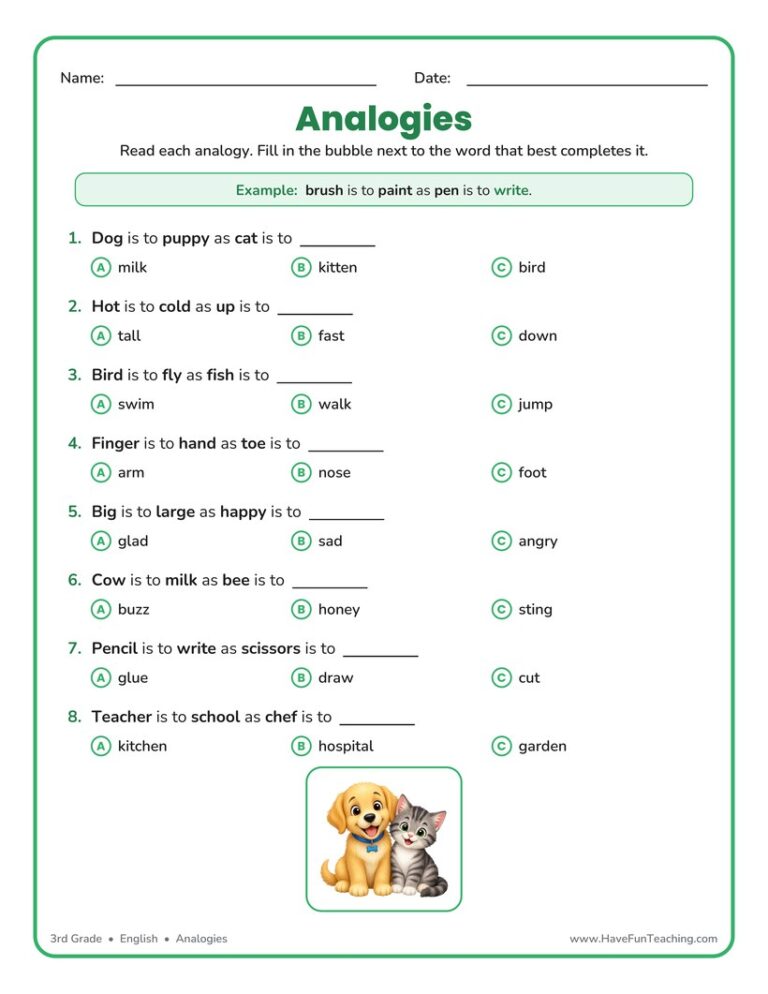
This Analogies Multiple Choice Worksheet helps 3rd graders complete word analogies by choosing the answer that matches each relationship. Includes a complete answer key—a fun, no-prep way to build vocabulary and reasoning skills.

Worksheet
Worksheet3rd GradeCompleting Analogies Worksheet

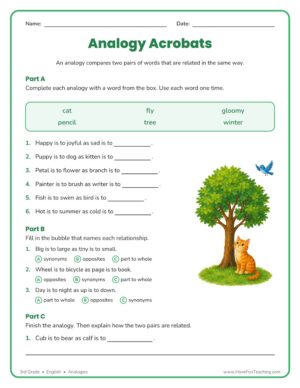
A Completing Analogies Worksheet for 3rd grade, with word bank, multiple choice, and write-and-explain practice in naming word relationships. Answer key included, so students build vocabulary and reasoning with no prep.

Worksheet
Worksheet3rd GradeAnalogies Worksheet

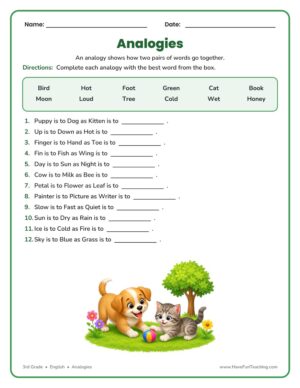
A word-bank analogies worksheet that helps 3rd graders complete word relationships like opposites, part-to-whole, and category. Includes a complete answer key — great for no-prep vocabulary practice.

Worksheet
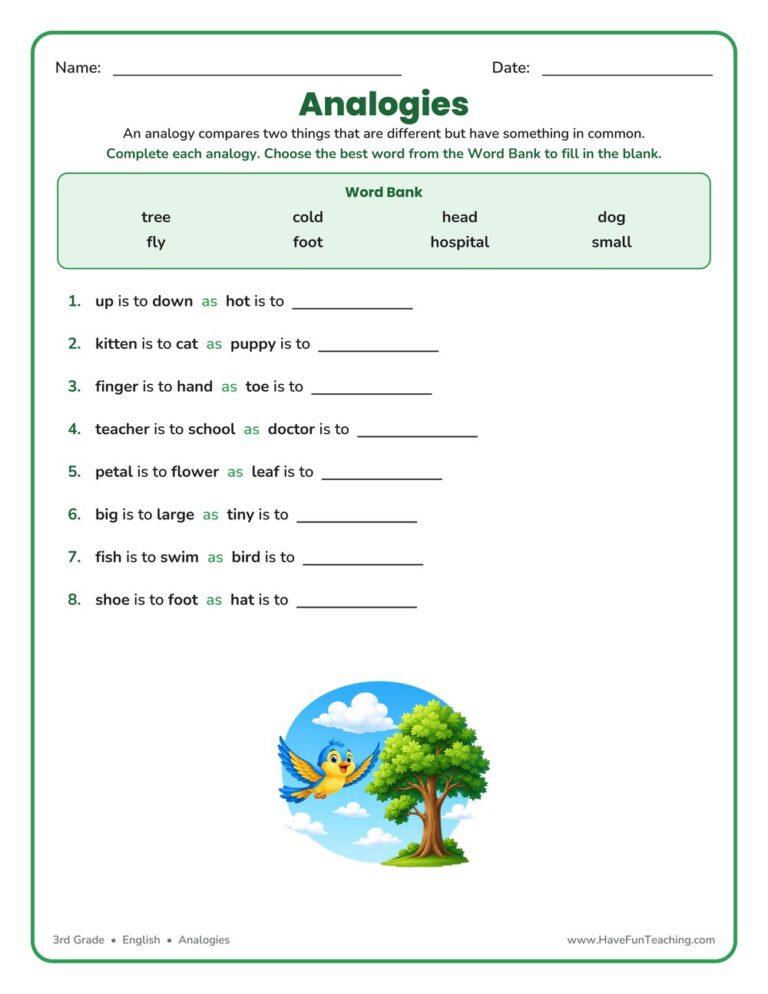
Worksheet3rd GradeAnalogies Word Bank Worksheet

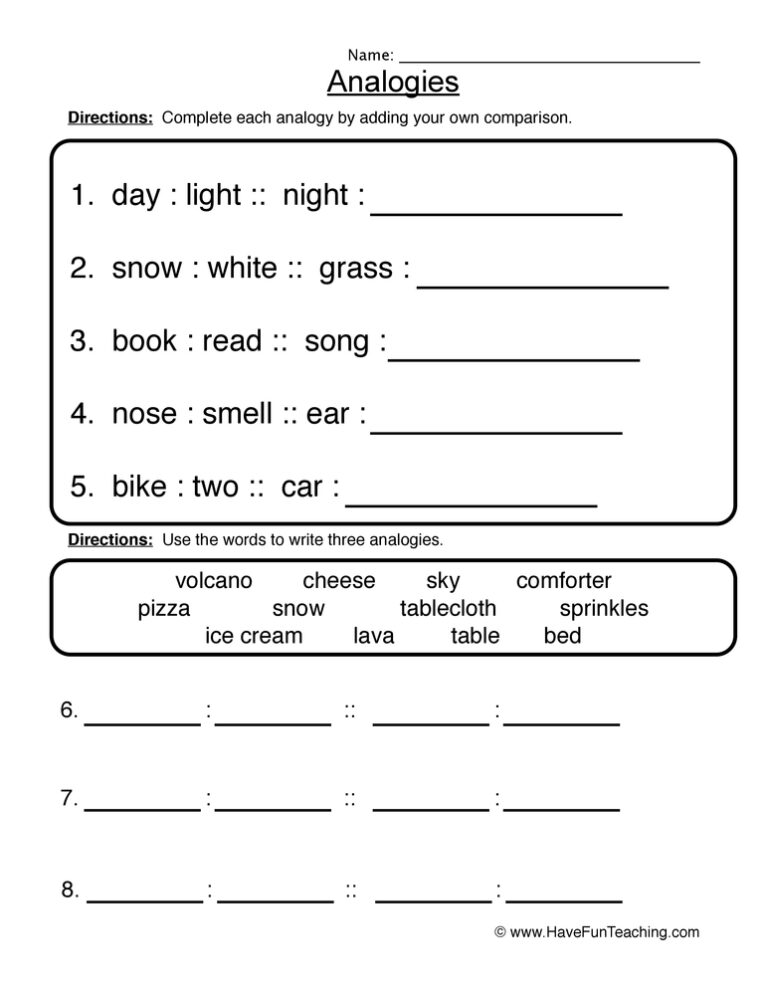
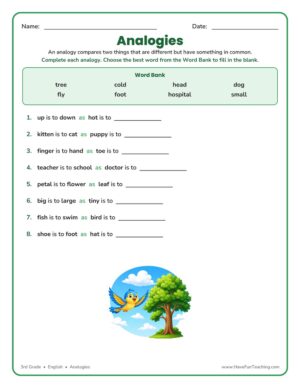
This analogies word bank worksheet gives 3rd Grade students eight analogies, a ten-word bank with two distractors and an answer key, so vocabulary reasoning is practiced and checked in one page.

Worksheet
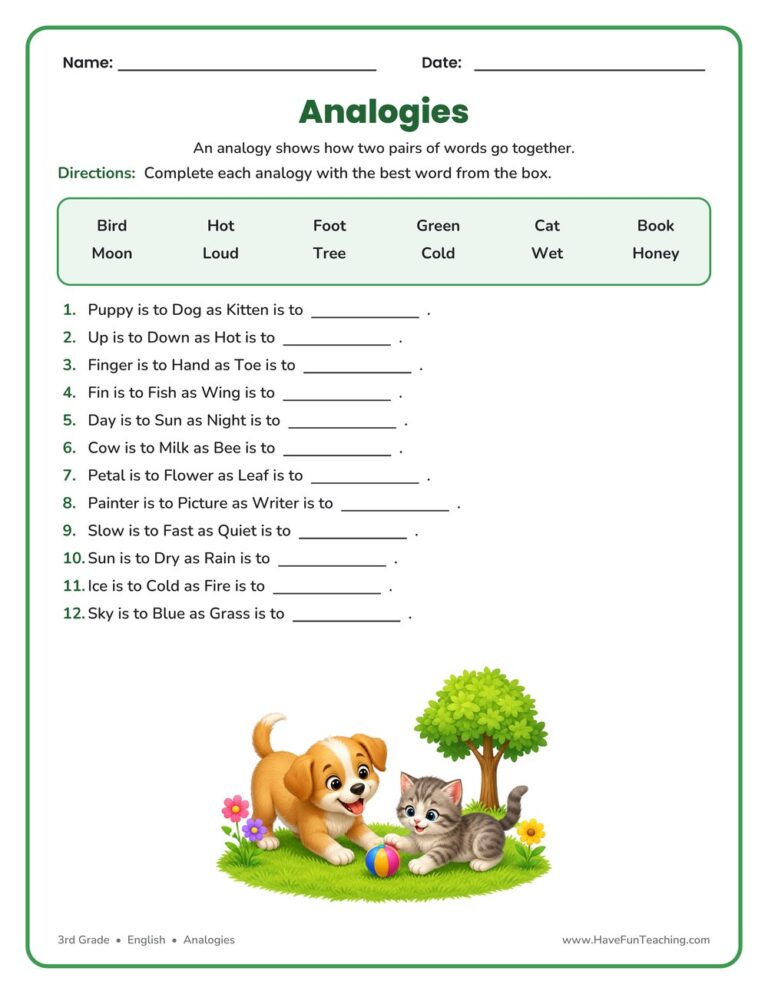
Worksheet3rd GradeAnalogy Fill in the Blanks Worksheet

A word-box Analogy Fill in the Blanks Worksheet where 3rd graders complete 12 analogies to build vocabulary and word-relationship reasoning. Answer key included—perfect for quick, no-prep practice at home or in class.

Worksheet
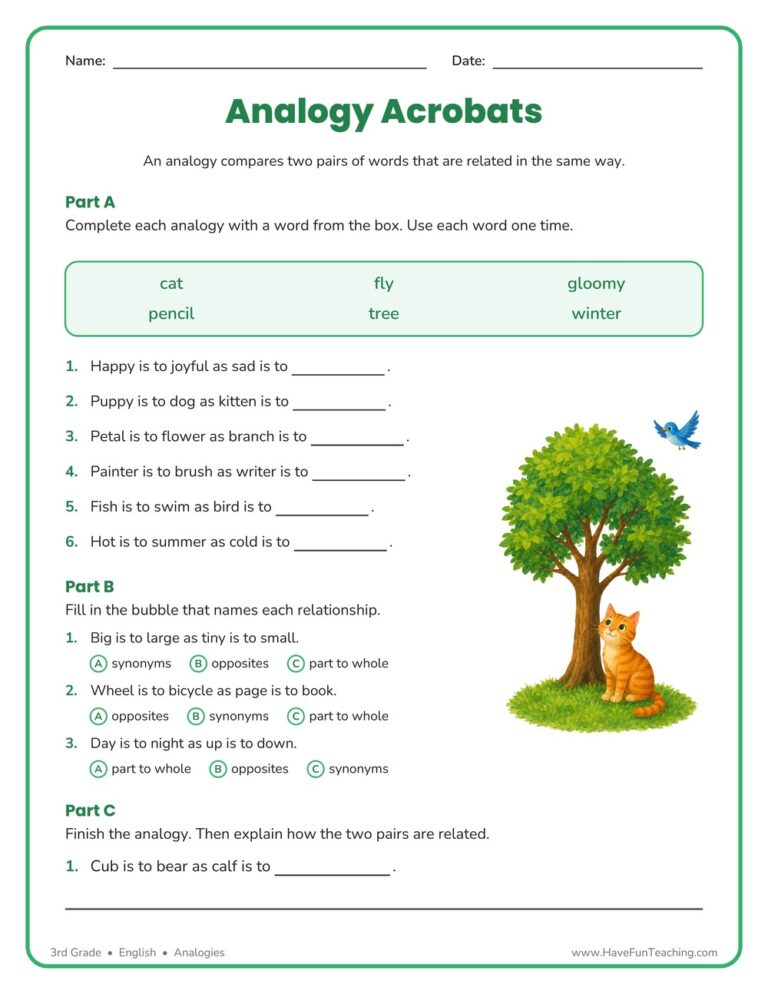
Worksheet3rd GradeComplete the Analogy Worksheet

This Complete the Analogy Worksheet gives 3rd Grade students six word-bank analogies, three relationship-naming questions, and a short writing prompt. Answer key included, so analogy practice takes no prep at all.

From our teachers' playbook

Find the link between the words

What do 3rd graders learn about analogies?

An analogy compares two pairs of words that are connected in the same way. Third graders learn to read hot : cold :: up : down as "hot is to cold as up is to down." The trick is finding the relationship first: opposites, same meaning, part to whole, or what something is used for. Then kids look for a second pair with the same link, like wheel is to car as leaf is to tree. The click comes when kids say the relationship out loud and the missing word jumps right out.

Our favorite ways to make analogies stick

Analogies build vocabulary and thinking at the same time. These moves make the hidden connection easy to find.

Say the relationship

Model one simple rule: before choosing an answer, make a sentence about the first pair. "A bird lives in a nest." Then use the same sentence for the second pair: "A bee lives in a..." Kids try it with the next three.

Why it works: handing over the work step by step, from teacher to student, is one of the most widely used teaching frameworks (Pearson and Gallagher, 1983).

Completing Analogies WorksheetTry it withCompleting Analogies WorksheetWorksheetsOpen it →
Pick the best pair

Give multiple-choice analogies as a quick morning check. Ask kids to cross out the choices with the wrong relationship first. It teaches them to think, not guess.

Why it works: a big review of study methods ranked quick self-quizzing among the most powerful ways to remember (Dunlosky and colleagues, 2013).

Analogies Multiple Choice WorksheetTry it withAnalogies Multiple Choice WorksheetWorksheetsOpen it →

Sketch the link

For tricky pairs, kids draw a tiny picture of each word and an arrow showing the relationship. Seeing "paw to dog" and "hand to person" side by side makes part to whole click.

Why it works: children learn more from words and pictures together than from words alone (Mayer, 2009).

Analogies WorksheetTry it withAnalogies WorksheetWorksheetsOpen it →
Questions parents and teachers ask about analogies

What is an analogy for 3rd graders?

An analogy compares two pairs of words that are related in the same way. For example, "cat is to kitten as dog is to puppy" compares adults and their babies.

What are the common types of analogies?

The most common types are synonyms, antonyms, part to whole, object to use and category. Learning these types helps kids find the relationship faster.

How do you solve an analogy?

First, figure out how the first pair is connected and put it into a sentence. Then use the same sentence to find the word that completes the second pair.

How can I practice analogies at home?

Make them up in the car: "Fish is to water as bird is to...?" Take turns creating them. Kids love stumping the grown-ups!