Skip to content
Start My 3 Free Days $0 today · cancel anytime

3rd Grade Arrays Resources

5 3rd grade arrays resources: 3 Common Core Lessons and 2 activities. How teachers use these

3rd Grade Arrays Resources

5 3rd grade arrays resources: 3 Common Core Lessons and 2 activities. How teachers use these

Common Core Lesson
Common Core Lesson3rd Grade3.OA.1 Third Grade Common Core Lesson

In this 3.OA.1 Third Grade Common Core Lesson, students match multiplication equations to groups of grocery item to build multiplication skills.

Activity
Activity3rd GradeSweet Rectangular Arrays Addition Activity

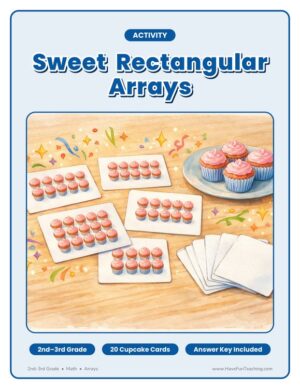
This sweet rectangular arrays addition activity has 2nd-3rd grade students match cupcake arrays to equal-addend equations. Cards, a recording sheet and practice page, with an answer key included.

Activity
Activity3rd GradeBe the Baker Multiplication Activity

Using this Be the Baker Multiplication Activity, students interpret products of whole numbers into equal groups.

Common Core Lesson
Common Core Lesson3rd Grade3.OA.3 Third Grade Common Core Lesson

In this 3.OA.3 Third Grade Common Core Lesson, students use multiplication and division strategies within 100 to solve word problems.

Common Core Lesson
Common Core Lesson3rd Grade3.OA.5 Third Grade Common Core Lesson

In this 3.OA.5 Third Grade Common Core Lesson, students apply properties of operations as strategies to multiply and divide.

From our teachers' playbook

Rows and columns make multiplying easy

What do 3rd graders learn about arrays?

An array is a set of objects arranged in equal rows and columns. Third graders use arrays to understand multiplication: 3 rows of 4 = 3 × 4 = 12. They see that turning an array sideways gives the same total, which shows the commutative property (3 × 4 = 4 × 3). Arrays also help kids solve word problems and break big facts into smaller ones. The click is when kids look at a carton of eggs and see 2 × 6 right away.

Our favorite ways to teach arrays

Arrays turn multiplication into something kids can see and build.

Turn it around

Kids build a 3 × 5 array with tiles, then rotate it 90 degrees and write the new number sentence. Seeing the total stay the same proves the commutative property.

Why it works: going from real objects to pictures to symbols is a core recommendation of the U.S. Department of Education's elementary math guide.

3.OA.5 Third Grade Common Core LessonTry it with3.OA.5 Third Grade Common Core LessonCommon Core LessonsOpen it →

Arrays in word problems

Give word problems about rows of chairs or trays of muffins, and have kids draw an array before they solve. Drawing first helps kids pick the right operation.

Why it works: mixing different kinds of problems in one practice set helped students do far better on a later test (Rohrer and Taylor, 2007).

3.OA.3 Third Grade Common Core LessonTry it with3.OA.3 Third Grade Common Core LessonCommon Core LessonsOpen it →

Arrays questions, answered

What is an array in 3rd grade math?

An array is a group of objects arranged in equal rows and columns. Third graders use arrays to show and solve multiplication problems.

How do arrays help with multiplication?

Arrays show multiplication as rows times columns. Kids can count, skip count or multiply to find the total, which builds understanding before memorizing facts.

What is the commutative property with arrays?

It means you can multiply in any order and get the same answer. Turning a 3 × 4 array sideways makes a 4 × 3 array with the same 12 objects.

How can I practice arrays at home?

Use muffin tins, ice cube trays or snacks. Ask your child, "How many rows? How many in each row? How many in all?"