
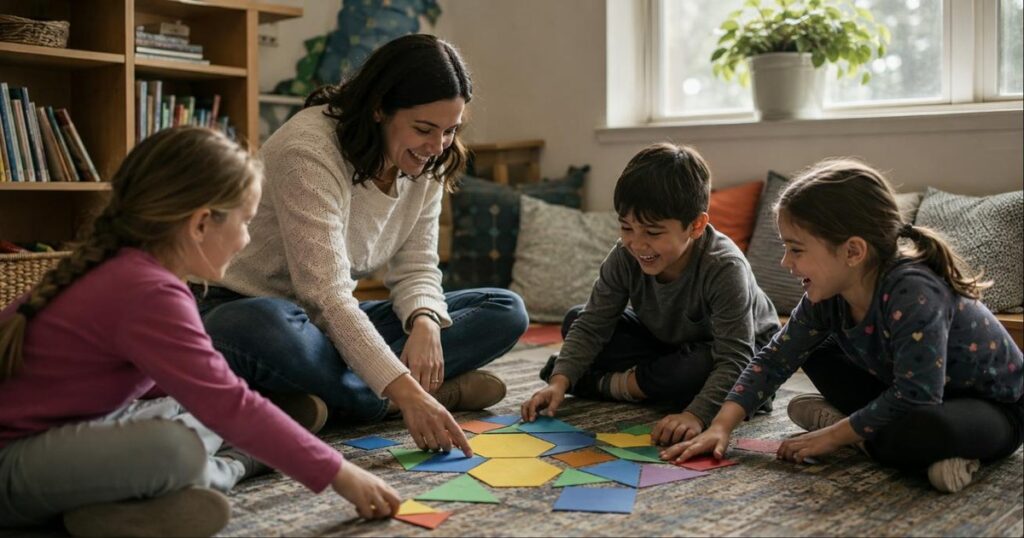
Geometry is the one math strand kids usually walk in already loving. They’ve been stacking blocks, folding paper airplanes, and arguing about who got the bigger slice of pizza since they were three. Then somewhere around third grade it turns into vocabulary lists and formulas, and the joy leaks out. Good geometry worksheets put it back — they give kids something to draw, cut, fold, measure, and point at.
That’s really the whole trick. Geometry is a visual, physical subject, so the practice pages that work are the ones that ask kids to do something on the page instead of just recall a definition. Here’s what to teach when, where kids reliably get stuck, and how to use printable practice so it actually sticks.
The short version
3 days free
Ready for the whole library?
You’ve had your freebie — but members download 10,000+ resources for every grade, all year long. Try it free — $0 today, cancel anytime.
Free for teachers
Pick your grade. We’ll send 10 free resources.
Worksheets, activities and a video — picked for your classroom, ready to print tonight.
One free bundle per teacher. We’ll also send free teaching ideas each week — unsubscribe anytime.



- Geometry develops in stages — kids recognize shapes long before they can describe why a shape is what it is. Teach in that order.
- The best geometry worksheets ask kids to draw, cut, fold, or measure — not just circle the right answer.
- Most upper-elementary confusion traces back to one thing: area and perimeter got taught as two formulas instead of two different questions.
- Ten focused minutes a day beats a forty-minute packet on Friday.
Why geometry worksheets work better than you’d expect
Worksheets have a bit of a reputation. Fair enough — a page of thirty identical problems isn’t teaching anybody much. But geometry is the exception, and it’s worth understanding why.
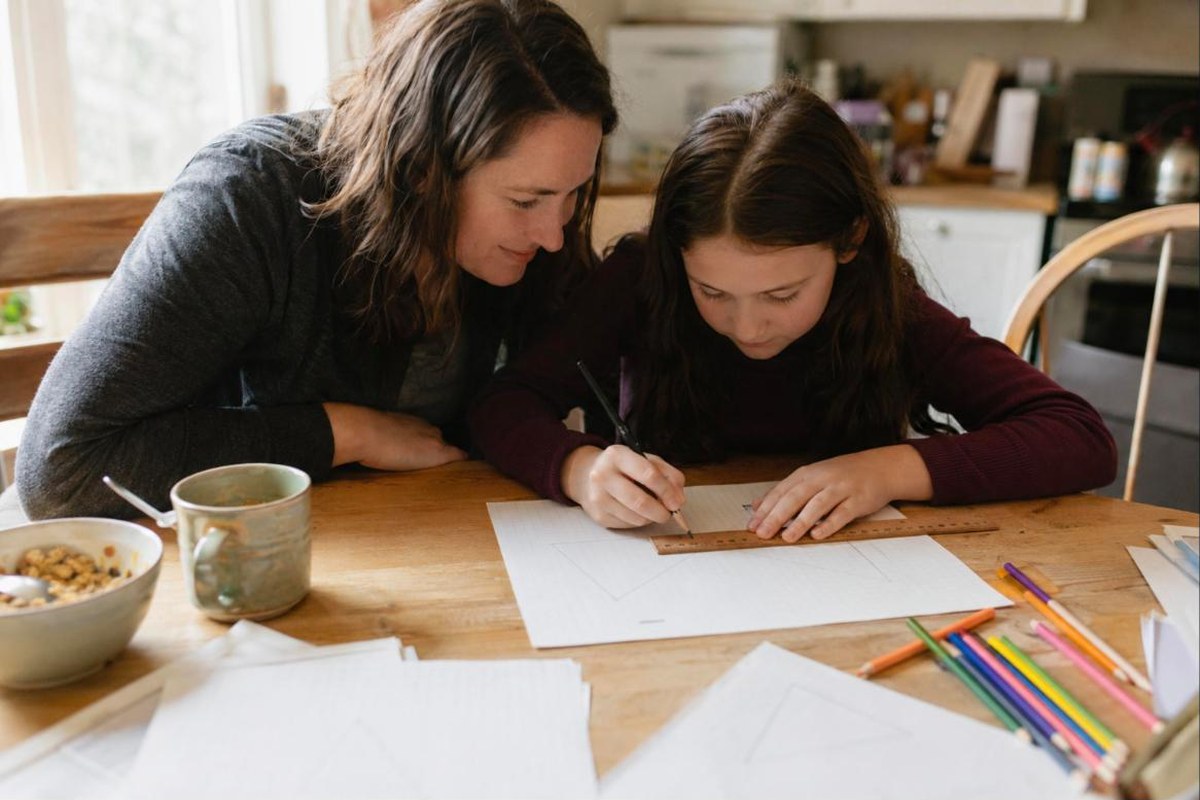
In most math strands, a worksheet is a container for repetition. In geometry, the page itself is the manipulative. A child who traces a hexagon, cuts it out, and folds it in half has done real mathematical work — she has tested a claim about symmetry with her hands. A child who draws a rectangle on grid paper and counts the squares inside it has discovered area rather than being told a formula. The paper isn’t standing in for the learning. It is the learning.
Researchers describe this progression as the van Hiele levels: children move from simply recognizing shapes, to describing their properties, to reasoning about how shapes relate. Each level has to be built before the next one makes any sense. The National Council of Teachers of Mathematics has been making this point for decades, and it explains an awful lot of fourth-grade frustration.
What geometry looks like at each grade level
You can’t teach angles to a kindergartner and you shouldn’t still be naming shapes in fifth grade. Here’s the honest progression, so you can pick practice that lands where your kids actually are.
Preschool and kindergarten: naming and noticing
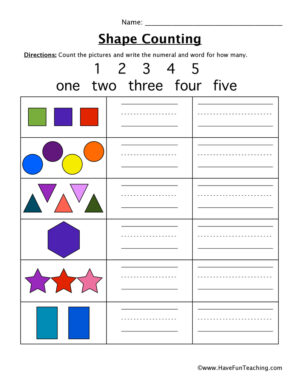
At this stage geometry is vocabulary and pattern-spotting. Circles, squares, triangles, rectangles. Sorting by shape. Finding shapes in the room and in books. Look for pages with big, clean figures and lots of white space — small print defeats a five-year-old’s fine motor skills before the math ever gets a chance.
First and second grade: properties and building
Now kids start describing shapes instead of just naming them. Sides, corners, “it has four sides but they’re not all the same.” This is also where composite shapes arrive — two triangles making a square, four squares making a bigger square. Cut-and-paste practice is worth its weight here, mess and all.
Third and fourth grade: area, perimeter, and angles
The big year. Area and perimeter both show up, usually within a few weeks of each other, and this is where most confusion starts. Angles arrive too — right, acute, obtuse. Grid-based practice is your friend, because it lets kids count their way to an answer before they ever meet a formula.
Fifth and sixth grade: formulas and reasoning
Volume, the area of triangles and irregular shapes, coordinate planes, and real multi-step word problems. By now kids should be able to explain why the formula works, not just plug numbers into it. If they can’t, back up — the gap is almost always at the third-grade level, not this one.
Let the songs do the memorizing
Shape names are pure vocabulary, and vocabulary is the thing music is best at. Ask a kindergarten teacher why her class can say “trapezoid” without blinking — it is almost never a worksheet that did it.
Have Fun Teaching has a whole album of Shape Songs built for exactly this: separate tracks for the circle, square, triangle, rectangle, hexagon, trapezoid, parallelogram, and polygons, plus a Shapes Song that sweeps up the lot. Put one on during morning work or on the way to lunch, and the names arrive on their own.
The pairing is the whole point. Play the Triangle Song, then give kids a triangle sorting sheet while it is still stuck in their heads: the song does the naming, the worksheet does the noticing. There are shape videos too, if you would rather project something than press play on audio — and the whole set is free to stream on the Have Fun Teaching YouTube channel.
7 ways to use geometry worksheets so kids stay engaged
Same page, wildly different results, depending on how you hand it over. These are the moves that turn a practice sheet into something kids lean into.
- Cut it up. Hand out the shape-identification page with scissors instead of pencils. Kids cut the shapes apart, sort them into piles, then glue them into categories. Same content, ten times the thinking.
- Go find it. Before the worksheet, send kids around the room for two minutes to find one of each shape. They come back with a rectangle window and a circle clock, and suddenly the page is about their world.
- Make it a prediction. Cover the answer space and ask kids to guess the area first. Then measure. Being a little bit wrong and finding out why is where the learning lives.
- Build it, then draw it. Give kids blocks or pattern tiles, have them build the figure, and only then let them record it on paper. The page becomes documentation instead of a test.
- Two colors, two ideas. When area and perimeter are on the same sheet, have kids trace the perimeter in one color and shade the area in another. The distinction becomes visual, and it sticks.
- Ten minutes, not forty. Short daily practice outperforms one long session every time. Print a week’s worth, do one page a day, and stop while they’re still interested.
- Let them write the problem. Once kids can solve a page, ask them to make one for a partner. Writing a good area problem takes more understanding than solving six of them.
Teacher tip: Keep a stack of blank grid paper next to your geometry worksheets. When a kid gets stuck on area, hand them a grid and let them count squares. Almost every third-grade area meltdown resolves itself in about ninety seconds this way.
Ready-to-print
Geometry practice for every level, ready in seconds
Shapes, angles, area, perimeter, and composite figures — sorted by grade so you can grab exactly the page you need. Print tonight, teach tomorrow.
Get the Geometry Worksheets Browse free resourcesNo login needed to browse · Preschool–6th · Print in seconds
Where kids get stuck in geometry (and how to help)
Four sticking points come up again and again, and every one of them has a fix that takes a few minutes rather than a whole reteach.
Area and perimeter blur together. This is the big one. Kids memorize two formulas that look similar and then guess. The fix isn’t more formula practice — it’s language. Perimeter answers “how far around?” Area answers “how much space inside?” Ask those two questions out loud every single time, and the formulas sort themselves out.
Shapes only count when they’re upright. A square rotated forty-five degrees becomes “a diamond” to a lot of kids, because every triangle they’ve ever seen has been sitting flat on its base. Deliberately show shapes tipped, stretched, and upside down. It takes about one lesson to fix and prevents years of confusion.
Angle vocabulary won’t stick. Acute, obtuse, and right all sound equally arbitrary. Anchor them to the body instead: a right angle is the corner of a book, an acute angle is a slice of pizza, an obtuse angle is a door that’s mostly open. Physical anchors outlast definitions.
Units get dropped. Square centimeters versus centimeters is not a nitpick — it’s the whole idea of area. Insist on units from the very first area problem, and treat a missing unit as an incomplete answer rather than a careless one.
If a child can fold it, cut it, or point at it, they can usually explain it. The formula is the last step, not the first.
Geometry practice that’s ready when you are
Most of the work in teaching geometry isn’t the teaching — it’s finding the right page at the right level on a Sunday night. That’s the part Have Fun Teaching is built to take off your plate.
- Every geometry page is sorted by grade and skill, so you can jump straight to composite shapes or angle types without scrolling past forty other topics.
- Pages are clean and print-friendly — big figures, generous white space, and no ink-guzzling backgrounds.
- The same skills show up as shapes worksheets, measurement worksheets, shape songs, and videos, so you can hit a concept three different ways when one doesn’t land.
Hundreds of resources are free to print without an account. If you want the full library — including the leveled sets that let you hand three different kids three different versions of the same geometry page — that’s what a membership is for.
Geometry worksheet questions teachers ask
What grade should kids start geometry worksheets?
Preschool, honestly. Three- and four-year-olds can sort and name circles, squares, and triangles, and that recognition stage is genuine geometry — it’s the foundation everything else sits on. Just keep early pages simple: big figures, few items, and lots of room to color or trace.
How do I explain the difference between area and perimeter?
Use questions instead of formulas. Perimeter answers “how far around the outside?” and area answers “how much space is inside?” Have kids trace the perimeter with a finger and shade the area with a crayon on the same figure. Once they can feel the difference, the formulas stop getting swapped.
Are printable geometry worksheets enough on their own?
They work best paired with something physical. Blocks, pattern tiles, scissors, or even a ruler and a walk around the room will do it. Use the page to record and practice what kids discovered with their hands — that combination is far stronger than either one alone.
How much geometry practice does a child need each week?
Ten focused minutes a day beats one long session. Three to four short sessions a week is plenty for most elementary students, and it keeps the topic fresh without turning it into a chore. Stop while they’re still enjoying it — that’s what brings them back tomorrow.
Are there songs for teaching shapes?
Yes — Have Fun Teaching has a full Shape Songs album, with individual tracks for the circle, square, triangle, rectangle, hexagon, trapezoid, parallelogram, and polygons. Songs work especially well for shape vocabulary in Preschool through second grade, because the names stick to a melody long before they stick to a definition.
Spend less time hunting for pages, more time teaching
Get every geometry worksheet, song, and video in one place — plus 10,000+ resources across every subject, Preschool through 6th grade.
- 10,000+ ready-to-teach resources
- Preschool–6th grade
- Loved by 2M+ teachers & homeschoolers
No card required to start · Cancel anytime
3 days free
Ready for the whole library?
You’ve had your freebie — but members download 10,000+ resources for every grade, all year long. Try it free — $0 today, cancel anytime.
Free for teachers
Pick your grade. We’ll send 10 free resources.
Worksheets, activities and a video — picked for your classroom, ready to print tonight.
One free bundle per teacher. We’ll also send free teaching ideas each week — unsubscribe anytime.