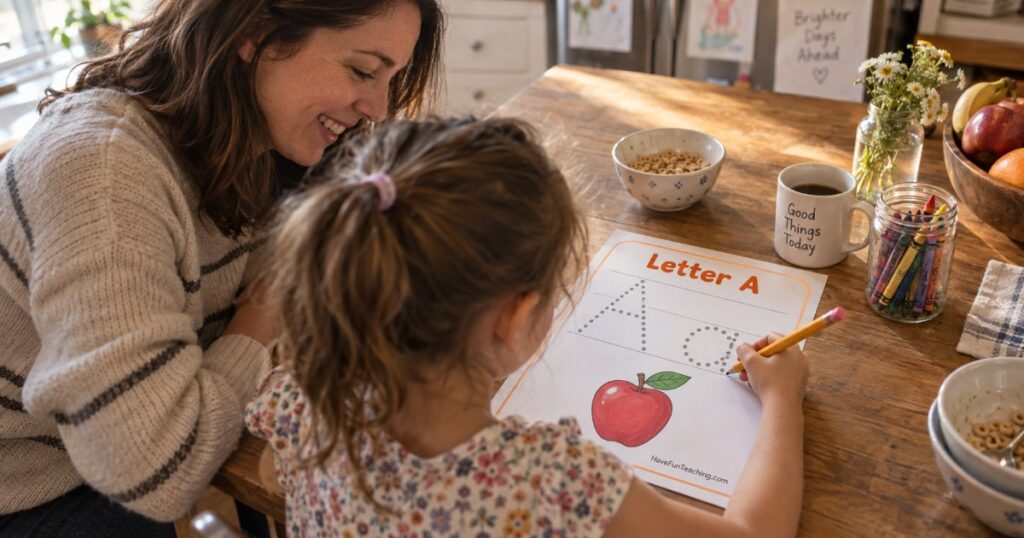
You print a stack of alphabet worksheets on Sunday night, and by Tuesday half of them are still in the tray with three letters traced and a rocket ship drawn in the margin. It isn’t that your kid won’t work. It’s that the page asked for twenty-six things at once, and nobody finishes twenty-six of anything.
The fix is smaller than it sounds. Give one letter at a time, put a picture next to it, and stop while everyone is still cheerful. Below is the order letters actually click in, the two places kids reliably get stuck, and ten printables you can have on the table in about ninety seconds.
The short version
3 days free
Ready for the whole library?
You’ve had your freebie — but members download 10,000+ resources for every grade, all year long. Try it free — $0 today, cancel anytime.
Free for teachers
Pick your grade. We’ll send 10 free resources.
Worksheets, activities and a video — picked for your classroom, ready to print tonight.
One free bundle per teacher. We’ll also send free teaching ideas each week — unsubscribe anytime.



- Letters come in three layers: recognize it, write it, then say its sound. Most stalls happen when a page asks for all three at once.
- Uppercase first. Capitals are made of straight lines and big curves, so small hands win sooner and quit less.
- One letter per sitting beats a full A–Z page. Five focused minutes a day outruns a forty-minute Sunday marathon.
- Have Fun Teaching has 163 alphabet worksheets, plus 82 songs, 86 videos and 34 hands-on activities on the same skill — so a letter that won’t stick on paper can be sung instead.
What alphabet worksheets actually teach, in order
“Knowing the alphabet” is really three separate jobs stacked on top of each other, and good alphabet worksheets only ask for one at a time.
Layer one is recognition. Your child sees a shape and names it. That’s it — no pencil, no sound. Circling every lowercase b in a grid is recognition work, and it’s the layer most of us skip past because it looks too easy.
Layer two is formation. The pencil comes out and the shape has to be built in the right order, starting at the top. Tracing pages with three-line guides live here. Formation is a motor skill, so it improves with repetition on a few letters rather than one pass at all of them.
Layer three is sound. The letter stops being a picture and starts being a job: A makes /ă/, and /ă/ starts apple. This is the layer that turns the alphabet into reading, and it’s the one worth spending the most time on. Reading Rockets has a clear, research-backed walkthrough of how children learn to read if you want the science behind the sequence.
Once you can name which layer a page is working, you can tell in two seconds whether it’s right for tonight — and you stop handing a sound worksheet to a kid who is still deciding which way N faces.
Why kids stall on letters — and what fixes it
Almost every alphabet stall we hear about is one of two things. Neither one means a child is behind.
The b/d/p/q pile-up
Four letters, one circle, one stick, four different arrangements. Kids don’t confuse them because they aren’t paying attention — they confuse them because for the first five years of life a chair is a chair whichever way it’s turned. Print orientation is a new rule.
What helps: separate them in time, not on the page. Teach b one week and d three weeks later, each with its own anchor word and picture. Drilling them side by side teaches the pair as a pair, which is exactly the confusion you’re trying to undo.
The alphabet song ceiling
A child can sing all twenty-six and still not point to M. The song is one long word until the letters get pulled out of it, and that gap surprises a lot of parents who assumed the singing meant the job was done.
What helps: break the chain. Ask for the letter after L without starting at A. Hand over a sheet with letters missing from a short run and have your child fill the gaps. That’s the moment the song turns into twenty-six separate, usable things.

Alphabet songs and videos do the memorizing for you
Paper is where letters get practiced; songs are where they get stored. There’s a reason a four-year-old who can’t reliably find Q can still belt out a whole chorus about it — music gives the brain a hook a worksheet can’t.
Have Fun Teaching has a song for every letter from A to Z. Browse all 82 alphabet songs, or watch the animated versions on the alphabet videos page. The classic Alphabet Song below has been played more than 392 million times on the Have Fun Teaching YouTube channel — a lot of kitchens.
Pair them deliberately: play the letter’s song first, then hand over that letter’s worksheet while the tune is still going. The singing warms up the sound, the page pins it down. If you want to get off the paper entirely for a day, the 34 alphabet activities cover matching, sorting and letter hunts you can run on the floor.
10 alphabet worksheets to print tonight
These ten are pulled from the full set of printable alphabet worksheets and run in the order most kids move through the skill — recognition, then formation, then sound. Start wherever your child actually is, not where the grade level says they should be. Every one comes with an answer key.
-
Preschool · Phonics
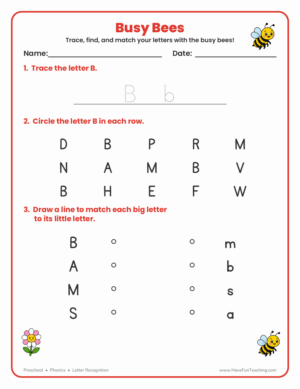
Busy Bees Letter Recognition Worksheet
A cheerful bee-themed page for tracing, finding and matching letters. Pure layer-one work, and a gentle place to start with a preschooler.
-
Preschool · Phonics
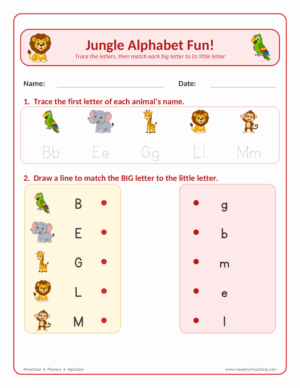
Jungle Animals Alphabet Worksheet
Trace beginning letters and match uppercase to lowercase, with a jungle animal on every prompt. Two pages, so it splits across two short sittings.
-
Kindergarten · Phonics
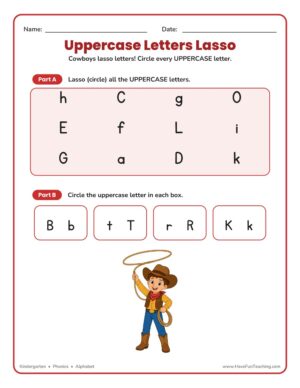
Identifying Uppercase Letters Worksheet
Capital letters get rounded up by a cowboy’s lasso. Same recognition job as a plain grid, except kids ask to do a second one.
-
Kindergarten · Phonics
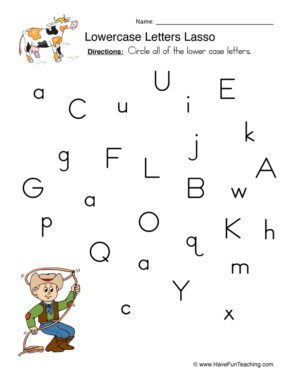
Lowercase Letters Circling Worksheet
Circle every small letter in the grid, then write it on a handwriting guide. It bridges recognition and formation, so it’s a good second step rather than a first one.
-
Kindergarten · Phonics
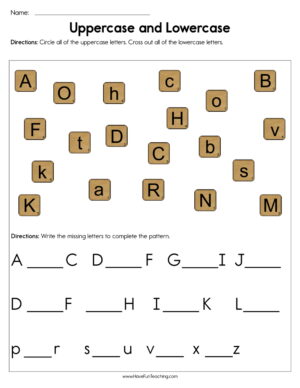
Uppercase and Lowercase Worksheet
Match capital letters to their small partners and sort letters by form. This is the page that finally makes A and a feel like the same thing.
-
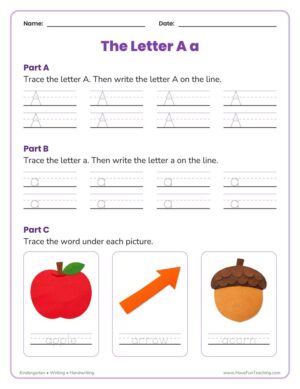
Kindergarten · Phonics
Three-line guides for capital A and lowercase a, plus picture words to trace. There’s one like it for all twenty-six letters, so you can work a letter a day.
-

Kindergarten · Phonics
Letter A Handwriting Practice Worksheet
Trace and then write the letter unaided on clear three-line guides. The unassisted half is where formation actually gets tested, so don’t skip to the end of the row.
-
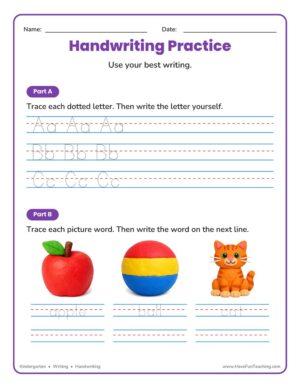
Kindergarten · Phonics
Three-line guides for Aa, Bb and Cc with the picture words apple, ball and cat. Worth keeping spare copies of — it’s what you reach for when a letter needs one more day.
-
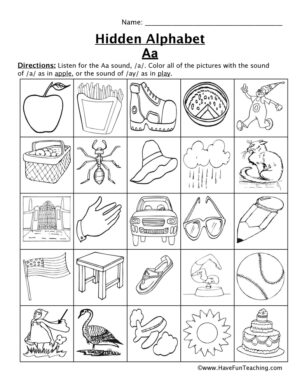
Kindergarten · Phonics
Name six pictures, color the ones that begin with Aa, then trace and write the letter. This is layer three, and it’s the page that quietly turns letter naming into reading.
-
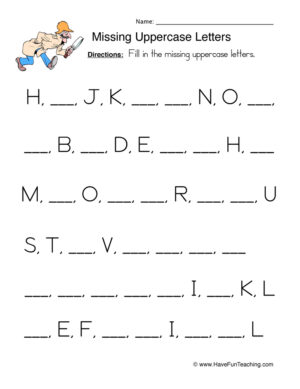
Kindergarten · Phonics
Uppercase Letter Order Worksheet
Fill in the missing capitals in four short alphabet runs, then write the letter that comes next. This is the one that breaks the alphabet song into separate letters.
Teacher tip: Print two copies of tonight’s page. Do the first one together, talking the whole way through it, then hand over the second and walk away. The independent copy is the one that tells you whether the letter actually landed — and it takes no extra prep.
Ready-to-print
163 alphabet worksheets, sorted by grade and letter
Tracing, matching, letter sounds, ABC order and handwriting practice — filter to the exact letter you need and print it in seconds. Answer keys included.
Get the Alphabet Worksheets Browse free resourcesNo login needed to browse · Preschool–6th · Print in seconds
How do I teach the alphabet at home?
Pick one letter. Say its name and its sound, find it somewhere in the room, sing its song, trace it twice, and stop. That loop takes five minutes, and daily beats any weekend marathon.
Teach uppercase first — capitals are straight lines and fat curves, so a three-year-old hand can actually make them, and early wins keep a kid coming back to the table. Skip alphabetical order: start with the letters in your child’s own name, then the workhorses (m, s, t, a, p), then the rest. Saving X and Z for last costs nothing.
And keep it light. A kid who associates letters with being corrected will find a reason to need the bathroom every time the folder comes out.
Five minutes a day, one letter at a time, with a song in it. That’s the whole method — everything else is decoration.
Where to find more alphabet practice
The alphabet section keeps every format for this skill in one place, so you can change the delivery without changing the letter. That matters more than any single printable — the letter that won’t stick on paper often lands on the third listen of a song.
- 163 printables — tracing, recognition, matching, letter sounds, ABC order and handwriting, filterable by grade and by letter.
- 82 songs and 86 videos — one for every letter, plus the animated collections, for the days nobody wants a pencil.
- 34 hands-on activities — letter hunts, matching games and sorting mats you can run on the rug in ten minutes.
Everything prints on regular paper, comes with an answer key, and needs no prep beyond hitting print.
Alphabet worksheet questions teachers ask
What age should a child start alphabet worksheets?
Around three or four, most children can handle recognition pages — circling, finding and matching letters. Hold off on tracing until they can hold a crayon comfortably, usually closer to four. If a page frustrates your child, it is almost always asking for formation before the recognition layer is solid.
Should I teach uppercase or lowercase letters first?
Uppercase first. Capital letters are built from straight lines and simple curves, so small hands succeed at them sooner, and early success keeps kids willing to practice. Lowercase letters have more curves, reversals and tricky pairs like b and d, so they land better once capitals feel automatic.
Are there free alphabet worksheets I can print?
Yes. Have Fun Teaching has hundreds of free printables you can download without an account, including alphabet pages. Browse the free resources section, or filter the alphabet worksheets page by grade to find the right level. A membership unlocks all 163 of them, plus the songs and videos.
Do alphabet songs really help kids learn letters?
They help with memorizing the sequence and the sounds, which is genuine progress. What songs do not do on their own is teach a child to identify a letter out of order. Pair the song with a worksheet that pulls single letters out of the run, and the two together do the whole job.
How long should an alphabet practice session last?
Five to ten minutes, once a day, is plenty for preschool and kindergarten. Short and frequent beats long and occasional every time, because letter formation is a motor skill. Stop while your child is still enjoying it — that is what makes them willing tomorrow.
Every letter, every format, one membership
Alphabet printables, songs, videos and activities for Preschool through 6th grade — plus every other skill your year runs on. Print it tonight, teach it tomorrow.
- 10,000+ ready-to-teach resources
- Preschool–6th grade
- Loved by 2M+ teachers & homeschoolers
No card required to start · Cancel anytime
3 days free
Ready for the whole library?
You’ve had your freebie — but members download 10,000+ resources for every grade, all year long. Try it free — $0 today, cancel anytime.
Free for teachers
Pick your grade. We’ll send 10 free resources.
Worksheets, activities and a video — picked for your classroom, ready to print tonight.
One free bundle per teacher. We’ll also send free teaching ideas each week — unsubscribe anytime.