
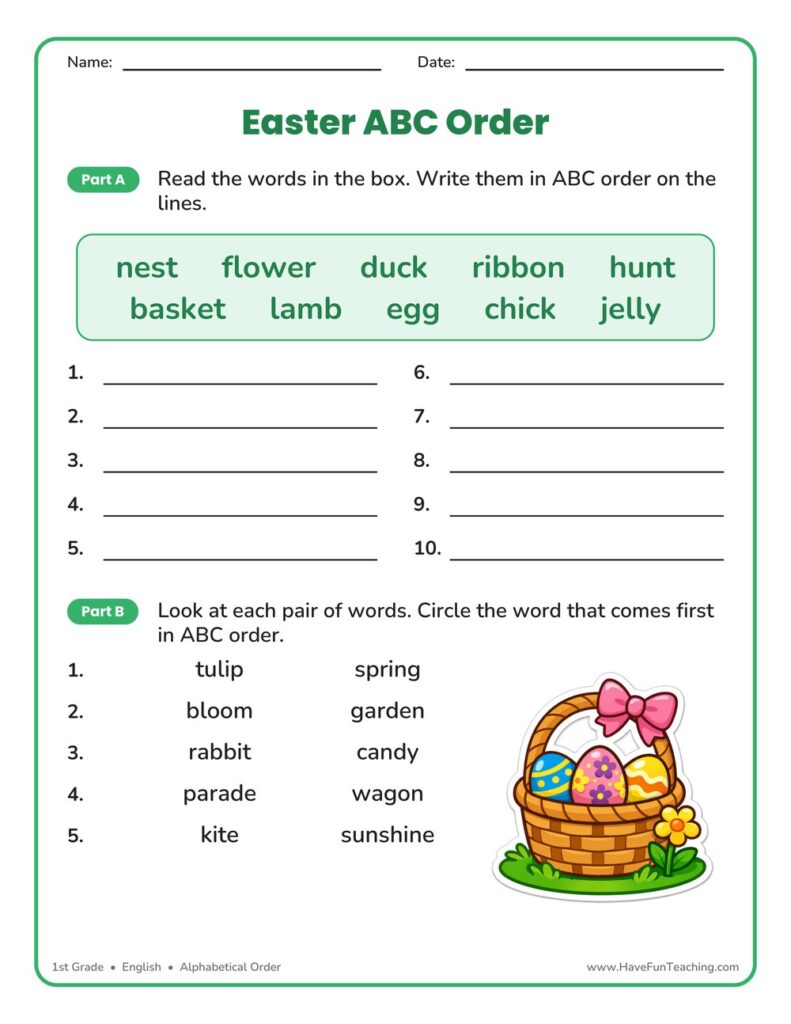
Easter Hunt ABC Order Worksheet
This Easter Hunt ABC Order Worksheet gives 1st graders ten spring words to arrange in alphabetical order, plus five quick pairs to compare. An answer key is included, so ABC practice stays fast and stress-free.
$6.97
Or free with a membership — members pay $3.33/mo for all 10,000+ resources. See plans
Want this one free?
Tell us where to send it and it’s yours — no card, no catch.
One free resource per teacher. We’ll also send free teaching ideas each week — unsubscribe anytime.
Teaching is easier with a membership
Unlimited printables, games & videos for PreK–6th — for your classroom or homeschool. Cancel anytime.
Start your 3-day free trial$0 today · cancel anytime · Instant access to 10,000+ resources
About this resource
Description
Alphabetical order is one of the first true reference skills a young reader learns, and it pays off every time a child opens a dictionary, a glossary, or a classroom word wall. This Easter Hunt ABC Order Worksheet gives first graders a friendly, spring-themed way to practice it. Every word on the page begins with a different letter, so students focus on the one thing that matters at this stage: finding each word’s first letter and placing it in the right spot in the alphabet.
The Easter alphabetical order worksheet is built in two short parts. In Part A, students read ten Easter and springtime words in the word box — basket, chick, duck, egg, flower, hunt, jelly, lamb, nest, and ribbon — and rewrite them in ABC order on ten numbered writing lines. The lines are sized for first-grade handwriting, so there is real room to write. In Part B, students look at five fresh word pairs and circle the word in each pair that comes first alphabetically. Because the Part B words never appear in Part A, the second half checks whether the skill has transferred rather than whether the list was memorized.
What’s Included
- 1 print-ready PDF worksheet
- Answer key
- 10 words to write in ABC order plus 5 circle-the-first-word pairs
This Easter Hunt ABC Order Worksheet helps children in three ways. First, it builds automatic alphabet sequencing — the child has to hold the alphabet in mind and search it, which is very different from simply reciting it. Second, it strengthens careful reading, because each word must be read before it can be sorted. Third, the two-part design moves students from a supported list to independent judgment, which is exactly how a skill becomes reliable.
Teachers and parents can stretch the practice further. Write the ten words on index cards and let children physically sort them across a table, or hide the cards around the room for a real classroom hunt and alphabetize whatever is found. Try alphabetizing classmates’ first names, the ingredients on a snack label, or the books on one shelf. Sing the alphabet slowly while a child points to each letter, then ask which of two letters comes first — that quick game is the whole skill in miniature.
Related Resources
What teachers say
Reviews
You must be logged in to post a review.

This alphabetical order to the first letter worksheet has 1st graders write ten simple words in ABC order. An answer key is included, making it easy to check and build early dictionary skills.

This living and non-living things ABC order worksheet has 1st grade students sort twelve words into two columns and write each list in alphabetical order. An answer key is included for quick, easy checking.

This letter order placement worksheet gives 1st Grade students four sets of six mixed-up letters to write in ABC order, with roomy boxes and an answer key included for quick checking.

Using Connect Four Putting Letters in Order Activity, students play Connect Four to practice putting letters in alphabetical order.
This Dogs Hard Alphabetical Order Activity will teach your students how to put three sets of sight words with repeating letters in alphabetical order.

This Valentine’s Day ABC Order Worksheet asks 1st graders to put eight holiday words in alphabetical order on numbered writing lines. An answer key is included, so checking the page takes seconds.

Using this Letter Order Activity, students order letters in alphabetical order to build their letter recognition and order skills.
This Farm Easy Alphabetical Order Activity will teach your students how to put three sets of sight words in alphabetical order.

This Dr. Seuss Books Alphabetical Order Worksheet will teach your students how to put seven Dr. Seuss books words in ABC order.

This Weather Names Alphabetical Order Worksheet will teach your students how to put weather words in ABC order.

This Rainforest ABC Order Activity will teach your students how to put eight words about Rainforest in alphabetical order.
This Ocean Hard Alphabetical Order Activity will teach your students how to put three sets of words about ocean vocabulary in alphabetical order.
Reviews
There are no reviews yet