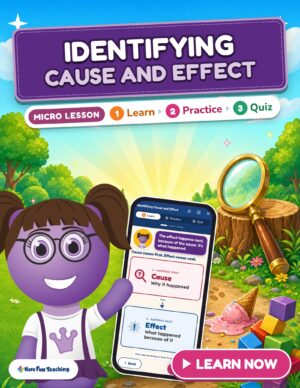
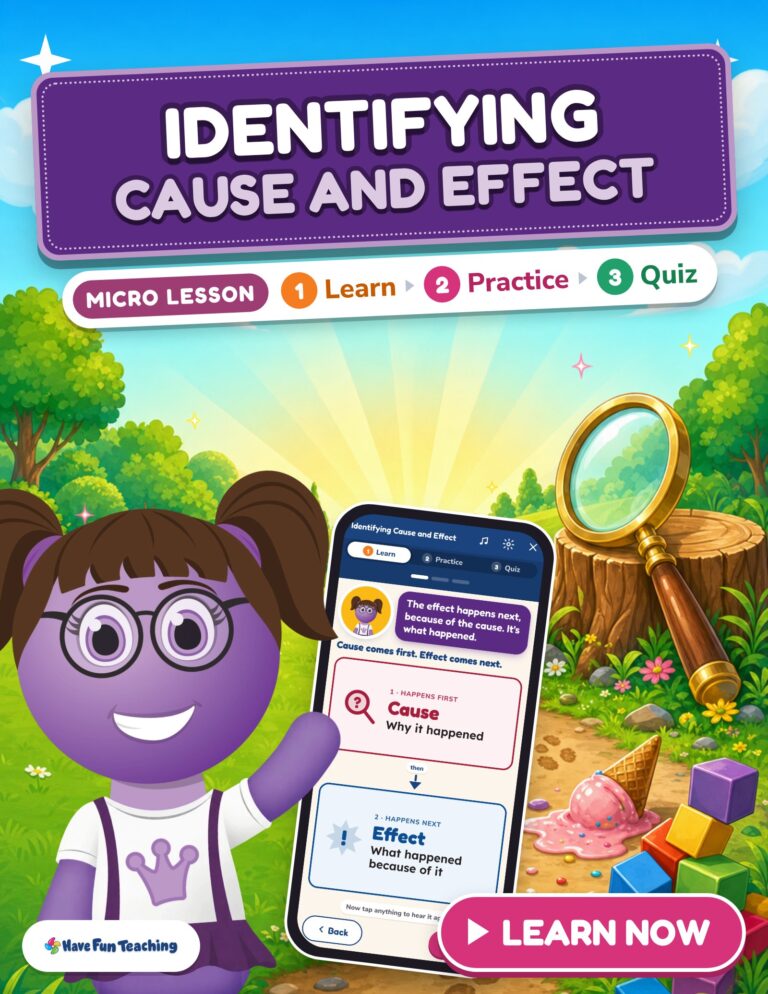
Lexy teaches kids how to find the cause and the effect, one step at a time. Kids practice with friendly hints, then show what they know in a 5-question quiz. Quiz scores go to HFT Classroom automatically.
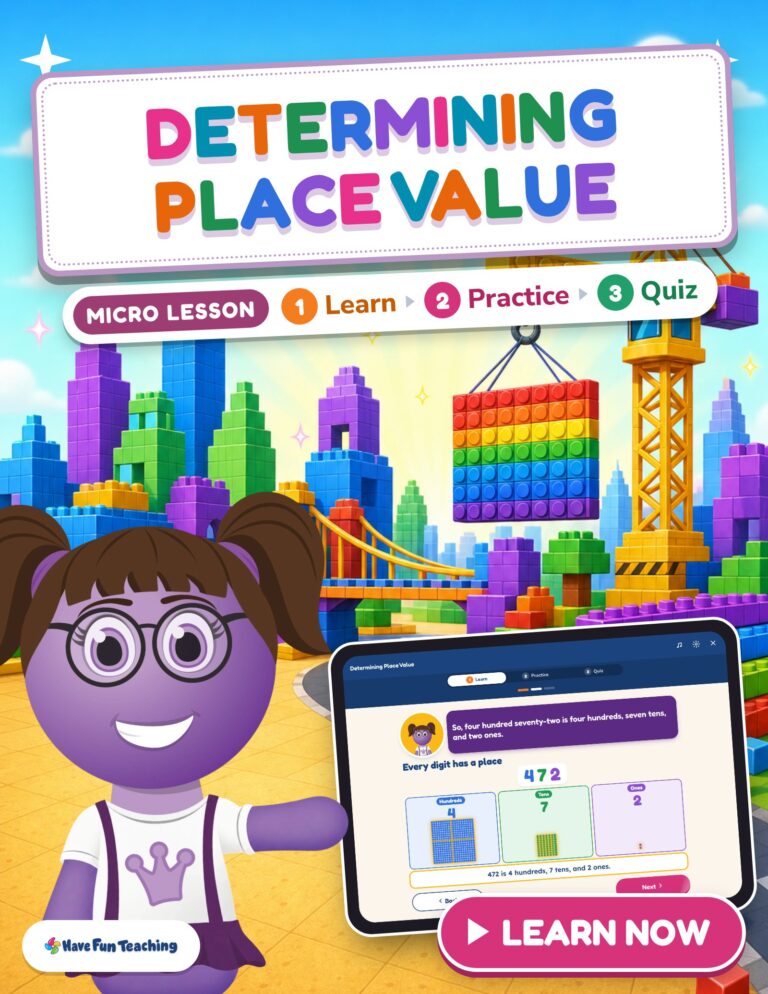
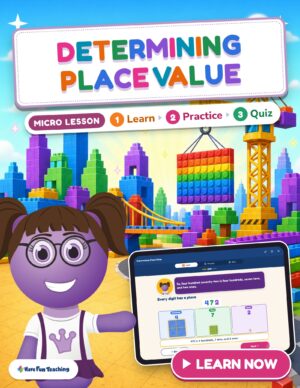
Lexy teaches kids how to find the hundreds, tens and ones in a number, one step at a time. Kids practice with friendly hints, then show what they know in a 5-question quiz. Quiz scores go to HFT Classroom automatically.
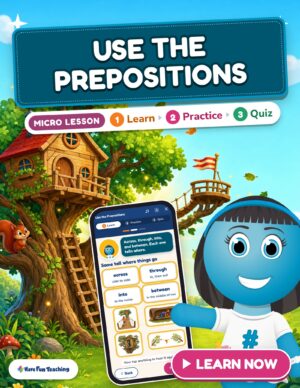
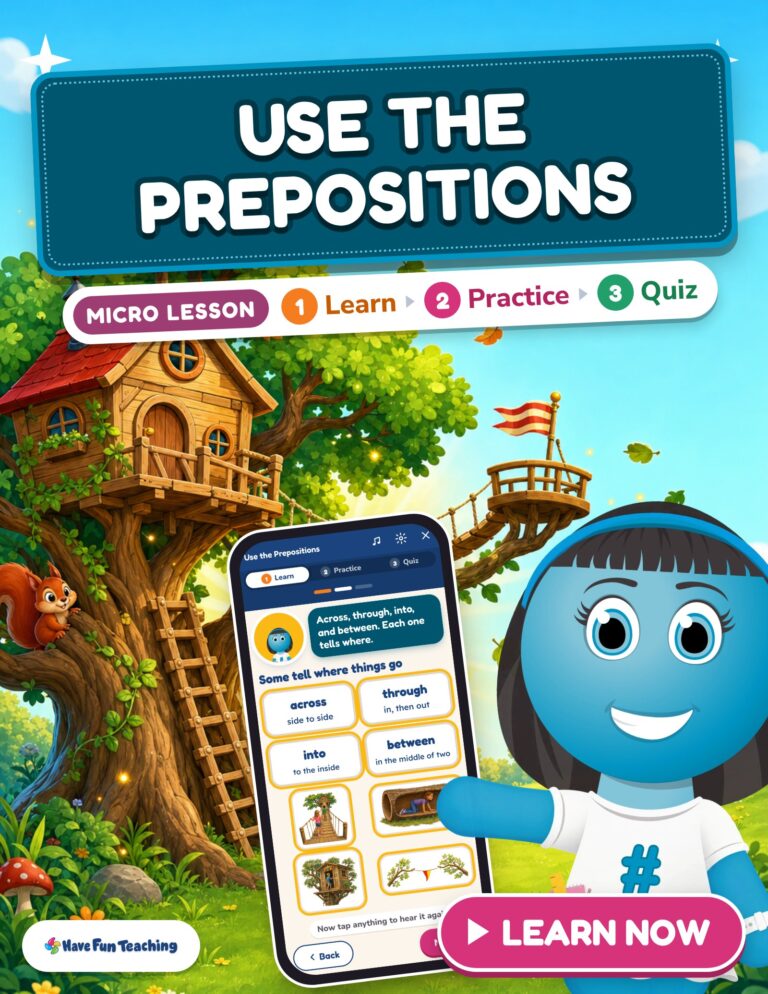
Penny teaches kids what a preposition is and how to pick the one that tells where, one step at a time. Kids practice with friendly hints, then show what they know in a 5-question quiz. Quiz scores go to HFT Classroom automatically.
A micro lesson teaches one skill, start to finish, in about the time it takes to sharpen a pencil. Kids see the idea modeled, try a few examples with read-aloud support, and get instant feedback on every answer. One skill per lesson is the whole trick: determining place value, or finding cause and effect, or using prepositions. Because it is short and focused, it fits right into a center rotation, a pull-out group or homework, and kids finish feeling successful.
How we use micro lessons in a real classroom
A micro lesson works best when it is part of a plan, not a filler. These are the three ways we lean on them.
Watch it, then try it
Start the place value lesson on the board with the whole class and pause after the modeled example. Ask, "What is the 7 worth?" before anyone clicks. Then send kids to try the rest on their own device while you pull a small group.
Why it works: handing over the work step by step, from teacher to student, is one of the most widely used teaching frameworks (Pearson and Gallagher, 1983).
Right after the cause and effect lesson, hand out three sticky notes. Kids write one cause and its effect from their own day, like "I forgot my coat, so I was cold." Ten seconds of reading tells you who got it and who needs another go.
Why it works: pulling an answer out of memory makes it stick far better than rereading it, one of the strongest findings in learning research (Dunlosky and colleagues, 2013).
A micro lesson is short enough to repeat. Run the prepositions lesson on Monday, then replay it the following Monday as a warm-up. Kids who struggled the first time usually breeze through the second, and that confidence boost is real.
Why it works: short practice spread over several days beats one long session, according to a large review of learning research (Dunlosky and colleagues, 2013).
Most take about 5 to 10 minutes. Each one teaches a single skill, so kids can finish in one sitting without losing focus.
What grades are micro lessons for?
They are written for elementary students. Read-aloud support helps younger or emerging readers work on their own, and older kids can move through them independently.
Can students do micro lessons at home?
Yes. They run in the browser, so they work well for homework or a quick review with a parent. Kids get feedback on every answer, so they are not practicing mistakes.
Do micro lessons replace my teaching?
No, they support it. We use them to preview a skill, review it later, or give extra practice to a small group while we work with another one.
Written by the Have Fun Teaching team of elementary teachers and homeschoolers. Research: Pearson, P. D., & Gallagher, M. C. (1983). The instruction of reading comprehension. Contemporary Educational Psychology, 8(3). Dunlosky, J., Rawson, K. A., Marsh, E. J., Nathan, M. J., & Willingham, D. T. (2013). Improving Students' Learning With Effective Learning Techniques. Psychological Science in the Public Interest, 14(1).
3 days free
2:39Ready to print!
Printables · Songs · Games
Loved by 2 million teachers & families
Where learning feels like play.
Printables, songs and games for every subject, Preschool through 6th. Ready to teach today, and kids beg for more.
$0due today
then $39.97$35.97for your first year, and $39.97 a year after that.

 Try it withDetermining Place Value Micro LessonMicro LessonsOpen it →