

How Many Faces and Vertices? Worksheet
This How Many Faces and Vertices? Worksheet has 2nd Grade students count the flat faces and corners on six solid figures, then compare their answers. Answer key included, so checking takes seconds.
$6.97
Or free with a membership — members pay $3.33/mo for all 10,000+ resources. See plans
Want this one free?
Tell us where to send it and it’s yours — no card, no catch.
One free resource per teacher. We’ll also send free teaching ideas each week — unsubscribe anytime.
Teaching is easier with a membership
Unlimited printables, games & videos for PreK–6th — for your classroom or homeschool. Cancel anytime.
Start your 3-day free trial$0 today · cancel anytime · Instant access to 10,000+ resources
About this resource
Description
Solid figures are where geometry stops being flat, and this How Many Faces and Vertices? Worksheet gives second graders a clear, hands-on way to describe them. A face is one of the flat surfaces on a solid shape. A vertex is a corner, the point where the edges of those faces meet. Once a child can count both, a cube stops being “a box” and becomes a shape with six faces and eight vertices — a thing that can be named, compared and sorted by its attributes. That is exactly what the second grade geometry standards ask for, and it is the language every later lesson on volume, surface area and nets is built on.
The sheet works in two short parts. Part A shows six solid figures drawn the way a textbook draws them, with the hidden edges dashed so a child can see all the way around each shape and count the corners at the back as well as the front: a cube, a square pyramid, a cylinder, a triangular prism, a rectangular prism and a triangular pyramid. Under each figure are two labeled writing lines, one for faces and one for vertices. Part B then asks the child to look back at those answers and reason with them — which shape has no vertices at all, and which two shapes share the same number of vertices. That second part is the step from counting to comparing. Use this How Many Faces and Vertices? Worksheet as morning work, as a math-center task, as homework, or as a quick check before a geometry unit test.
What’s Included
- One printable 2nd Grade math worksheet, ready to print on US Letter paper
- Part A: six solid figures with dashed hidden edges, each with faces and vertices lines
- Cube, square pyramid, cylinder, triangular prism, rectangular prism and triangular pyramid
- Part B: two comparison questions that send students back to their own answers
- A full answer key on the final page
This worksheet helps children in three concrete ways. First, the dashed hidden edges make the count honest: a child cannot get eight vertices on a cube by counting only the four corners facing them, so the drawing itself teaches that a solid has a back. Second, the six shapes are chosen so the answers spread out — two faces, four, five and six all appear, and one shape has zero vertices — which stops a student from settling into a pattern and forces a fresh count every time. Third, Part B turns the finished chart into evidence: comparing the shapes is real reasoning, not another round of counting, and it is the kind of question a test will ask.
Teachers and parents can stretch this 2nd grade geometry worksheet well past one sitting. Hand out real objects — a tissue box, a soup can, a party hat, a wooden block — and have children match each one to a figure on the page before they write anything. Ask them to trace a finger along every edge of a shape while counting out loud, which catches the corners that hide at the back. After the sheet is finished, cover the pictures and read out a pair of numbers, then let a partner name the shape. For an extra challenge, have students count the edges too and look for the pattern that connects faces, vertices and edges.
Related Resources
What teachers say
Reviews
You must be logged in to post a review.

Using the Shapes Song, students learn all about shapes, including Shape Names and Shape Recognition. The Shapes Song by Have Fun Teaching is a song that teaches the shapes. Shapes have names their made of angles and lines, there are flat shapes and solid shapes we see them all the…

This Identifying the Name of Shapes Worksheet helps 2nd graders choose the correct name for each 2D shape, from circles to hexagons. Answer key included—a quick, no-prep geometry practice for home or class.

Using the Circle Song, students will learn all about circles. A circle is a shape that goes around and around. It's like a pizza, and a cookie, a ring, and a coin. A circle is a shape that goes around and around. In this song, your kids will also draw…

Using the Square Song (MP3), students learn all about squares, including Shape Names and Shape Recognition through a catchy song!
Using the Shape Song (MP3), students learn all about shapes, including Shape Names and Shape Recognition through a catchy song!

In this Seaside Symmetry Activity, students recognize a line of symmetry for a two-dimensional figure as a line across the figure such that the figure can be folded along the line into matching parts.

Using the Shape Songs (MP3 Album), students learn all about shapes, including Shape Names and Shape Recognition through a catchy song!

A drawing shapes by the rules worksheet where 2nd graders read an attribute clue, draw the matching shape, name it, and count its sides and corners. Answer key included for fast, no-prep geometry practice.
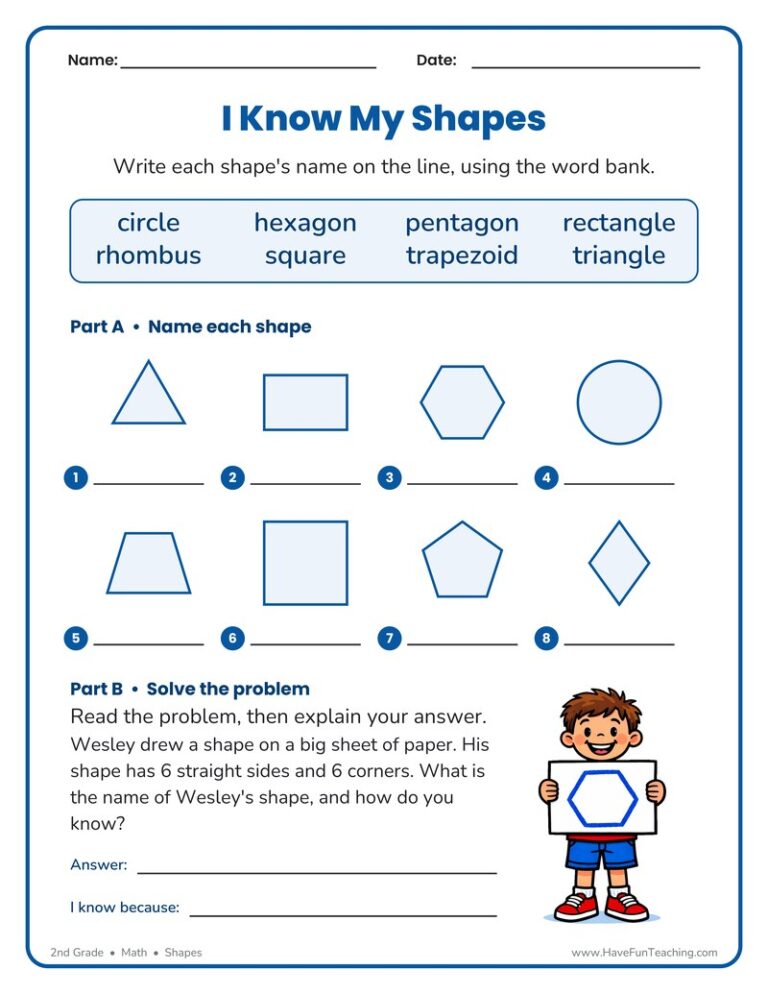
This Identifying Shapes Worksheet asks 2nd graders to name eight figures from a word bank, then explain a six-sided shape. Answer key included, making it a quick no-prep geometry review.
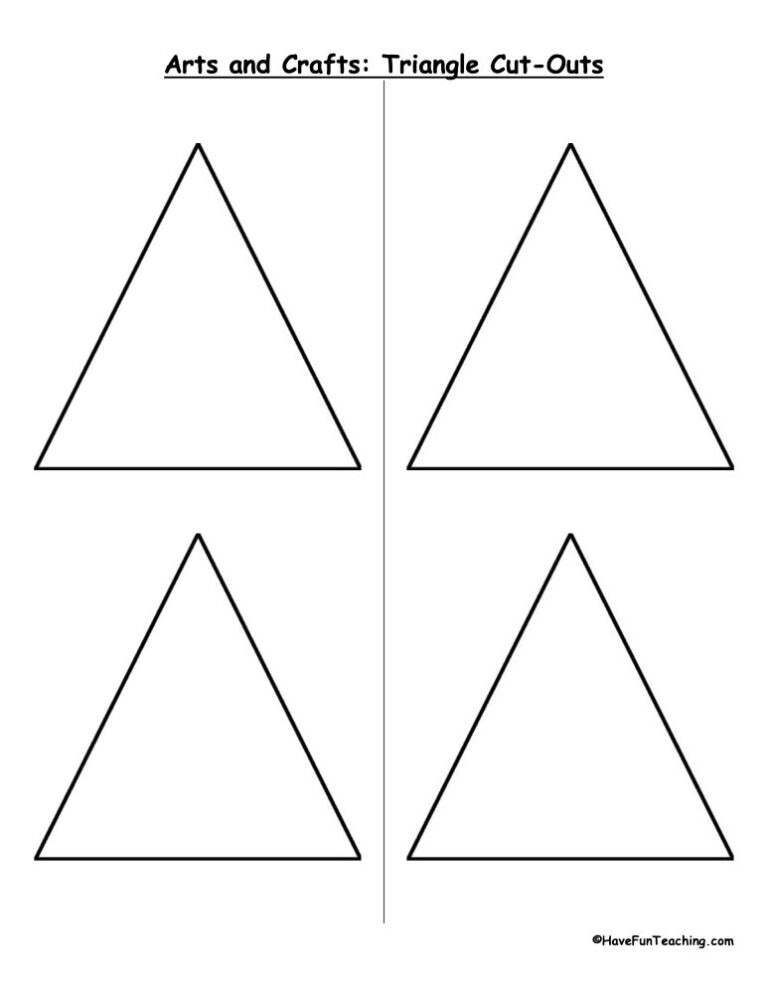
These Triangle Cut Outs will quickly give you templates for classroom decoration or student activities.
Using the Circle Song (MP3), students learn all about circles, including Shape Names and Shape Recognition through a catchy song!

Using the Triangle Song (MP3), students learn all about triangles, including Shape Names and Shape Recognition through a catchy song!




Reviews
There are no reviews yet