
Identifying Shapes Worksheet
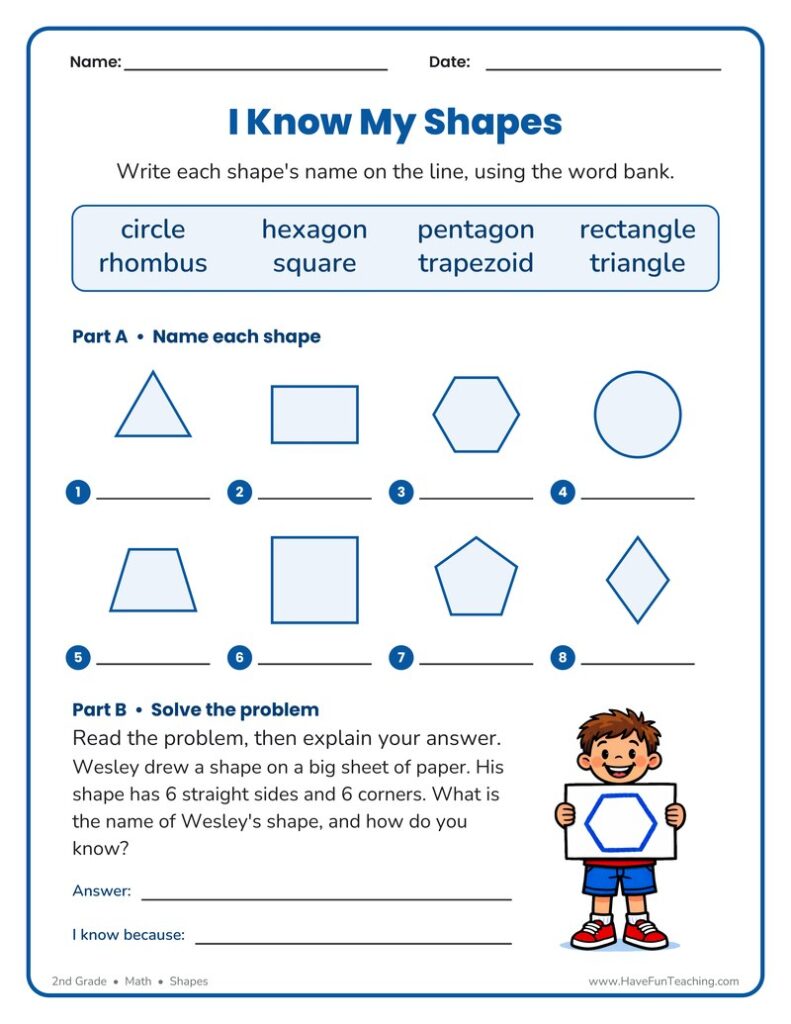
This Identifying Shapes Worksheet asks 2nd graders to name eight figures from a word bank, then explain a six-sided shape. Answer key included, making it a quick no-prep geometry review.
$6.97
Want this one free?
Tell us where to send it and it’s yours — no card, no catch.
One free resource per teacher. We’ll also send free teaching ideas each week — unsubscribe anytime.
Free teacher account · no credit card
Membership
Get every game, song, & printable
- Every game, on any device
- 10,000+ printables
- Assign online with HFT Classroom
Then $39.97/year · cancel anytime · See plans
- Instant digital download
- Printable PDF + answer key
- Made by real teachers
Teacher / Family membership
Teaching is easier with every resource
One membership for your whole year: 10,000+ worksheets, games, songs and videos for Preschool–6th, for your classroom or homeschool.
- Unlimited printables & downloads
- Every game, on any device
- Assign online with HFT Classroom
- Cancel anytime
Teacher / Family membership · 3 days free
Yearly
Monthly would be $119.64 a year
$3.33/month
Billed $39.97 once a year
You save $79.67 every year
Start My 3 Free Days$0 today · cancel anytime
Monthly
$9.97/month
Flexible, month to month
Yearly is just $3.33/mo. Switch and save $79.67
Start My 3 Free Days$0 today · cancel anytime
About this resource
Description
Naming shapes is where geometry begins. Before a child can measure a figure, partition it, or find its area, they have to look at it and say what it is — and by second grade that list has grown well past circles and squares to include pentagons, hexagons, rhombuses, and trapezoids. This identifying shapes worksheet gives students eight clean, correctly drawn figures and asks them to name each one, which is exactly the recognition work that later geometry standards are built on top of.
This 2nd grade geometry worksheet keeps the task simple to read and honest to the math. A word bank across the top holds all eight shape names in alphabetical order, so a child who recognizes a hexagon but cannot yet spell it still gets full credit for knowing it. Part A shows eight shapes — triangle, rectangle, hexagon, circle, trapezoid, square, pentagon, and rhombus — each with a writing line beneath it. The shapes are deliberately not printed in word-bank order, so students have to actually look at each figure instead of matching down the list. Part B closes with a short word problem: Wesley draws a shape with six straight sides and six corners, and the student names it and explains how they know. Print it, hand it out, and use Part B as the discussion starter.
What’s Included
- 1 print-ready PDF worksheet
- Answer key
- An 8-word shape bank, 8 name-the-shape figures, and 1 explain-your-thinking word problem
There are three reasons this identifying shapes worksheet helps children learn shape names that stick. First, every figure is drawn to true geometric proportion, so a pentagon really has five equal sides and a rhombus really is a slanted equal-sided quadrilateral — children are not learning a cartoon version they will have to unlearn later. Second, the shapes appear in a scrambled order relative to the word bank, which quietly blocks the guess-in-order strategy and forces genuine recognition. Third, the closing word problem moves from naming to reasoning: a student who can explain that six sides and six corners means hexagon understands the shape by its attributes, which is precisely what the second grade standard asks for.
Teachers and parents can keep this going all week. Go on a shape hunt around the room or the neighborhood and tally every hexagon, trapezoid, and rhombus you find — stop signs, honeycomb, road signs, and floor tiles are all fair game. Build shapes with craft sticks or pipe cleaners and count the sides and corners out loud as you go. Play a guessing game where one person describes a shape only by its number of sides and corners and the other names it. Fold paper into squares and triangles and talk about what changed. The more often a child says the shape name while pointing at the real figure, the faster the vocabulary becomes automatic.
Related Resources
What teachers say
Reviews
You must be logged in to post a review.

Using the Shapes Song, students learn all about shapes, including Shape Names and Shape Recognition. The Shapes Song by Have Fun Teaching is a song that teaches the shapes. Shapes have names their made of angles and lines, there are flat shapes and solid shapes we see them all the…

This Identifying the Name of Shapes Worksheet helps 2nd graders choose the correct name for each 2D shape, from circles to hexagons. Answer key included—a quick, no-prep geometry practice for home or class.

Using the Circle Song, students will learn all about circles. A circle is a shape that goes around and around. It's like a pizza, and a cookie, a ring, and a coin. A circle is a shape that goes around and around. In this song, your kids will also draw…

Using the Square Song (MP3), students learn all about squares, including Shape Names and Shape Recognition through a catchy song!
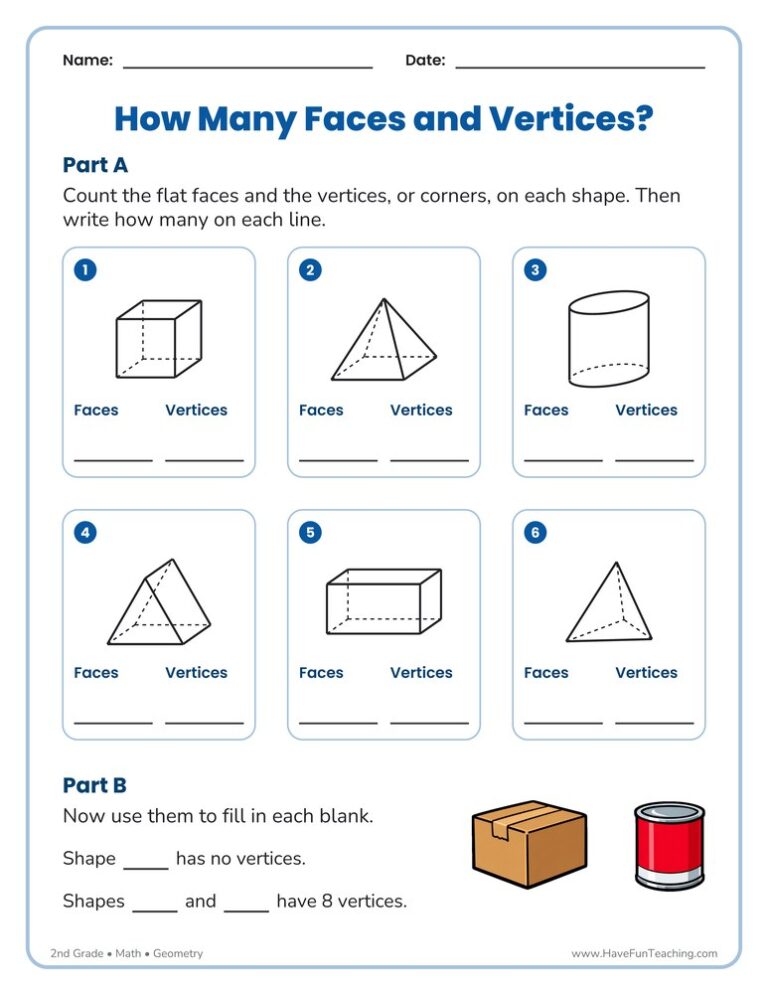
This How Many Faces and Vertices? Worksheet has 2nd Grade students count the flat faces and corners on six solid figures, then compare their answers. Answer key included, so checking takes seconds.

Using the Triangle Song (MP3), students learn all about triangles, including Shape Names and Shape Recognition through a catchy song!

Using the Shape Songs (MP3 Album), students learn all about shapes, including Shape Names and Shape Recognition through a catchy song!
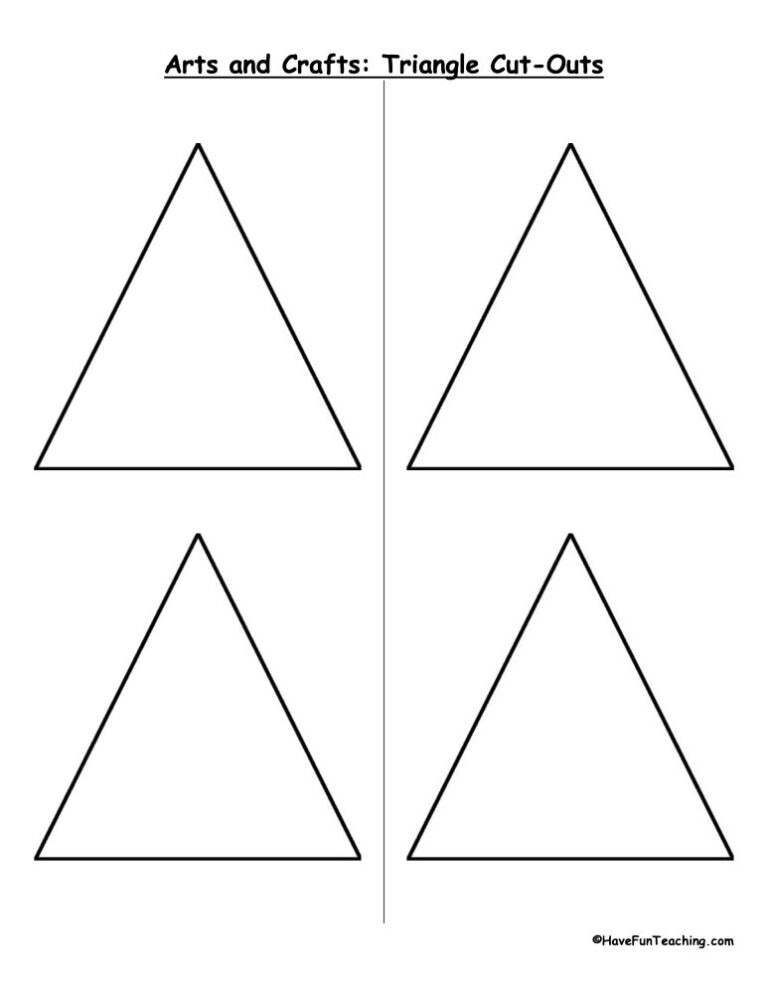
These Triangle Cut Outs will quickly give you templates for classroom decoration or student activities.

A drawing shapes by the rules worksheet where 2nd graders read an attribute clue, draw the matching shape, name it, and count its sides and corners. Answer key included for fast, no-prep geometry practice.
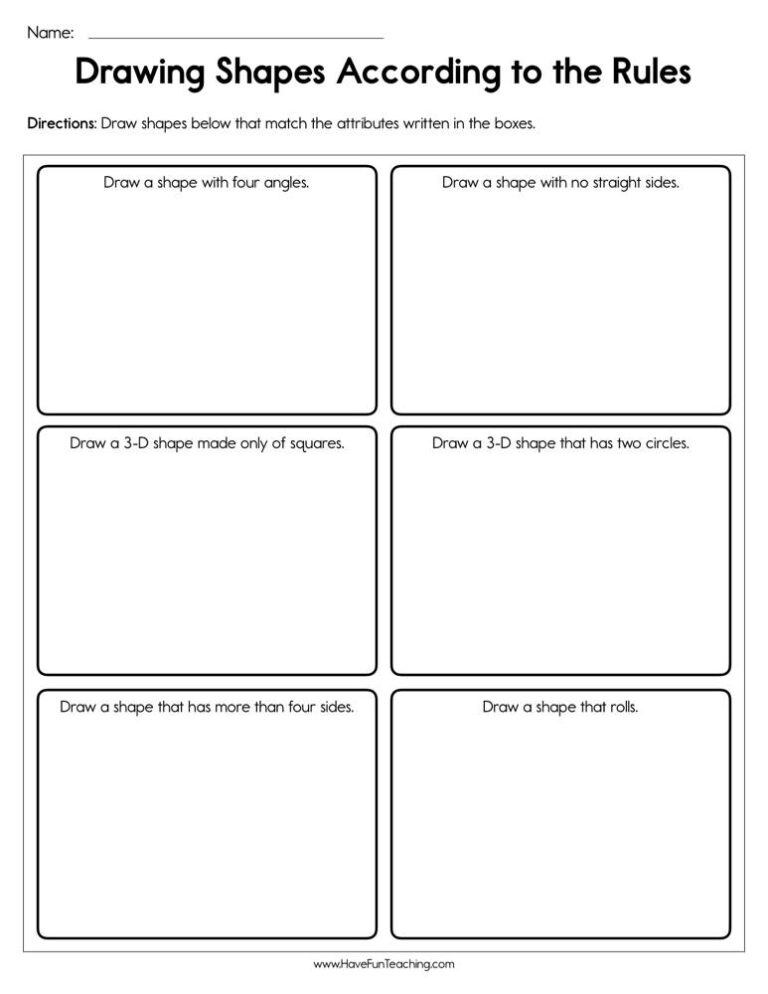
This drawing shapes according to the rules worksheet has 2nd graders read six shape rules, draw each shape, and name it from a word bank. An answer key is included for quick checking.
Using the Shape Song (MP3), students learn all about shapes, including Shape Names and Shape Recognition through a catchy song!
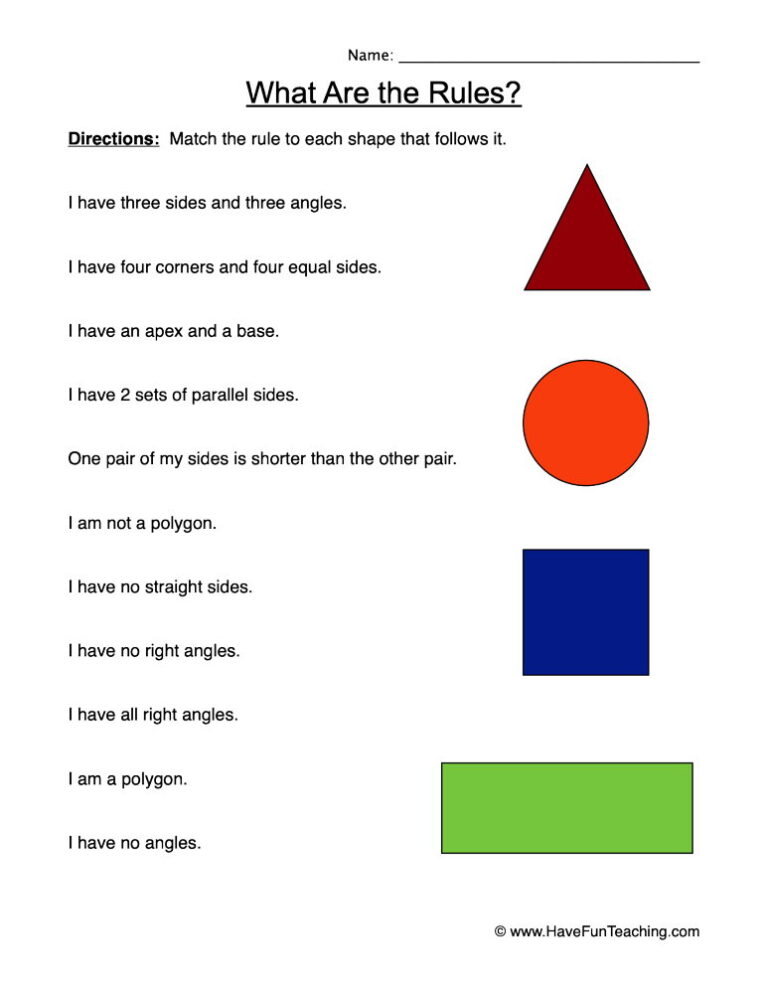
This matching shape attributes worksheet has 2nd graders match five shapes to the rules they follow, then count sides and corners. An answer key is included, so checking work takes seconds.
Reviews
There are no reviews yet