
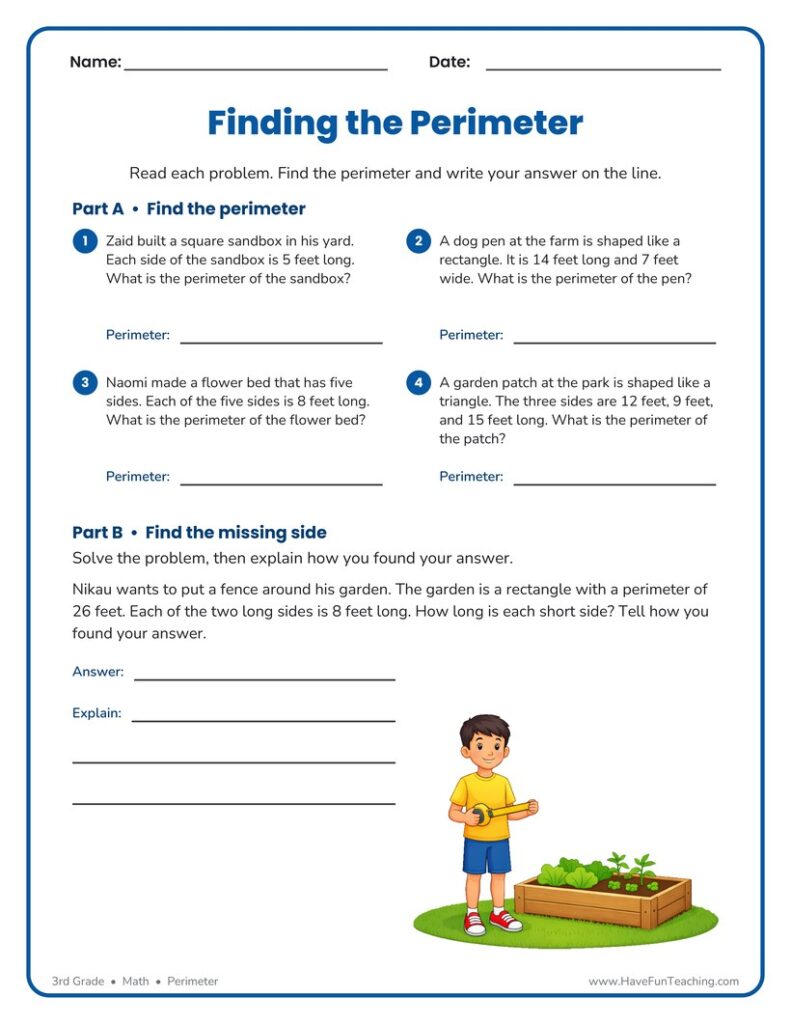
Solving Perimeter Word Problems Worksheet
A Solving Perimeter Word Problems Worksheet that gives 3rd graders five real-world problems, including one missing-side challenge with a written explanation. Answer key included for fast, no-prep perimeter practice.
$6.97
Or free with a membership — members pay $3.33/mo for all 10,000+ resources. See plans
Want this one free?
Tell us where to send it and it’s yours — no card, no catch.
One free resource per teacher. We’ll also send free teaching ideas each week — unsubscribe anytime.
Teaching is easier with a membership
Unlimited printables, games & videos for PreK–6th — for your classroom or homeschool. Cancel anytime.
Start your 3-day free trial$0 today · cancel anytime · Instant access to 10,000+ resources
About this resource
Description
Perimeter is the distance all the way around the outside of a flat shape, and third graders meet it everywhere — a fence around a garden, a border around a bulletin board, trim around a rug. This Solving Perimeter Word Problems Worksheet takes that idea off the page and into real situations, so students add side lengths for a purpose instead of copying a formula. Working from a written story also asks children to decide what the numbers mean before they compute, which is exactly the reasoning third-grade standards expect.
This 3rd grade geometry worksheet gives students two kinds of practice on one page. Part A holds four short word problems about a square sandbox, a rectangular dog pen, a five-sided flower bed, and a triangular garden patch, each with a writing line for the answer. Part B raises the difficulty: students are told the perimeter of a rectangle and the length of its two long sides, then work backward to find the missing short side and explain their thinking on the lines provided. Use it as guided practice after a lesson, as morning work, as a quick check before a unit test, or as homework that parents can follow easily.
What’s Included
- 1 print-ready PDF worksheet
- Answer key
- 4 perimeter word problems plus 1 missing-side problem with a written explanation
There are three reasons this Solving Perimeter Word Problems Worksheet helps children learn. First, every problem names a real object with believable measurements, so students build a mental picture instead of guessing at which operation to use. Second, the shapes vary — square, rectangle, pentagon, triangle — so children learn that perimeter always means adding every side, not memorizing one rule for one shape. Third, the missing-side problem asks students to reverse their thinking and then justify it in writing, which turns a computation exercise into genuine mathematical reasoning.
Teachers and parents can stretch this skill well past the page. Hand students a tape measure and let them find the perimeter of a desk, a doormat, or a book, then compare their answers. Mark a rectangle on the playground with chalk and have children walk its perimeter, counting heel-to-toe steps for each side. Build shapes with craft sticks of equal length so the perimeter can be counted rather than calculated. For an extra challenge, give a perimeter and ask students to design as many different rectangles as they can that match it — a quick, playful introduction to the idea that shape and perimeter are not the same thing.
Related Resources
What teachers say
Reviews
You must be logged in to post a review.
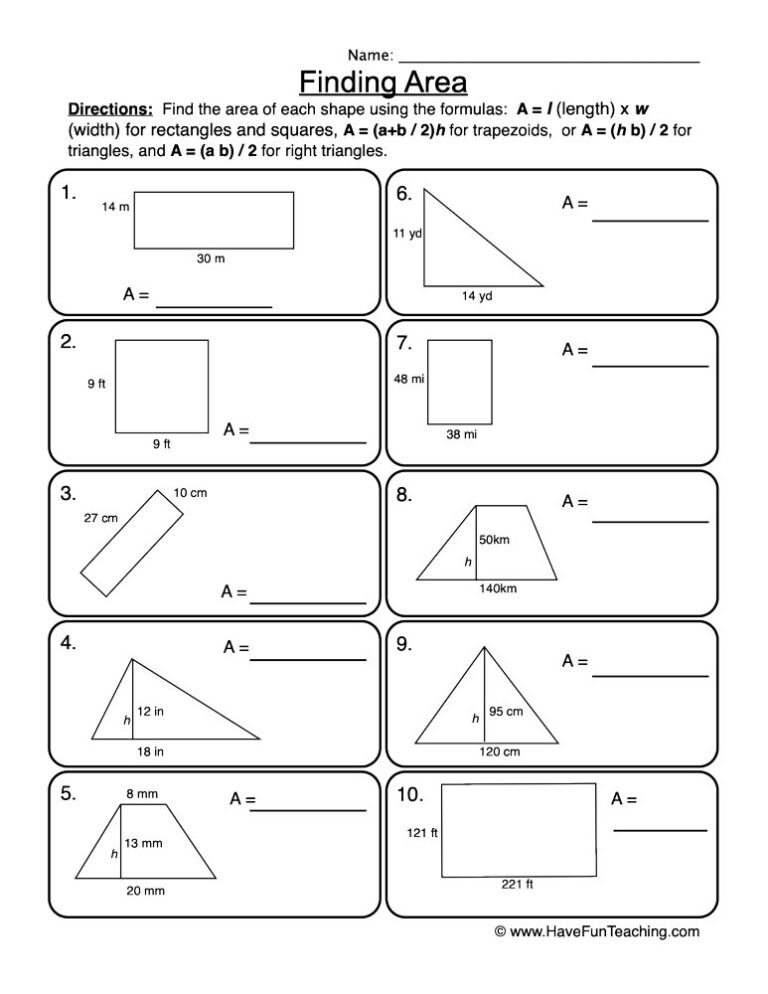
A Finding Different Shapes Area Worksheet where 3rd graders find the area of rectangles, squares, and composite shapes in square units. Answer key included—great for no-prep area practice.

This 3rd grade Finding the Area of Grid Shapes Worksheet has students count unit squares to find the area of rectangles and L-shapes. Answer key included.
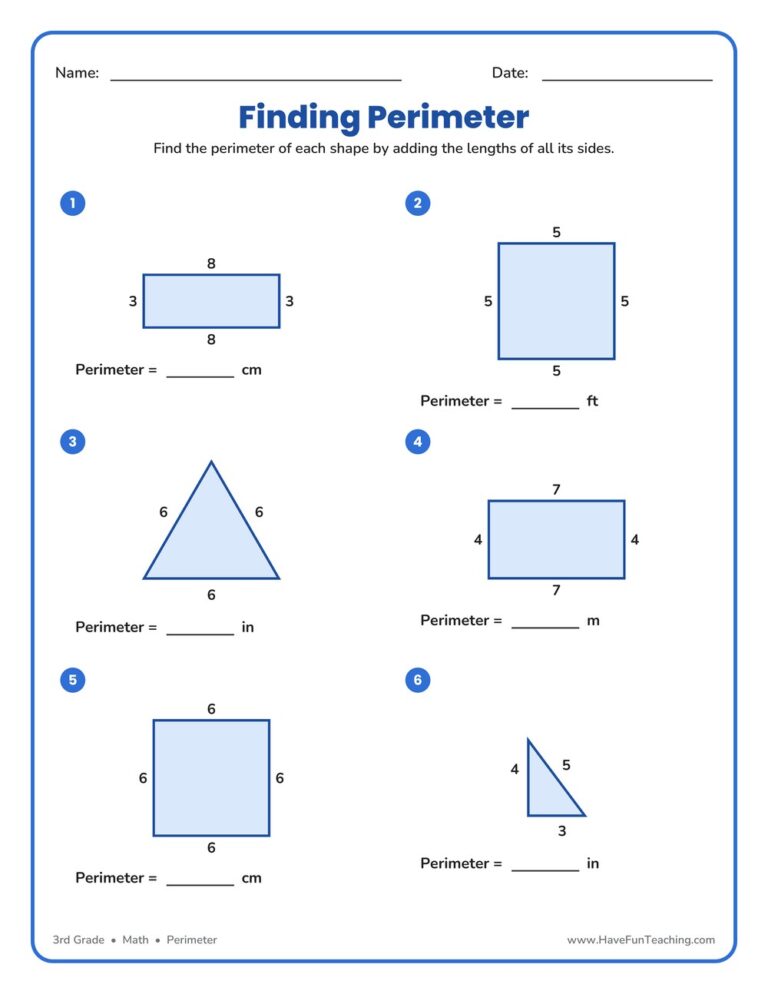
A 3rd grade finding shape perimeter worksheet where students add the side lengths of rectangles, squares, and triangles to find each shape’s perimeter. Includes a complete answer key for quick, no-prep geometry practice.

Using the Shapes Song, students learn all about shapes, including Shape Names and Shape Recognition. The Shapes Song by Have Fun Teaching is a song that teaches the shapes. Shapes have names their made of angles and lines, there are flat shapes and solid shapes we see them all the…
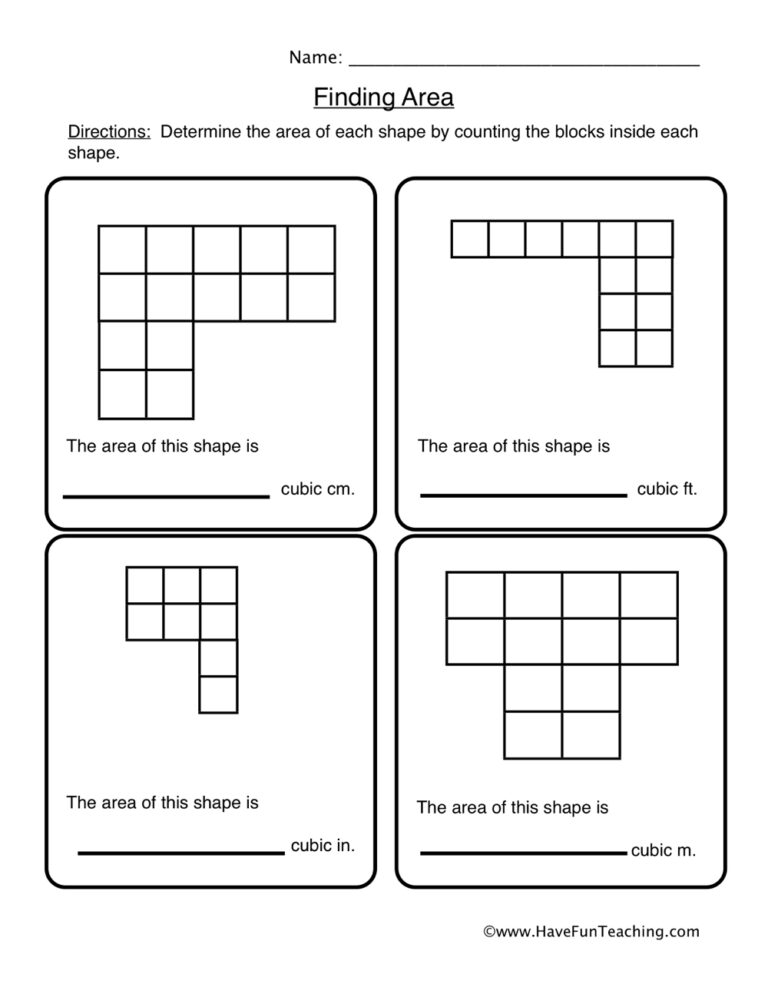
A count-the-squares finding area of irregular shapes worksheet that helps 3rd graders measure area by counting unit squares on six grid figures. Answer key included, perfect for no-prep area practice at home or school.

This Finding the Area by Multiplying Worksheet gives 3rd graders six labeled rectangles on a unit grid to practice finding area by multiplying length by width. An answer key is included for easy, no-prep geometry practice.

This Finding the Area in Square Units Worksheet lets 3rd graders count same-size squares inside six shapes to measure area. Includes a complete answer key—great for hands-on, no-prep geometry practice at home or school.
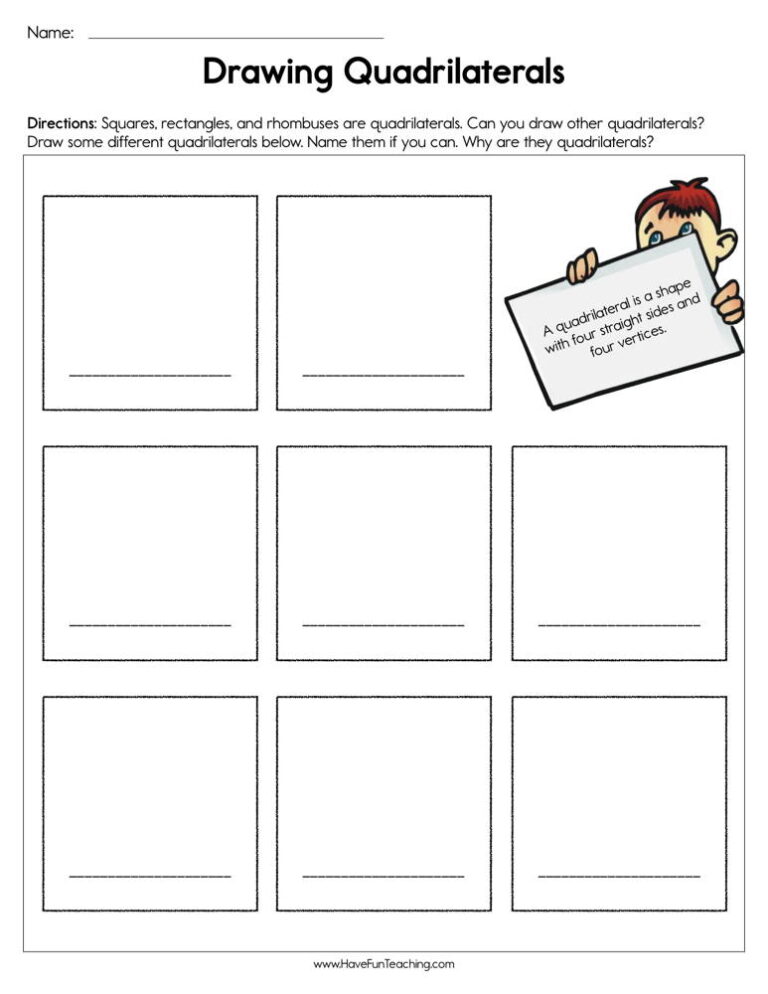
This drawing quadrilaterals worksheet has 3rd graders construct a square, rectangle, rhombus, and trapezoid on dot grids, then explain their thinking. Answer key included for fast, no-prep geometry practice.

Using the Square Song (MP3), students learn all about squares, including Shape Names and Shape Recognition through a catchy song!

A 3rd grade Finding Quadrilaterals Worksheet where students count sides, color the four-sided shapes, match quadrilateral names to their attributes, and explain their thinking. Answer key included for fast, no-prep geometry practice.
Using the Shape Song (MP3), students learn all about shapes, including Shape Names and Shape Recognition through a catchy song!

In this Seaside Symmetry Activity, students recognize a line of symmetry for a two-dimensional figure as a line across the figure such that the figure can be folded along the line into matching parts.
Reviews
There are no reviews yet