
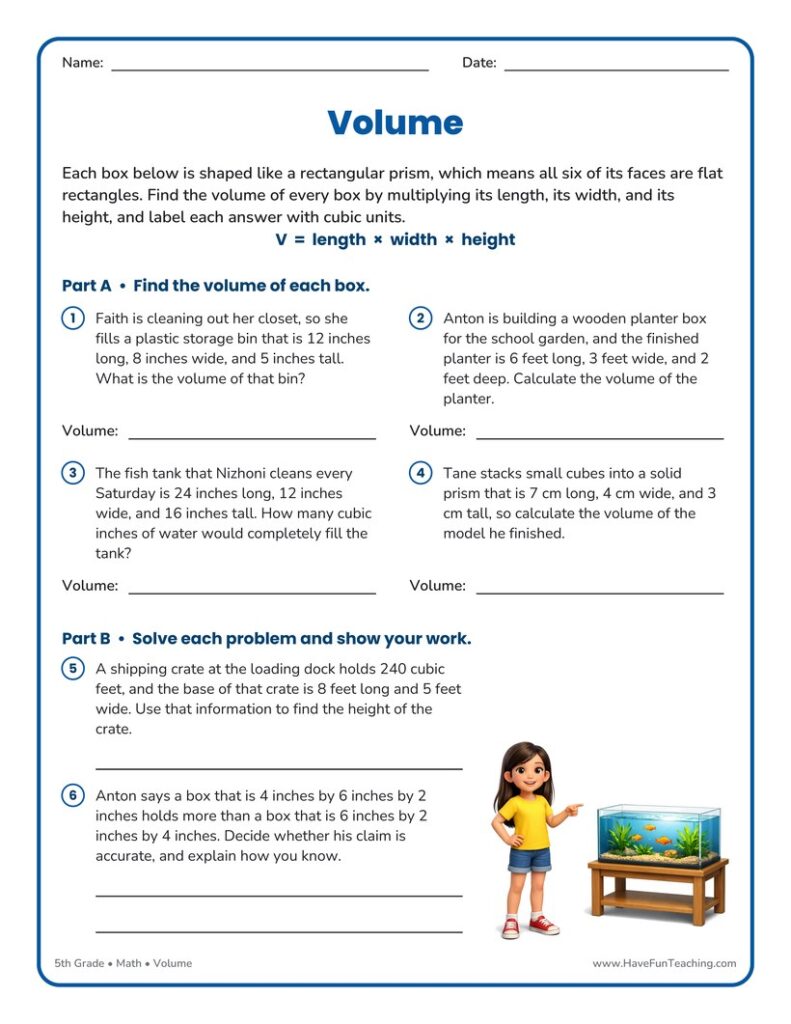
Volume Word Problems Worksheet
Practice with this Volume Word Problems Worksheet, where 5th Grade students multiply length, width, and height to solve real container problems. An answer key is included, so checking student work takes only seconds.
$6.97
Or free with a membership — members pay $3.33/mo for all 10,000+ resources. See plans
Want this one free?
Tell us where to send it and it’s yours — no card, no catch.
One free resource per teacher. We’ll also send free teaching ideas each week — unsubscribe anytime.
Teaching is easier with a membership
Unlimited printables, games & videos for PreK–6th — for your classroom or homeschool. Cancel anytime.
Start your 3-day free trial$0 today · cancel anytime · Instant access to 10,000+ resources
About this resource
Description
Volume is the amount of space inside a solid figure, and fifth graders measure it by working out how many unit cubes would fit inside a rectangular prism. This Volume Word Problems Worksheet gives students realistic containers to think about — a storage bin, a planter box, a fish tank, and a stack of centimeter cubes — and asks them to apply the formula V = length × width × height. Practicing volume word problems helps a student connect a multiplication sentence to an object they can actually picture, which is exactly the move that fifth grade standards and state assessments ask for.
This printable is a one-page, two-part activity with a full answer key. In Part A, students find the volume of four rectangular prisms described in short word problems and label every answer with the correct cubic units. In Part B, they work backward to find the missing height of a shipping crate, then explain in writing why changing the order of the three side lengths does not change the volume. Use this 5th grade geometry worksheet for independent practice, morning work, a math center, homework, or a quick review the day before a unit test.
What’s Included
- 1 print-ready PDF worksheet
- Answer key
- 4 one-step volume problems set in real-life situations
- 1 multi-step problem that solves for a missing dimension
- 1 written-response question about the order of the factors
There are three reasons this Volume Word Problems Worksheet helps students learn the skill. First, every problem names a real container, so students have to choose the right cubic units instead of memorizing a rule with no meaning attached. Second, the missing-dimension problem asks students to divide as well as multiply, which builds the flexible thinking fifth grade geometry expects. Third, the written explanation gives a teacher a fast, honest look at whether a student truly understands why the formula works, not just whether the arithmetic came out right.
Teachers can hand out centimeter cubes and ask students to build the prism from problem four before they multiply anything, so the answer is something they can hold. Parents can carry a ruler around the kitchen and measure a cereal box, a drawer, or a lunch container, then compare the result to the problems on this page. Small groups can be challenged to design two different boxes that hold exactly the same volume, and the class can sort the finished designs on the board and talk about what they notice.
Related Resources
What teachers say
Reviews
You must be logged in to post a review.

A 5th grade finding the area of triangles worksheet with six labeled figures students solve using A = ½ × base × height. Complete answer key included for no-prep geometry practice.

This Volume Rectangular Prisms Worksheet gives 5th graders practice multiplying length, width, and height, finding a missing edge, and solving two real-world problems. Answer key included for fast, no-prep checking.
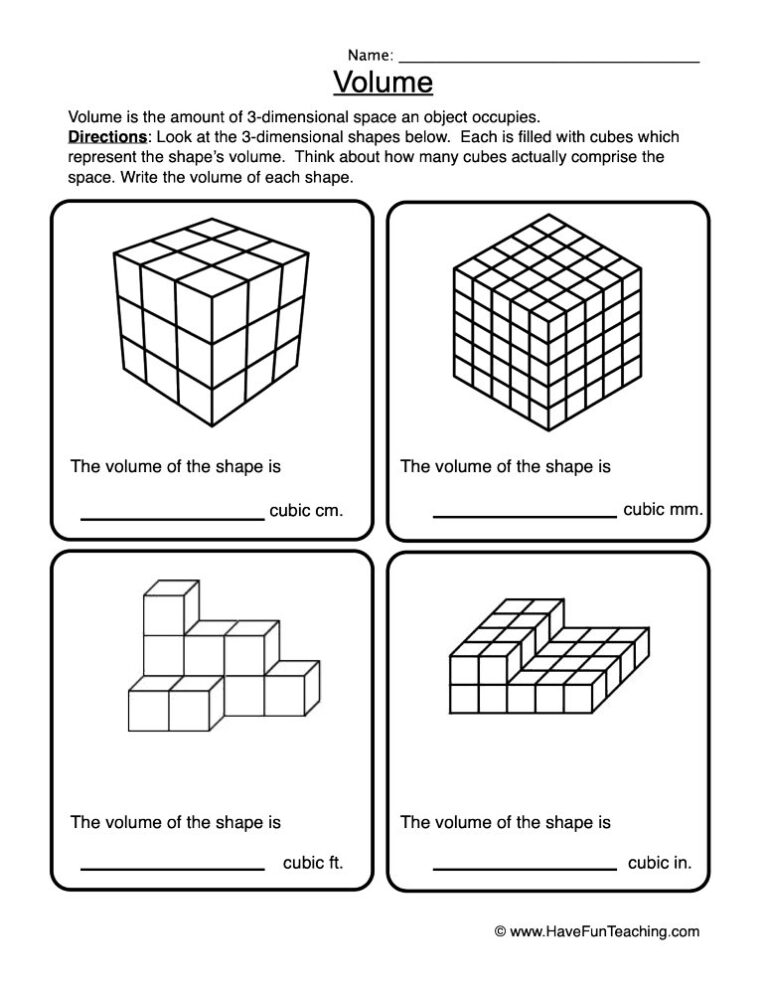
This Volume Cubes Worksheet gives 5th graders three ways to find volume: counting unit cubes, using length times width times height, and solving a packing problem. An answer key is included, so practice is quick to check.

Four labeled rectangular prisms plus two multi-step word problems make this volume worksheet a quick 5th grade check on length x width x height. Answer key included, so no prep is needed.

In this Seaside Symmetry Activity, students recognize a line of symmetry for a two-dimensional figure as a line across the figure such that the figure can be folded along the line into matching parts.
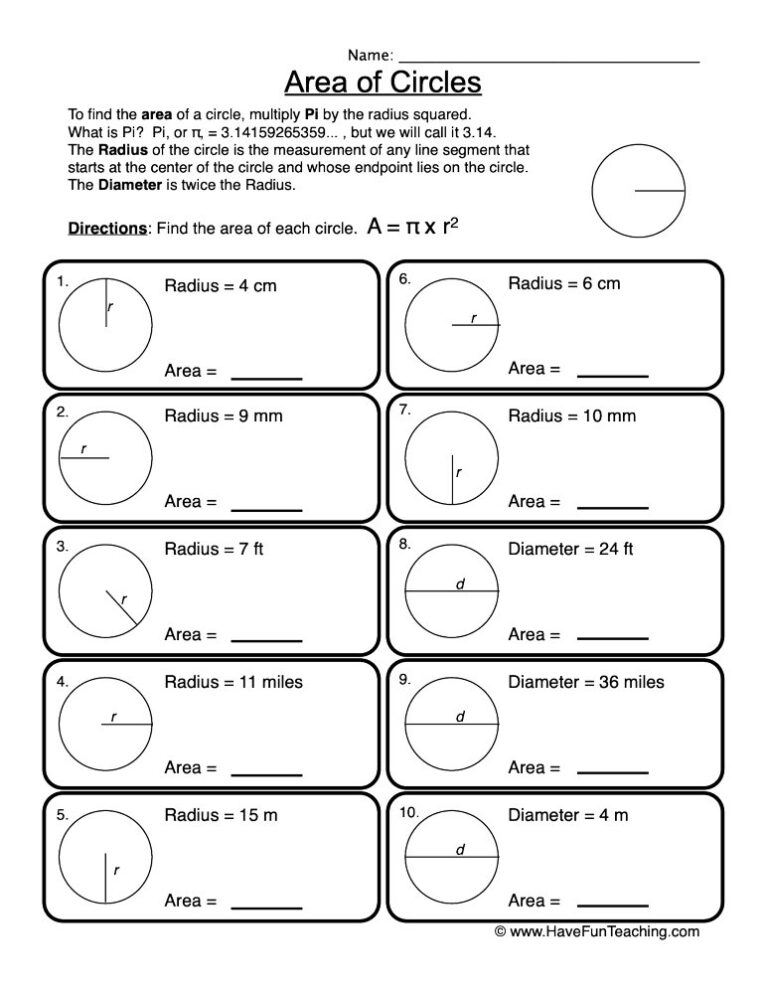
This area circles worksheet has 5th graders use A = 3.14 x r x r on six labeled circles, then solve two real-world area problems. An answer key is included, so practice is quick to check.
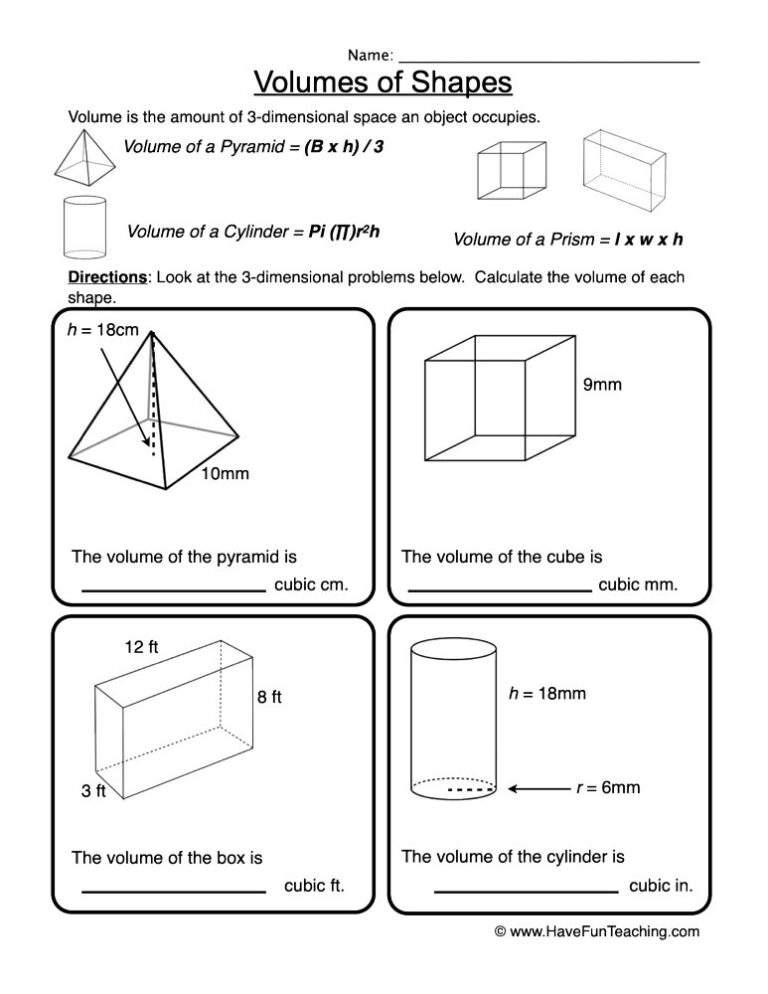
This Volume of 3D Shapes Worksheet has 5th graders use V = l x w x h on four labeled rectangular prisms plus two real-world word problems. Answer key included for fast, no-prep geometry practice.

This Volume, Surface Area Rectangular Prisms Worksheet gives 5th Grade students four labeled prisms plus an applied box comparison, with an answer key included, so measurement practice builds real reasoning.

Using the Volume Song (Original Music Video), students will be able to define, give examples and find volume of 3D Shapes using the catchy and memorable lyrics.
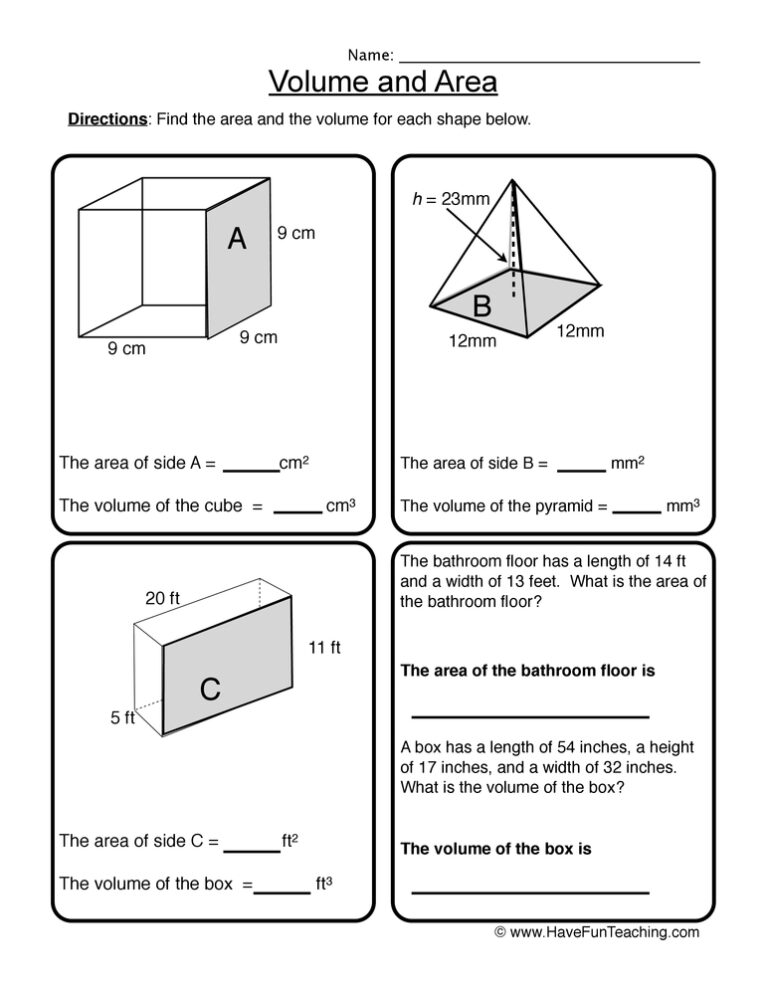
This Volume Area Worksheet gives 5th graders four labeled prisms and an applied box problem, with the volume and face-area formulas supplied. An answer key is included for fast, no-prep marking.
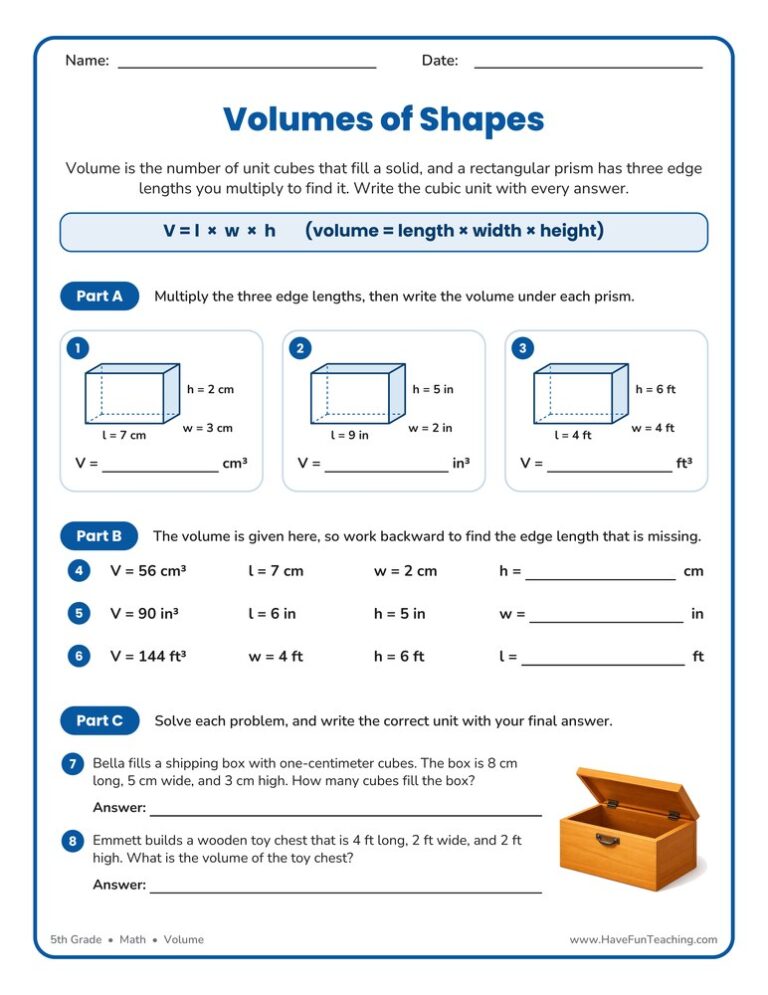
This volume of shapes worksheet asks 5th grade students to find the volume of labeled rectangular prisms, solve for a missing edge, and answer two word problems. An answer key is included.

Using this Area and Perimeter Pirate Activity, students apply the area and perimeter formulas for rectangles to match each pirate with his ship.

Reviews
There are no reviews yet