
Skip to content
Start My 3 Free Days $0 today · cancel anytime

Homonyms Resources

7 homonyms resources: 4 worksheets, 2 Common Core Lessons and 1 activity. How teachers use these

Homonyms Resources

7 homonyms resources: 4 worksheets, 2 Common Core Lessons and 1 activity. How teachers use these

Worksheet
Worksheet1st GradeMultiple Meanings Worksheet

This multiple meanings worksheet has 1st grade students use sentence clues to circle the right picture and name picture pairs with one word. An answer key is included for fast, easy checking.

Worksheet
Worksheet2nd GradeIllustrating Multiple Meaning Worksheet

This illustrating multiple meaning worksheet has 2nd grade students circle the meaning of bat, bark and duck in each sentence and draw a picture of it. An answer key is included to make checking quick.

Worksheet
Worksheet2nd GradeMatching Multiple Meaning Worksheet

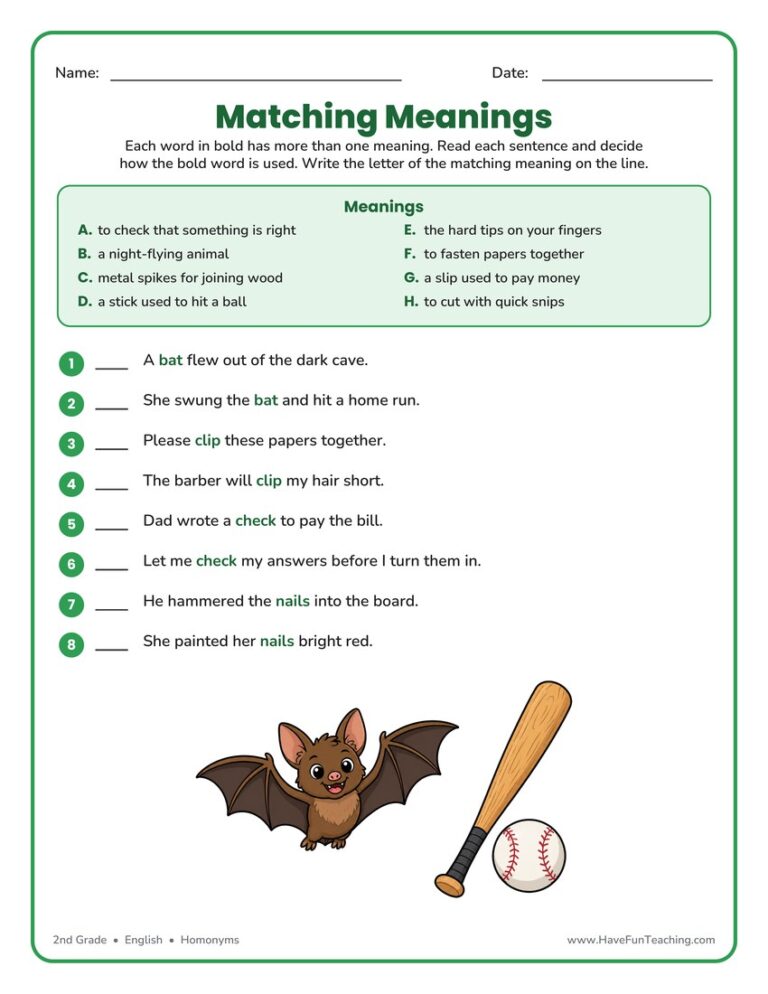
The Matching Multiple Meaning Worksheet helps 2nd graders use sentence context to match bold homonyms like bat, clip, and check to the right meaning. Answer key included — an easy, no-prep context-clues activity.

Worksheet
Worksheet3rd GradeMultiple Meanings Writing Sentences Worksheet

This multiple meanings writing sentences worksheet gives 3rd graders two words, two illustrated meanings each, and room to write their own sentences so they learn to read tricky words in context.

Activity
Activity4th GradeL.4.4 Common Core Activity

Using this L.4.4 Common Core Activity, students will determine or clarify the meaning of unknown or multiple meaning words.

Common Core Lesson
Common Core Lesson2nd GradeL.2.4 Second Grade Common Core Lesson

This L.2.4 Second Grade Common Core Lesson includes L.2.4 Worksheets, L.2.4 Activities, L.2.4 Assessment, and L.2.4 Poster.

Common Core Lesson
Common Core Lesson4th GradeL.4.1 Fourth Grade Common Core Lesson

Using L.4.1 Fourth Grade Common Core Lesson, students correctly use frequently confused words in order to clearly share their message.

From our teachers' playbook

Same word, totally different meaning

What do kids learn about homonyms?

Homonyms are words that look and sound the same but have different meanings. A bat can be a flying animal or the stick you swing at a ball. A dog's bark is not the same as a tree's bark! Kids usually meet homonyms in 2nd grade and keep growing with them through 4th grade, when they use context clues to figure out which meaning fits a sentence. Many classes also compare them to homophones, like to, too and two, that only sound alike. The click moment comes when a child giggles at a joke that only works because of a word with two meanings.

Our favorite ways to teach homonyms

Homonyms are word play at its best. These moves help kids see both meanings and choose the right one.

Draw both meanings

Fold a paper in half and write one homonym at the top, like "ring." Kids draw one meaning on each side: a ring on a finger and a phone ringing. Drawing both pictures makes the two meanings impossible to mix up.

Why it works: pairing a picture with each word gives kids two ways to remember it, a well-tested principle of how people learn (Mayer, 2009).

Illustrating Multiple Meaning WorksheetTry it withIllustrating Multiple Meaning WorksheetWorksheetsOpen it →

Think aloud with context clues

Read a sentence like "The pitcher poured lemonade" and think out loud: "Pitcher could mean a baseball player, but poured tells me it is a jug!" Modeling how you use the other words in the sentence teaches the strategy kids need for reading.

Why it works: handing over the work step by step, from teacher to student, is one of the most widely used teaching frameworks (Pearson and Gallagher, 1983).

L.2.4 Second Grade Common Core LessonTry it withL.2.4 Second Grade Common Core LessonCommon Core LessonsOpen it →

Match the meaning

Give pairs of sentences that use the same word and have kids match each one to its meaning. Short, frequent rounds like this build the habit of checking which meaning fits before moving on.

Why it works: pulling an answer out of memory makes it stick far better than rereading it, one of the strongest findings in learning research (Dunlosky and colleagues, 2013).

Matching Multiple Meaning WorksheetTry it withMatching Multiple Meaning WorksheetWorksheetsOpen it →
Homonym questions parents and teachers ask

What is a homonym?

A homonym is a word that is spelled and pronounced the same as another word but has a different meaning, like bat, bark or ring. Some teachers use the word more loosely to include homophones too.

What is the difference between homonyms and homophones?

Homonyms look and sound the same but mean different things. Homophones sound the same but are spelled differently, like hear and here, or flower and flour.

What grade learns homonyms?

Most kids start with multiple-meaning words in 2nd grade and keep working on them through 4th grade, using context clues to choose the right meaning.

What are some easy homonyms for kids?

Try bat, bark, ring, fall, park, wave, bear and fly. Each one has two meanings kids already know, so it is easy to draw and talk about both.

Keep exploring



