
Skip to content
Start My 3 Free Days $0 today · cancel anytime

5th Grade Arrays Resources

1 5th grade arrays resources: 1 activity. How teachers use these

5th Grade Arrays Resources

1 5th grade arrays resources: 1 activity. How teachers use these

Activity
Activity5th GradeFall into Multiplication Activity

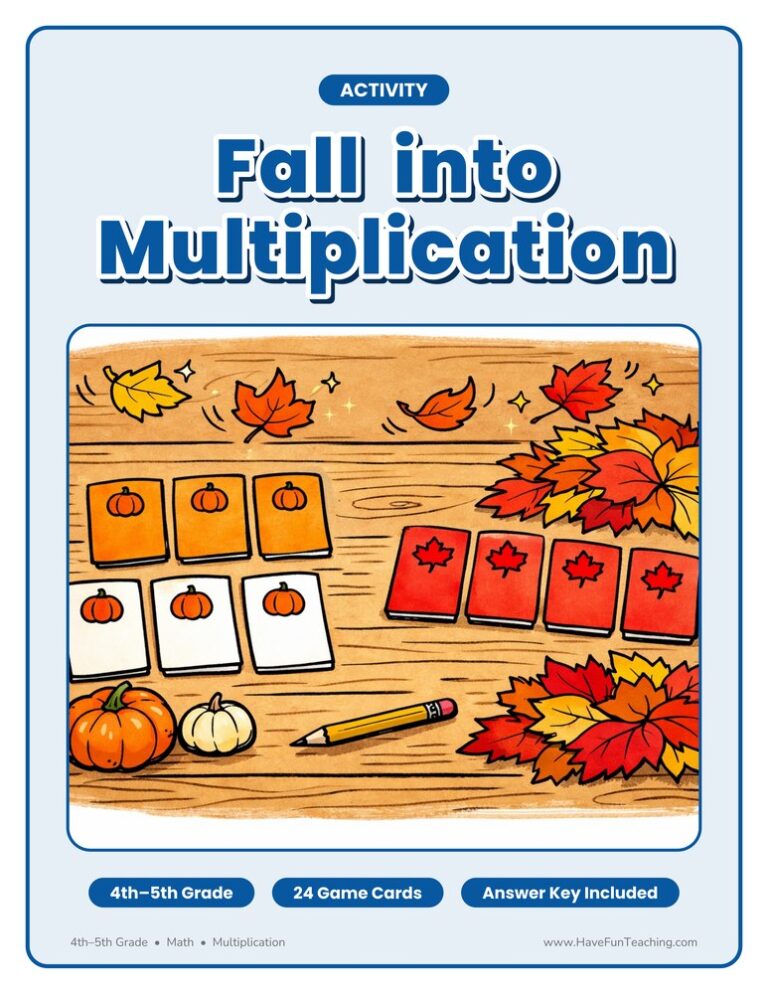
This fall into multiplication activity has 4th and 5th graders solve pumpkin problems with area models and match each product to a leaf. Answer key included.

From our teachers' playbook

Rows and columns grow up

What do 5th graders learn about arrays?

In 5th grade, arrays grow into the area model, a powerful way to multiply bigger numbers. Kids break a problem like 23 × 14 into a rectangle split into parts: 20 × 10, 20 × 4, 3 × 10, 3 × 4, then add the pieces to get 322. They also use arrays to multiply fractions, shading a square to see that ½ × ⅓ = ⅙. The click: arrays show why the standard algorithm works, not just how.

Our favorite ways to make arrays powerful

Fifth graders are ready to use arrays as a thinking tool. These moves help them see the math inside the rectangle.

Area model on grid paper

Have kids draw 14 × 12 on grid paper, then cut it into four friendly parts: 10 × 10, 10 × 2, 4 × 10, 4 × 2. Label each piece and add. Building it on a grid shows exactly where every partial product comes from.

Why it works: going from real objects to pictures to symbols is a core recommendation of the U.S. Department of Education's elementary math guide.
Fall into Multiplication ActivityTry it withFall into Multiplication ActivityActivitiesOpen it →

Connect it to the algorithm

Solve 23 × 14 with an area model on one side of the board and the standard algorithm on the other. Draw arrows to match each partial product. Kids stop memorizing steps and start understanding them.

Why it works: showing first, practicing together, then letting kids try alone is the "gradual release" model teachers have relied on for decades (Pearson and Gallagher, 1983).

Shade fractions in a square

Draw a square, shade half of it one way, then a third the other way. The overlap shows ½ × ⅓. Kids see why multiplying fractions can make the answer smaller.

Why it works: children learn more from words and pictures together than from words alone (Mayer, 2009).

What's on this page

Teacher favorites right now: Fall into Multiplication Activity.

Questions teachers and parents ask about 5th grade arrays

How are arrays used in 5th grade?

Arrays grow into the area model, which helps kids multiply multi-digit numbers and fractions. Breaking a big rectangle into smaller parts makes tough problems manageable.

What is the area model for multiplication?

It is a rectangle split into parts by place value. To solve 23 × 14, kids multiply 20 × 10, 20 × 4, 3 × 10 and 3 × 4, then add the four partial products to get 322.

How do arrays help with multiplying fractions?

Shading a square in two directions shows the overlap, which is the product. For ½ × ⅓, the overlap covers one sixth of the square, so the answer is ⅙.

Why do teachers use arrays instead of just the algorithm?

Arrays show why multiplication works. When kids understand the parts, they make fewer mistakes with the algorithm and can check their answers more easily.


