Skip to content
Start My 3 Free Days $0 today · cancel anytime

5th Grade Percentages Resources

3 5th grade percentages resources: 3 worksheets. How teachers use these

5th Grade Percentages Resources

3 5th grade percentages resources: 3 worksheets. How teachers use these

Worksheet
Worksheet5th GradeMaking Percentages Worksheet

Students rename fractions and decimals as percents, read two shaded grid models, and solve two real-world problems on this Making Percentages Worksheet. Built for 5th grade with an answer key included, so practice stays quick and low-prep.

Worksheet
Worksheet5th GradePie Graphing Pies Worksheet

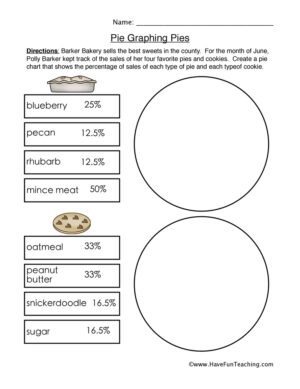
This Pie Graphing Pies Worksheet asks 5th graders to read a bakery circle graph, find the percent for each cookie, and shade their own graph. An answer key is included, so checking the work takes seconds.

Worksheet
Worksheet5th GradeBowling Percentages Worksheet

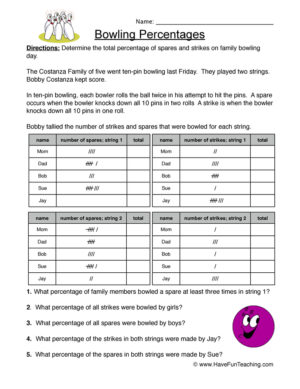
This bowling percentages worksheet has 5th grade students count tally marks, find totals, and calculate percents of strikes and spares. An answer key is included for quick checking.

From our teachers' playbook

Out of 100, every single time

What do 5th graders learn about percentages?

Percent just means "out of 100," and 5th grade is where many kids meet that idea for the first time. They shade a hundreds grid and see that 25 squares is 25% = 25/100 = 0.25, all the same amount written three ways. They connect friendly percents to fractions they already know: 50% is half, 25% is a quarter, 10% is one tenth. Pie charts become readable once kids know the whole circle is 100%. The click: a percent is just a fraction wearing a different outfit.

Our favorite ways to make percentages make sense

Percents get scary when they are only rules. These moves keep them visual and tied to fractions and decimals kids already trust.

Shade the hundreds grid

Give every child a 10-by-10 grid and say "Shade 40%." Then ask them to write it as a fraction and a decimal under the grid. Seeing 40 out of 100 squares makes the three forms feel like one idea instead of three new rules.

Why it works: children learn more from words and pictures together than from words alone (Mayer, 2009).

Making Percentages WorksheetTry it withMaking Percentages WorksheetWorksheetsOpen it →
Is it more or less than half?

Before calculating, ask partners to estimate out loud: "Is 45% of the class more or less than half? How do you know?" Talking through the estimate first catches silly answers before they happen.

Why it works: when kids say the precise math words, their understanding gets sharper, a recommendation of the U.S. Department of Education's elementary math guide.

Bowling Percentages WorksheetTry it withBowling Percentages WorksheetWorksheetsOpen it →
Read a pie chart with me

Put a pie chart on the board and think aloud: "This slice is about a quarter of the circle, so it is close to 25%. All the slices together must make 100%." Then have kids check whether the chart adds up.

Why it works: showing first, practicing together, then letting kids try alone is the "gradual release" model teachers have relied on for decades (Pearson and Gallagher, 1983).

Pie Graphing Pies WorksheetTry it withPie Graphing Pies WorksheetWorksheetsOpen it →

Questions teachers and parents ask about 5th grade percentages

Do 5th graders learn percentages?

Many 5th grade classes introduce percents as "out of 100" and link them to fractions and decimals. Solving percent problems, like finding 30% of a number, is usually a bigger focus in 6th grade.

How do you explain percent to a child?

Tell them percent means "out of 100." If you got 80 out of 100 points, you got 80%. A hundreds grid or 100 pennies makes the idea easy to see and touch.

How are percents, fractions and decimals connected?

They are three ways to write the same amount. One half is 1/2, 0.5 and 50%. Learning a few friendly matches, like 1/4 = 25% and 1/10 = 10%, helps kids move between them quickly.

How can I practice percentages at home?

Shopping is perfect practice. Point out a sign that says 50% off and ask what the new price would be. Phone battery levels and test scores are great real-life percents too.